Object Status:
Extant
Accession Date:
By 1799
Primary Source Reference:
Charles Willson Peale, Lecture on Natural History 39. (ca. 1799). Academy of Natural Sciences of Drexel University Archives, coll. 40. / https://ansp.org/research/library/archives/0000-0099/coll0040/
Additional Source Text:
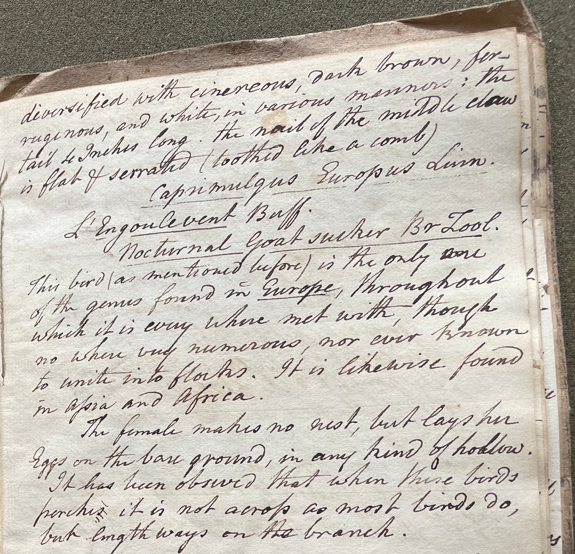
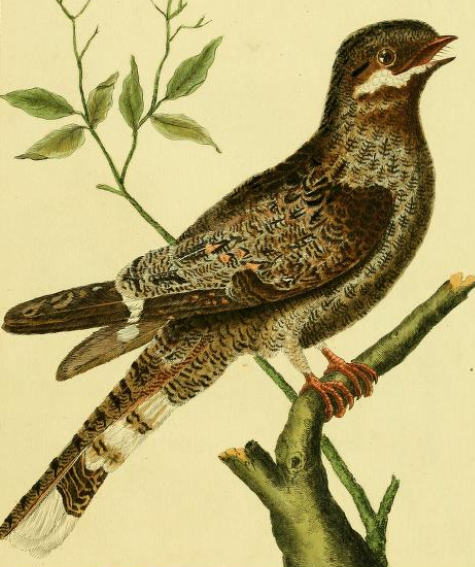
Charles Willson Peale (1741-1827) wrote, in his 39th Lecture (ca. 1799): "No. 1974. Goat-sucker. This is the European bird. The length 10 ½ Inches; the plumage can scarce be well described; the ground colour is almost black, but most beautifully diversified with cinereous, dark brown, ferruginous, and white, in various manners; the tail 4 Inches long; the nail of the middle claw is flat & serrated (toothed like a comb). Caprimulgus Europus Linn. L'Engoulevent Buff. Nocturnal Goat sucker. Br. Zool. This bird (as mentioned before) is the only one of the genus found in Europe, throughout which it is every where met with, though no where very numerous, nor ever known to unite into flocks. It is likewise found in Assia and Africa. The female makes no nest, but lays her eggs on the bare ground, in any kind of hollow. It has been observed that when these birds perch it is not across as most birds do, but lengthways on the branch." (Academy of Natural Sciences of Drexel University Archives, coll. 40)
Specimen Type:
Dead/preserved
Current Common Name:
European Nightjar
Current Scientific Name
Caprimulgidae | Caprimulgus europaeus