Object Status:
Extant
Accession Date:
By 1799
Primary Source Reference:
Charles Willson Peale, Lecture on Natural History 13. (ca. 1799). Academy of Natural Sciences of Drexel University Archives, coll. 40. / https://ansp.org/research/library/archives/0000-0099/coll0040/
Additional Source Text:
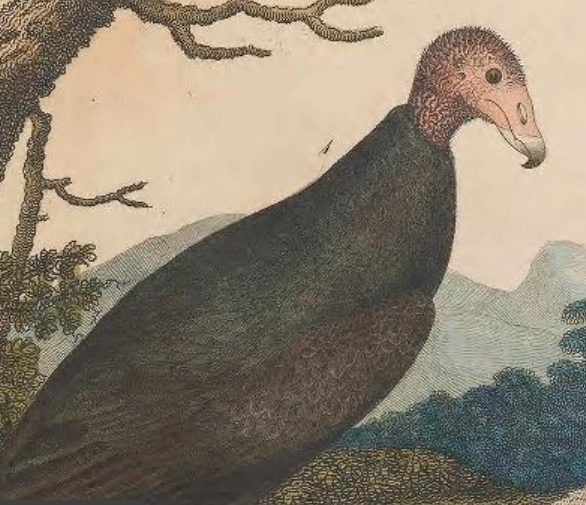
Charles Willson Peale (1741-1827) wrote, in his 13th Lecture (ca. 1799): "No. 1 & 2. These Vultures are called Turkey Buzzard by Catesby in his Natural History of South Carolina, and it is the common name which they are known by in Maryland and Virginia. It is the Vultur aura of Linnaeus. They are very numerous in all the southern states, but we see very few of them in this part of Pennsylvania. Pliase observe the head and neck and neck are of a red colour, thinly covered with a sort of black hairs. The nostrils are large & of an oblong form, open intirely through the Bill. They are of a brown black, a little varied in the colour; and nearly about the size of a Common Turkey." (Academy of Natural Sciences of Drexel University Archives, coll. 40)
Peale continued: "These birds are extremely useful, in warm climates, where they soon devour all the dead carcasses which might otherwise tend to currupt and taint the air. It was remarked, that, not a Buzzard was to be seen in Maryland some months after General Braddock's defeat in Pennsylvania [on 9 July 1755, at Fort Duquesne], where many hundreds of dead bodies lay unburied on the field of battle. Formerly they were protected by a law in South Carolina any person killing one was subjected to fine of 5£. In the revolutionary war, when encampment of the American army became dirty and like to be unwholesome, they generally removed to some few hundred yards distance. The usefulness of these birds appeared in a strong point of light; for in a very short time they entirely cleared the Field of all putrescent substances, so that the army could then comfortably return to their former situation. Whether these are exactly the same species as those in Assia and Africa, I have not yet the opportunity of knowing, but am inclined to think otherwise; some authors have supposed that they came originally from Africa to America." (ANSP Archives, coll. 40)
Peale continued: "The vultures of Chili attack small living animals; this is not the case with the vultures before us; I have observed their manners in Maryland, where they are very numerous, and these, they wholly feed on dead bodies. Besides, the manners of the vulture at the Cape of Good Hope, as described by Kolbin, materially differs from these. He had often been a spectator of their mode of anatomising the dead bodies of cows, oxen, and wild animals, which they devour. 'These birds', says he, 'separate the flesh from the skin and the bones with such art, that they leave only the bare skeleton, covered, however, with the skin so entire and unbroken, that it is imposible to percieve that the carcase is emty, without a close examination. In performing this opiration, they first make an aperture in the belly of the animal, from whence they tear out the intrals, and devour them. They then enter the emty space thus formed, and seperate the flesh from the bones and skin, without discomposing either'." (ANSP Archives, coll. 40)
Peale continued: "They attack their prey by surprise; if an ox, who is left to return from the yoke to his stall alone, should chance to lie down and rest by the way, he is as sooner perceived by the vultures, there they fall upon him, and devour him. When they attack an ox in the feilds, they generally assemble to the number of an hundred, and sometimes more, and thus overpower him by a general onset." [A note in the margin indicates that this quote was taken from "A New System of Natural History, p. 76"]. I have maintained one of this kind [Carthartes aura] alive for many months, and always found it a timid inoffensive animal with respect to the poultry of my yard. It would not meddle with the smallest chicking while alive, but east only the offal of meat or fish thrown to it. Its only means of Deffence which it seemed to use against those that tormented it, was the disgorging the contents of its full stomach, which sends forth a very disagreeable […], especially when the animal had been allowed to eat food in a putrid state. When I examined these birds, found a thick coat of firm fat covering the whole of the intestins at the time I preserved them, the flesh smelt rather stronger than other Rapacious Birds, all of which are considerably offensive. The first stomack being removed, the most disagreeable part of the operation was got over." (ANSP Archives, coll. 40)
Alexander Wilson (1766-1813) described this species under the name "Turkey Vulture, or Turkey Buzzard / Vultur aura" in American Ornithology vol. 9, published posthumously (Pl. 75), where "Peale's Museum No. 11, male—[and] 12, female" were cited among the synonyms (Wilson 1814: 96). / https://www.biodiversitylibrary.org/item/175518#page/104/mode/1up (text) / https://www.biodiversitylibrary.org/item/175518#page/86/mode/1up (plate)
Specimen Type:
Live (later taxidermied)
Current Common Name:
Turkey Vulture
Current Scientific Name
Cathartidae | Cathartes aura