Object Status:
Extant
Accession Date:
By 1799
Primary Source Reference:
Charles Willson Peale, Lecture on Natural History 36. (ca. 1799). Academy of Natural Sciences of Drexel University Archives, coll. 40. / https://ansp.org/research/library/archives/0000-0099/coll0040/
Additional Source Text:
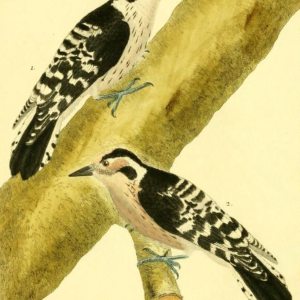
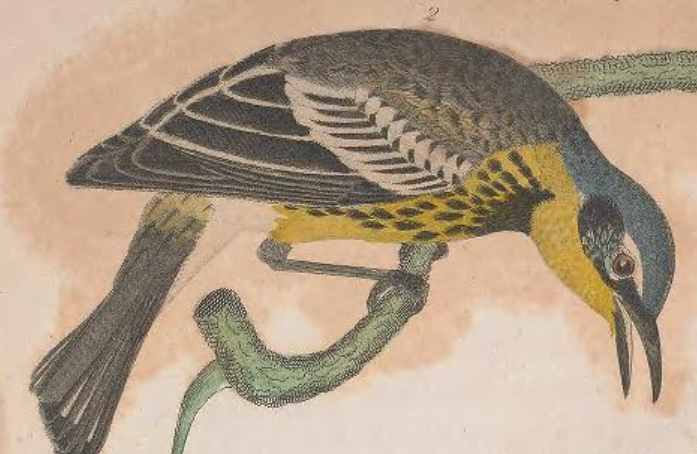
Charles Willson Peale (1741-1827) wrote, in his 36th Lecture (ca. 1799): "No. 1791. Black and Yellow Warbler. The predominant colours are such, therefore I give it this name. I think it has not yet been described, at least I cannot find it in any of the Authors. The top of the head is blue-black; next [to] the base of the upper mandible black, which passes on each cheek in a broad band; a fine line of white from the top of the Eyes to the hind head, & a spot of white under the Eye; back black; tail black with the middle wholly black; just above the tail yellow; wings brown, beautifully barred with white; the throat and under part of the breast a bright brimstone yellow; a large patch of black on the brest; sides striped with black." (Academy of Natural Sciences of Drexel University Archives, coll. 40)
Peale continued: "No. 1792. Female. the top of the head is rather browner than in the male; the back a greater tinge of green & spotted with black; less black on the breast; in general the colours less vivid. These were found in the vicinity of Philadelphia. They are a scarce bird." (ANSP Archives, coll. 40)
According to Franklin L. Burns, 1932, "Charles W. and Titian Ramsay Peale and the Ornithological Section of the Old Philadelphia Museum", Wilson Bulletin 44: 23–35, Peale wrote in (a now unlocated page of) "A Walk Through the Philad[elphi]a Museum" (1805-1806): "Black and Yellow Warbler, male and female; a nondescript." / http://www.jstor.org/stable/4156050 / This is confirmed in a draft copy of the essay, which includes the following listing: "Black & Yellow Warbler male & female, nondescript." (Historical Society of Pennsylvania, coll. 0481)
Alexander Wilson (1766-1813) described this species under the name "Black and Yellow Warbler / Sylvia magnolia" in American Ornithology vol. 3 (Pl. 23), where "Peale's Museum, No. 7783" was cited (Wilson 1811: 63). / https://www.biodiversitylibrary.org/item/175516#page/77/mode/1up (text) / https://www.biodiversitylibrary.org/item/175516#page/72/mode/1up (plate)
Notes:
Wilson (1811: 63, American Ornithology vol. 3) only collected two specimens (both males) and he credited Peale as the discoverer of this species: “Mr. Peale, however, has the merit of having been the first to discover this elegant species, which he informs me he found several years ago not many miles from Philadelphia. No notice has ever been taken of this bird by any European naturalist whose works I have examined.” Peale’s female specimen was overlooked, or it may have been destroyed, because Wilson (1811: 63) also wrote: “markings of the female not known.” For more discussion, see Matthew R. Halley, 2024, "Return to the ‘Great Pine Swamp’ of Alexander Wilson", Bulletin of the British Ornithologists’ Club 144(1): 48-72.
Specimen Type:
Dead/preserved
Current Common Name:
Magnolia Warbler
Current Scientific Name
Parulidae | Setophaga magnolia