Object Status:
Extant
Accession Date:
By 1799
Primary Source Reference:
Charles Willson Peale, Lecture on Natural History 34. (ca. 1799). Academy of Natural Sciences of Drexel University Archives, coll. 40. / https://ansp.org/research/library/archives/0000-0099/coll0040/
Additional Source Text:
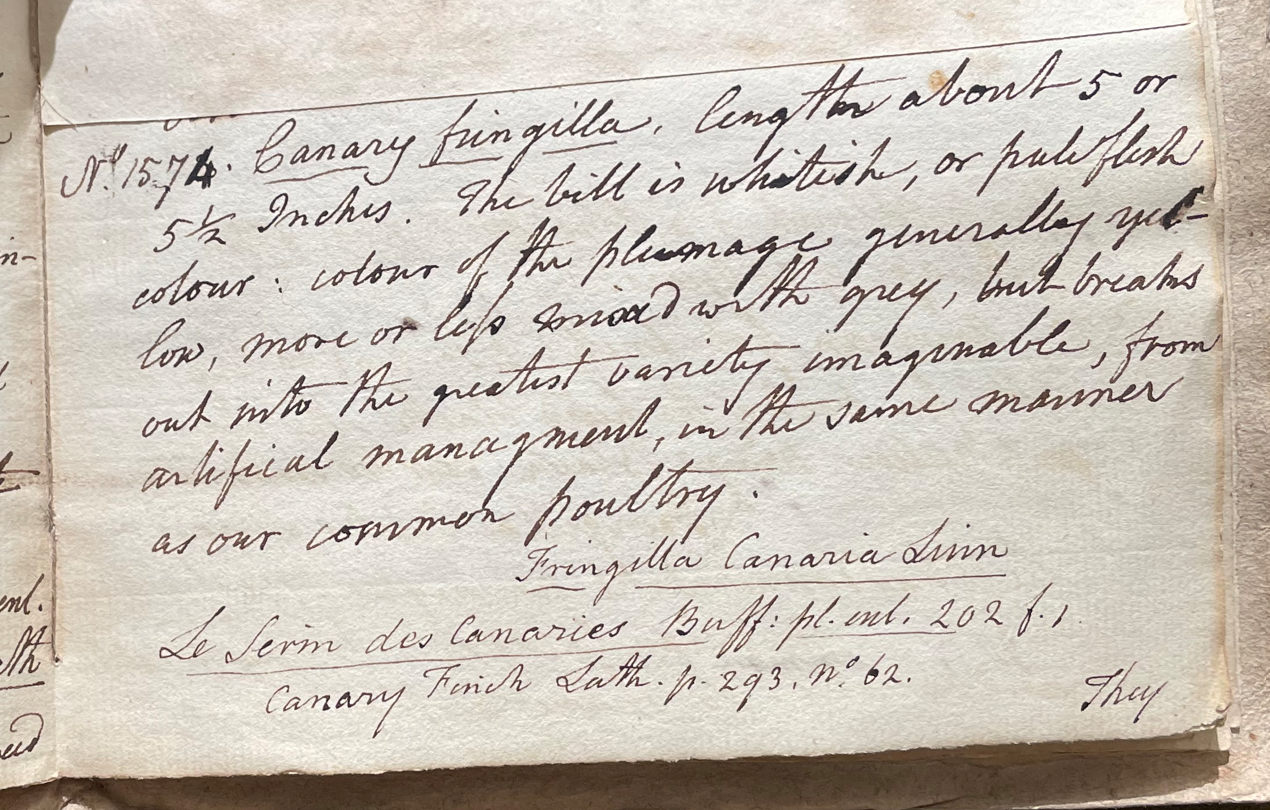
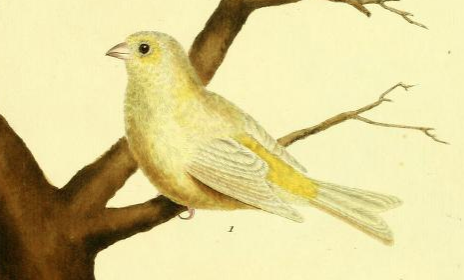
Charles Willson Peale (1741-1827) wrote, in his 34th Lecture (ca. 1799): "No. 1574. Canary fringilla. Length about 5 or 5 ½ Inches. The bill is whitish, or pale flesh colour; colour of the plumage generally yellow, more or less mixed with grey, but breaks out into the greatest variety imaginable, from artificial management, in the same manner as our common poultry. Fringilla Canaria Linn. Le Serin des Canaries Buff. pl. enl. 202. f. 1. Canary Finch Lath. p. 293. No. 62. They inhabit, in a wild state, the Canary Islands chiefly, as well as others; as Palma, Cape Verd, Fayal, Madeira, and are said to frequent watery places." (Academy of Natural Sciences of Drexel University Archives, coll. 40)
Peale continued: "The manner of rearing these birds is fully treated of in Buffon, he occupies above 50 pages for this bird alone, and those fond of keeping numbers of them, will find pleasure and instruction in his account of the Canary bird. No. 1575. A variety of the Canary, I think a mixture of the Citril [Citril Finch, Carduelis citrinella] and Canary—The Citrils is a species common in the south of France and Itally, said to be a fine singing bird. No. 1576. Female canary with a crest inverted." (ANSP Archives, coll. 40)
Peale wrote, in "A Walk Through the Philad[elphi]a Museum" (1805–1806): "In the first Case we see a variety of the Sparrows of Europe…[including] varieties of those charming Songsters the Canary birds (F. Canaria). It is deserving of remark that Birds domesticated are generally very subject to produce varieties, which is not the case in the State of Nature." (Historical Society of Pennsylvania, coll. 0481)
The donation of a Canary skeleton, "Dissected for the Museum," was announced in the Aurora General Advertiser on 28 November 1806.
Specimen Type:
Dead/preserved
Current Common Name:
Domesticated Canary
Current Scientific Name
Fringillidae | Serinus canaria