Object Status:
Extant
Accession Date:
By 1799
Primary Source Reference:
Charles Willson Peale, Lecture on Natural History 34. (ca. 1799). Academy of Natural Sciences of Drexel University Archives, coll. 40. / https://ansp.org/research/library/archives/0000-0099/coll0040/
Additional Source Text:
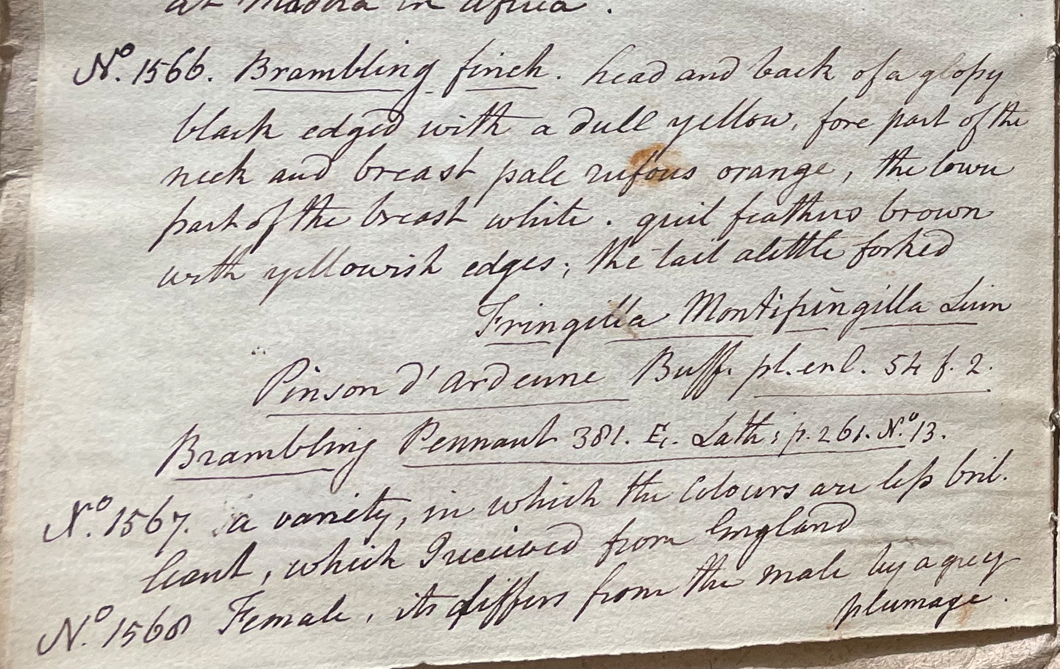
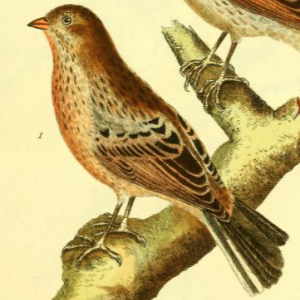
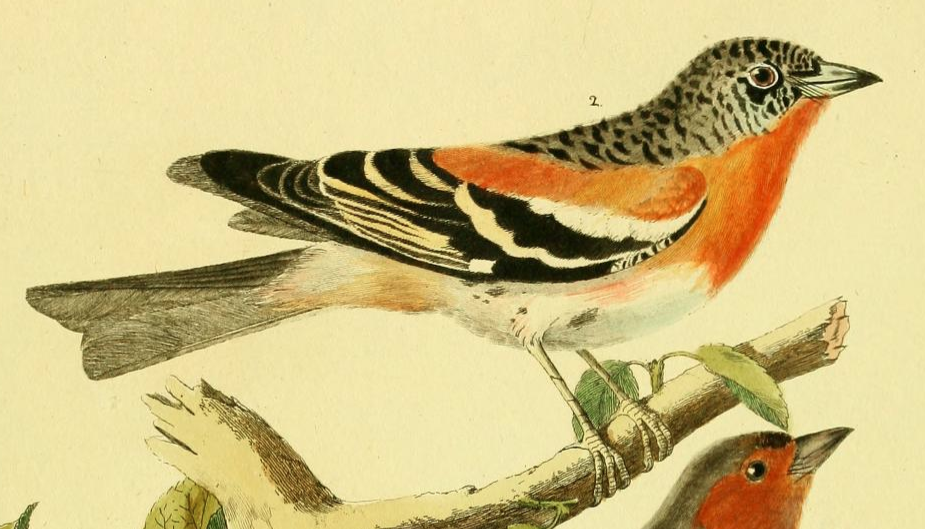
Charles Willson Peale (1741-1827) wrote, in his 34th Lecture (ca. 1799): "No. 1566. Brambling finch. head and back of a glossy black edged with a dull yellow, fore part of the neck and breast pale rufous orange, the lower part of the breast white; quil feathers brown with yellowish edges; the tail a little forked. Fringilla Montifringilla Linn. Pinson d'Ardenne Buff. pl. enl. 54. f. 2. Brambling Pennant 381. E. Lath. p. 261. No. 13. No. 1567. A variety in which the colours are less brilliant, which I received from England." (Academy of Natural Sciences of Drexel University Archives, coll. 40)
Peale continued: "No. 1568. Female. it differs from the male by a grey plumage on the neck, and the other colours on the body fainter. This species migrates into England at certain seasons, but does not build there. It is frequently found among Chaffinches, & sometimes comes in vast flocks. They are also seen at certain times in vast clouds in France, insomuch that the ground has been quite covered with their filth, and more than 600 Dozen were killed each night. They are said to be particularly fond of Beech mast, but will eat seeds of various other kinds. Their flesh is eaten by many but it is apt to prove better. This species is found throughout Europe, & is common in the pine forests of Russia & Sibiria, but those of the last are darker in colour & less in size." (ANSP Archives, coll. 40)
Specimen Type:
Dead/preserved
Current Common Name:
Brambling
Current Scientific Name
Fringillidae | Fringilla montifringilla