Object Status:
Extant
Accession Date:
By 1799
Primary Source Reference:
Charles Willson Peale, Lecture on Natural History 17. (ca. 1799). Academy of Natural Sciences of Drexel University Archives, coll. 40. / https://ansp.org/research/library/archives/0000-0099/coll0040/
Additional Source Text:
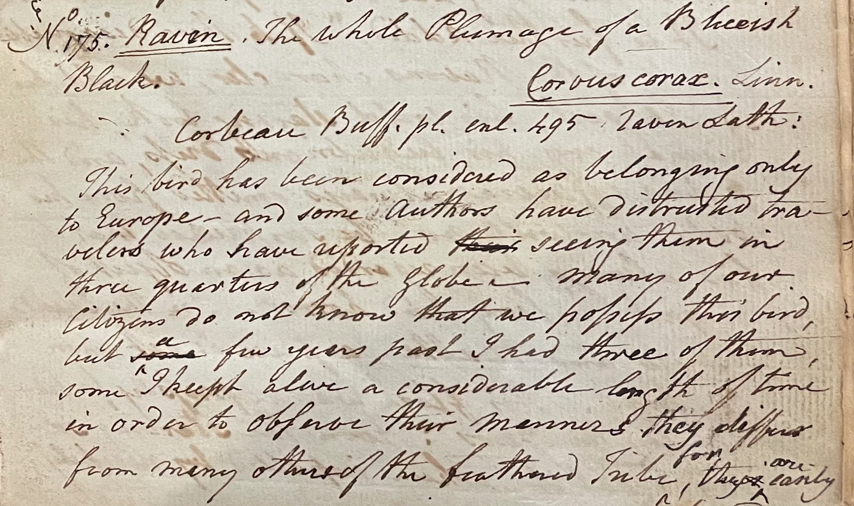
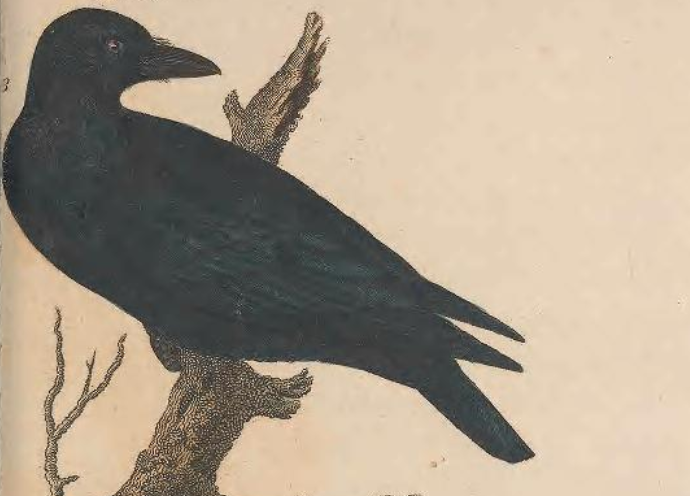
Charles Willson Peale (1741-1827) wrote, in his 17th Lecture (ca. 1799): "No. 175. Raven. The whole plumage of a Blueish Black. Corvus corax. Linn. Corbeau. Buff. pl. enl. 495. Raven Lath. This bird has been considered as belonging only to Europe, and some authors have distrusted travelers who have reported seeing them in three quarters of the globe. Many of our citizens do not know that we possess this bird, but a few years past I had three of them. Some I keept alive a considerable length of time in order to observe their manners. They differ from many others of the feathered Tribe. They are easily tamed even when old, are remarkably familiar in the domesticated state, and will eat any thing that is given them; yet prefer flesh. It is singular that this Bird should have so bad a character given of it, yet with very little foundation." (Academy of Natural Sciences of Drexel University Archives, coll. 40)
Here, Peale began a long quote, evidently taken from the Roman author Pliny the Elder (23/24–79 CE), according to a footnote: 'He is loaded with the imputation of a most gross and indelicate voracity, which is allured by every putrid exhalation, and gratified by the foulest carrion. Thus, he has ever been regarded as the most cowardly, ignoble and disgusting of all the Rapacious tribes.' It is further added, [that] 'If to these disagreeable traits of the Raven's character, we add his ignoble gait, his wild staring look, his dismal cry, his lugubrious dress, and the putrid effluvia always emitted from his body, we will not be surprised that he has always been regarded as an object of disgust, infamy and horror. In the Islands of Faro and Malta, a price is set on his head. His flesh was expressly forbidden by the Jews. Even the starving savages only eat it, when impelled by necessity, with extreme reluctance." (ANSP Archives, coll. 40)
Peale continued, quoting from and paraphrasing Pliny: "'The Raven has always been accounted a bird of bad omen, whose knowledge of futurity enabled him only to anouce calamity. When among the Ancients, the observation of omens was made a part of Religion; the voice of this bird myst have afforded ample room for their superstition. The desire of prying into futurity, is a weakness that has always accompanied human nature. Every action of this bird was deemed momentous; every circumstance of its flight was observed; and no less than 64 different inflexions of its voice were distinguished by the priests, all more or less portentous of calamity. Every one of its notes had a determined signification, which it was the business of knaves to interpret, and of the credulous to believe'." (ANSP Archives, coll. 40)
Peale then concluded his Lecture account of the Raven by opining, in his own words: "How strange these descriptions, and how ridiculas these fables. This bird had nothing of that loathsome voracity; or disagreeable smell in it, more than a common crow; like that Bird, after it had eaten a sufficiency, it would hide what was remaining, to take gain when it should want." (ANSP Archives, coll. 40).
Peale wrote, in "A Walk Through the Philad[elphi]a Museum" (1805–1806): "Few of our Citizens know that we possess the Ravin, (Corvus corax) it is rarely found near Philada. but abound in the western parts of Pennsylvania. They are readily tamed even when full grown and become very familiar, and have nothing of that reported disagreable odour, more than a common Crow, those childish Idea of its knowledge of futurity are the fabrication of knaves to impose on the encredulous." (Historical Society of Pennsylvania, coll. 0481)
Alexander Wilson (1766-1813) described this species under the name "Raven / Corvus corax" in American Ornithology vol. 9, published posthumously (Pl. 75), where "Peale Museum, No. 175" was cited (Wilson 1814: 113). / https://www.biodiversitylibrary.org/item/175518#page/123/mode/1up (text) / https://www.biodiversitylibrary.org/item/175518#page/105/mode/1up (plate)
Titian Ramsay Peale (1779-1885) deposited "1 Raven" [specimen] on 23 March 1821, after returning from the Long Expedition, as recorded in the Peale Museum Accessions Book, p. 112 (Historical Society of Pennsylvania, coll. 0481).
On 9 January 1822, a notice in Poulson's American Daily Advertiser mentioned that T. R. Peale had deposited "Two Ravens, one dissected to display the Anatomy of the ear," after returning from the Long expedition.
An unmounted male specimen of "Corvus corax (Raven)" from Missouri was listed in "A Catalogue of Duplicate Specimens...", May 1822. [unpublished] American Philosophical Society Library (Mss.B.P31). This presumably referred to Titian's specimen from the Long Expedition specimen.
Notes:
Here, for simplicity, we state that Titian R. Peale (1799-1885) deposited the Long Expedition specimens at Peale's Museum. However, it should be noted that the specimens did not belong to Titian, and were not his to give away. Officially, they were the property of the United States government, and as such were formally deposited by Major Stephen Harriman Long (1784-1864), who led the government-sponsored expedition. The Peale Museum Accessions Book, pp. 112-113 (Historical Society of Pennsylvania, coll. 0481) contains an "Invoice of Zoological Specimens and Drawings prepared by Titian Peale, Assistant Naturalist for the Exploring Expedition, and deposited in the Philadelphia Museum by Majr. S. H. Long, Maj. U.S. Engr. pursuant to instructions of the Secretary of War." At the conclusion of the invoice, "Rubens Peale [1784-1865], manager" signed the following statement: "Received, Philadelphia Museum, March 23d. 1821. of Majr. S. H. Long, the several articles, specified in the above Invoice, as a deposit for safe keeping, preservation and Exhibition; and I hereby promise, as agent for the Institution to hold the said articles subject to the orders of the War Department, thru the said Maj. Long." (HSP, coll. 0481)
Specimen Type:
Live (later taxidermied)
Current Common Name:
Common Raven
Current Scientific Name
Corvidae | Corvus corax