Object Status:
Extant
Accession Date:
By 1799
Primary Source Reference:
Charles Willson Peale, Lecture on Natural History 37. (ca. 1799). Academy of Natural Sciences of Drexel University Archives, coll. 40. / https://ansp.org/research/library/archives/0000-0099/coll0040/
Additional Source Text:
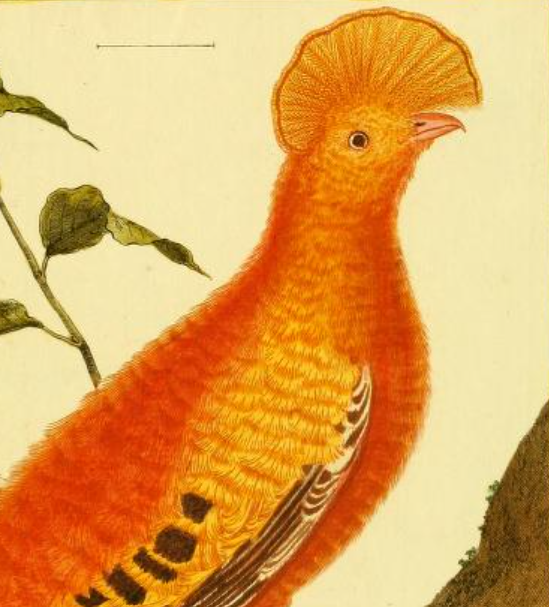
Charles Willson Peale (1741-1827) wrote, in his 37th Lecture (ca. 1799): "No. 1883. Cock of the Rock. Though this bird is of an uniform colour, it is one of the most beautiful of South America. The head is furnishd with a double round crest, one of these specimens shews the crest opened, and the other closed. The general colour of the plumage [is] orange, inclining to saffron; the wing coverts loose and fringed; the quills are partly white and partly brown; 12 tail feathers; the base half of the 10 middle ones orange and from thence to the ends brown; the outer feathers are brown, and the base half of the inner web orange; all of them are similarly fringed; the upper tail covert very long, loosely webbed, and square at the ends; feet & claws yellow. The female is altogather brown, except the under wing coverts, which are a rufous orange; the crest is neighter so complete, nor rounded as that of the male. Both males and females are at first grey, or a very pale yellow, inclining to brown. Pipra Rupicola Linn. Coq de Roche, Buff. pl. enl. 39." (Academy of Natural Sciences of Drexel University Archives, coll. 40)
Peale continued: "747 female. This beautiful species inhabits various parts of Surinam, Cayenne, and Guiana, in rocky situations. Mr. Buffon says, "Though this bird must have attracted the notice of all who ever saw it, no traveler has described its habits or economy. Sonini de Manoncour [i.e., Charles-Nicolas-Sigisbert Sonnini de Manoncourt, 1751–1812] is the first who has observed it with attention. It lodges not only in the deep clefts of the rocks, but even in the large dark caverns which totally exclude the solar rays; a circumstance that has induced many to believe it is a nocturnal bird; whereas it flies and sees distinctly in the day time. However, it seems naturally to prefer gloomy recesses, since it is most frequent in caves which cannot be entered without the light of torches. We may therefore presume, that their eyes are constructed like those of cats, and adapted both for the day and the night." (ANSP Archives, coll. 40)
Peale continued: "The male and female are equally lively, and extremely wild. It is impossible to shoot them, unless the person be concealed behind a rock, where he must wait several hours before an opportunity occurs; for the instant they perceive him, they escape to a distance by a flight which is rapid, though rather low and short. They feed upon small wild fruits, and usually scrape the ground, clap their wings, and shake themselves like the dunghill fowls; but they never crow like the cock, nor cluck like the hen. They construct their nest rudely in the holes of rocks with small dry sticks; and commonly lay two white spherical eggs, which are the size of those of Pigeons. The males emerge oftener from their caverns than the females, which seldom appear, and probably do not quit their retreats except in the night. They can easily be tamed, and Mr. de Manoncour saw one at the Dutch-post on the river Maroni, which was allowed freely to live and run about with the poultry." (ANSP Archives, coll. 40)
Notes:
Peale did not specify the origin of the specimen described in his lecture, but it seems likely to be Cayenne, French Guiana, a major South American trade center in the 18th century. In 1793, Raphaelle Peale (1774-1825) travelled to Cayenne to collect specimens for Peale's Museum. However, to the editor's (MRH) knowledge, there is no detailed inventory of the specimens he brought back, and there are many examples of specimens from northern South America that were donated by other people. For more discussion about Raphaelle's travels, see Lillian B. Miller, 1993, "Father and Son: The Relationship of Charles Willson Peale and Raphaelle Peale", The American Art Journal 25: 4-161. / https://doi.org/10.2307/1594599
Specimen Type:
Dead/preserved
Current Common Name:
Guianan Cock-of-the-Rock
Current Scientific Name
Cotingidae | Rupicola rupicola