Object Status:
Extant
Accession Date:
By 12 October 1792
Primary Source Reference:
Charles Willson Peale, letter to Thomas Hall of Moorfields, London, dated 12 October 1792; Selected Papers, 2, part 1: 42.
Additional Source Text:
Charles Willson Peale (1741-1827) sent "Scarlet sparrows Cock & Hen" to Thomas Hall in London, on 12 October 1792, in exchange for European specimens (Miller 1988: 42, Selected Papers, Vol. 2, part 1, Yale University Press).
On 30 April 1797, Peale sent a "Scarlet Sparrow" to Étienne Geoffrey Saint-Hilaire(1772-1844) at the Paris Museum (Miller 1988: 198).
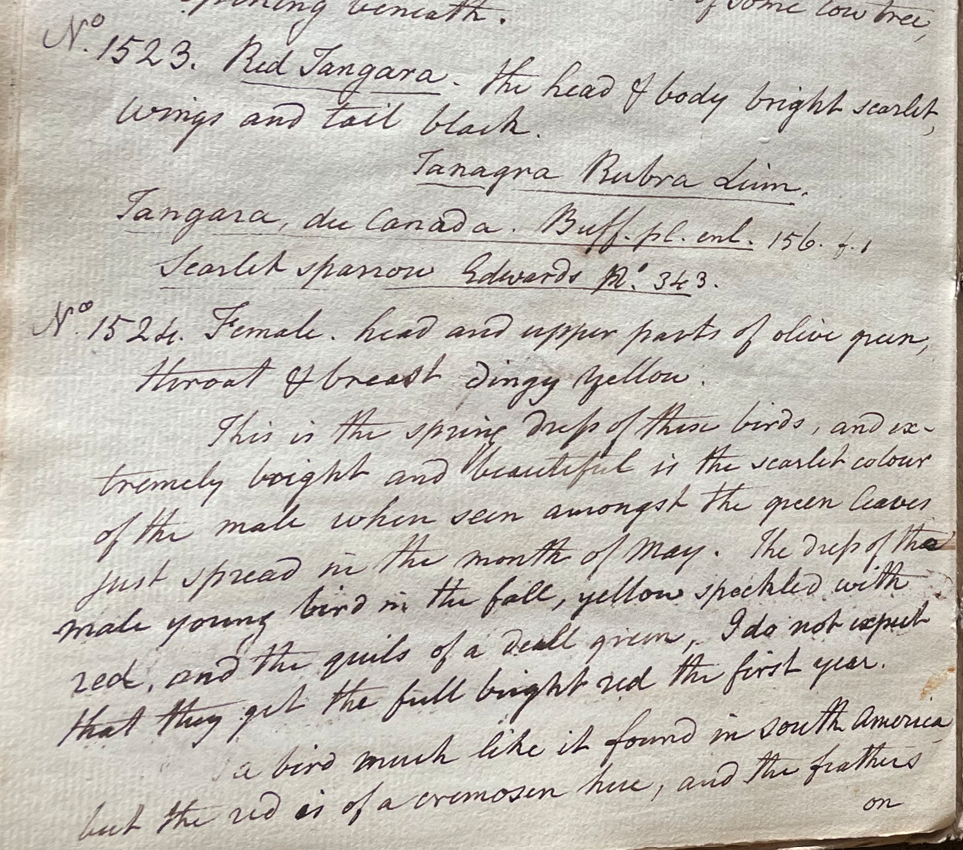
In his 33rd Lecture, Peale wrote: "No. 1523. Red Tangara. the head & body bright scarlet, wings and tail black. Tanagra Rubra Linn. Tangara, du Canada. Buff. pl. enl. 156. f. 1. Scarlet Sparrow Edwards No. 343. No. 1524. Female. head and upper parts of olive green, throat & breast dingy yellow. This is the spring dress of these birds, and extremely bright and beautiful is the scarlet colour of the male when seen amongst the green leaves, just spread in the month of May. The dress of the male young bird in the fall, yellow speckeled with red, and the quils of a dull green. I do not epect that they get the full bright red the first year. A bird much like it [is] found in South America, but the red is of a crimson hue, and the feathers on legs black. There is also one other described belonging to Canada, which has the end of the tail tipped with white. We have some instances of the birds before us, breeding in Pennsylvania, but in general I believe they go further northward." (Academy of Natural Sciences of Drexel University Archives, coll. 40)
In "A Walk Through the Philad[elphi]a Museum", Peale (1805–1806) wrote: "Red Tangara (T. Rubra) is found in the Middle States generally throughout the United States. the female how different in its Plumage, her olive colours render her difficult to be seen in the amidst the foliage of the Trees, while scarlet of the [male] seems heightened to appear almost like a flame of fire." (Historical Society of Pennsylvania, coll. 0481)
Alexander Wilson (1766-1813) described this species under the name "Scarlet Tanager / Tanagra rubra" in American Ornithology vol. 2 (Pl. 11), where "Peale's Museum No. 6128" was cited (Wilson 1810: 42). Corroborating Peale's comment about "A bird much like it found in South America", Wilson (1810: 44) mentioned that he visited the Peale Museum to compare the Scarlet Tanager to two specimens of the Brazilian Tanager, "Tanagra Brazilia of Turton" (now Brazilian Tanager, Ramphocelus bresilius). / https://www.biodiversitylibrary.org/item/175511#page/50/mode/1up (text) / https://www.biodiversitylibrary.org/item/175511#page/45/mode/1up (plate)
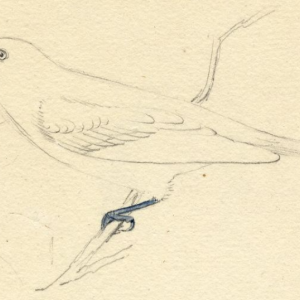
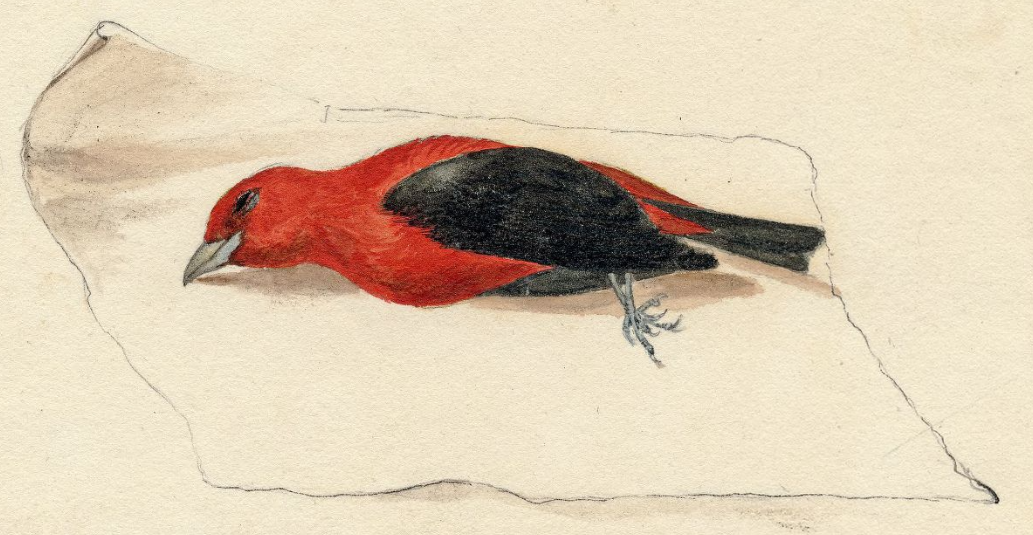
Titian Ramsay Peale (1799-1885) drew a male Scarlet Tanager (shown here) at "Engineer Cantonement Mo." in 1820, during the Long Expedition, which is extant in the American Philosophical Society Library (Mss.B.P31.15d, 130). This was presumably one of the "sundry small birds" deposited on 23 March 1821, as recorded in the Peale Museum Accessions Book (Historical Society of Pennsylvania, coll. 0481).
Six unmounted specimens of "Tanagra rubra (Red Tanager)" and 5 specimens (4 mounted, 1 unmounted) of "Tanagra aestiva (Summer Red Bird)" were listed in "A Catalogue of Duplicate Specimens...", May 1822. [unpublished] American Philosophical Society Library (Mss.B.P31).
Specimen Type:
Dead/preserved
Current Common Name:
Scarlet Tanager
Current Scientific Name
Cardinalidae | Piranga olivacea