Object Status:
Extant
Accession Date:
By 1799
Primary Source Reference:
Charles Willson Peale, Lecture on Natural History 28. (ca. 1799). Academy of Natural Sciences of Drexel University Archives, coll. 40. / https://ansp.org/research/library/archives/0000-0099/coll0040/
Additional Source Text:
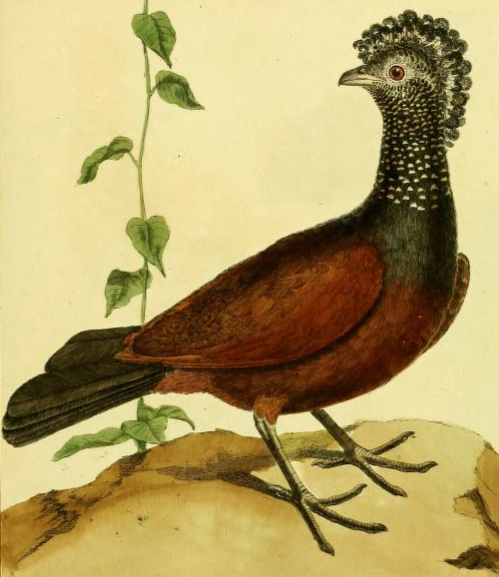
Charles Willson Peale (1741-1827) wrote, in his 28th Lecture (ca. 1799): "No. 1047. Red Curassow. plumage of a brown red, darker on some parts of the body. The crest long, much frizzled and variegated with black & white, as is also the upper part of the neck; the cere is black, round, about the eyes white; the leg coverts barred with white & black, on the wings the same; the under parts of the body a dingy white. No. 1048. perhaps is the female of the preceeding; the feathers of the crest are less variegated with white; the coverts of the legs a dingy white. Crax alector rubra Linn. Hocco de Perou Buff. pl. enl. 123? [sic, =125] (Academy of Natural Sciences of Drexel University Archives, coll. 40)
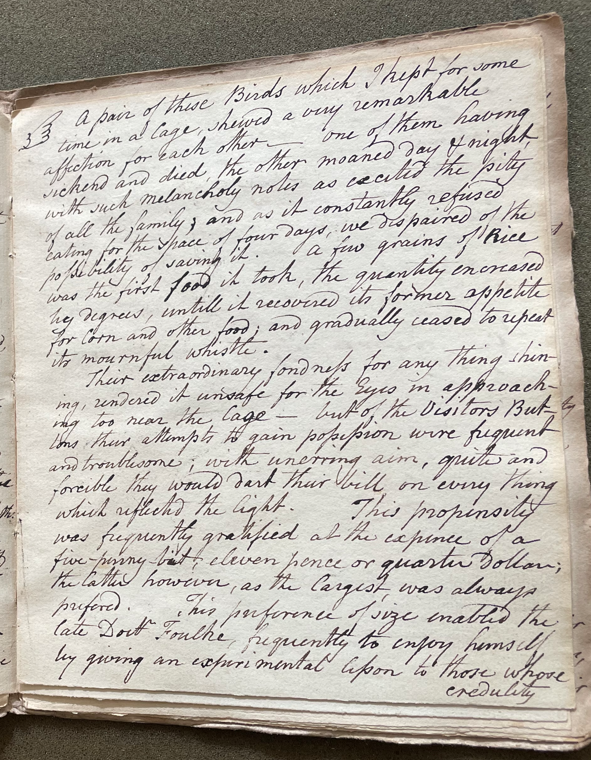
Peale continued: "A pair of these birds which I kept for some time in a cage, shewed a very remarkable affection for each other. One of them having sickened and died, the other moaned day & night, with such melancholy notes as excited the pity of all the family; and as it constantly refused eating for the space of four days, we despaired of the possibility of saving it. A few grains of Rice was the first food it took, the quantity increased by degrees, until it recovered its former appetite for corn and other food; and gradually ceased to repeat its mournful whistle." (ANSP Archives, coll. 40)
Peale continued: "Their extraordinary fondness for anything shining, rendered it unsafe for the Eyes in approaching too near the cage. But of the visitors buttons, their attempts to gain possession were frequent and troublesome; with unerring aim, quite and forcible they would dart their bill on every thing which reflected the light. This propensity was frequently gratified at the expence of a five-penny bait; eleven pence or quarter Dollar; the latter however, as the largest, was always preferred. This preference of size enabled the late Doctr [John] Foulke [1757–1796] frequently to enjoy himself by giving an experimental lesson to those whose credulity out-ran their reason; informing them that as an evidence of the brids superios understanding, they would distinguish by the most unique […] choise between the different values of silver or copper coin. Desirous of witnessing such an uncommon instance of sagacity, they have held towards him the different coins; quick as thought the bird has seized the largest, and with one swallow secured possession. The Boy who cleaned the cage generally found the money, together with Buttons, thimbles, &c. sometimes perfect, but generally very much corroded by the acid of the stomack." (ANSP Archives, coll. 40)
Rubens Peale (1784-1865) wrote to his father from London, on 1 June 1803, about a list of specimens wanted by German naturalist Lopold de Fichtel, to exchange for specimens of German and Hungarian birds: "Crax Alector or Crested Curassow. Crax Globicem or Globose Curassow [=Crax rubra Linnaeus 1758], and others which he will mention in his letter to you" (Miller 1988: 529, Selected Papers, Vol. 2, part 1, Yale University Press). This implies that Peale had multiple specimens of each (i.e., duplicates to trade).
Peale wrote, in "A Walk Through the Philad[elphi]a Museum" (1805–1806): "[Here are] the crested Curassow (C. Alector) and Red Curassow (C. Alector Rubra). The yellow cere very probable these are male & female, such is the opinion of some authors. The yellow lump at the base of the bills indicates the state of health in them; when is full and smooth in bird is in good health, but if it is [shrivled] up the reverse." (Historical Society of Pennsylvania, coll. 0481)
Notes:
Peale's reference to "pl. enl. 123?" is an evident error, because the "Hocco de Perou" appeared on Pl. Enl. 125 in Martinet's Planches enluminées (shown here).
Specimen Type:
Live (later taxidermied)
Current Common Name:
Great Curassow
Current Scientific Name
Cracidae | Crax rubra