Object Status:
Extant
Accession Date:
By 1799
Primary Source Reference:
Charles Willson Peale, Lecture on Natural History 18. (ca. 1799). Academy of Natural Sciences of Drexel University Archives, coll. 40. / https://ansp.org/research/library/archives/0000-0099/coll0040/
Additional Source Text:
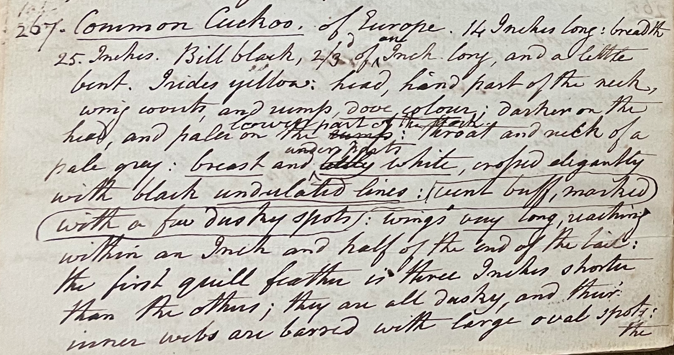
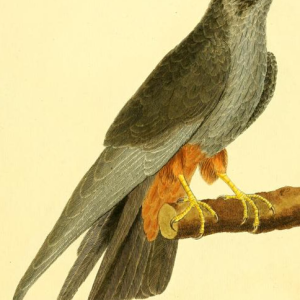
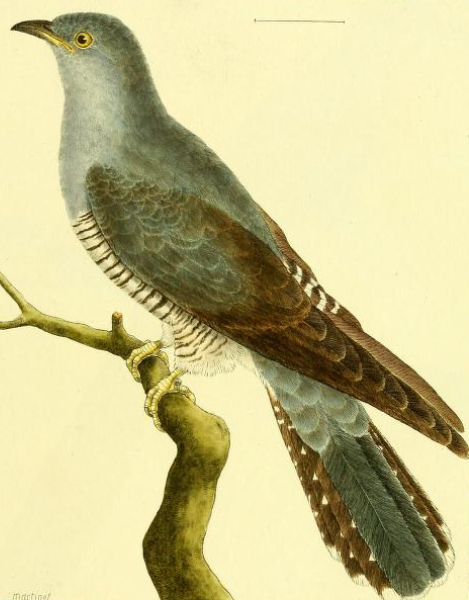
Charles Willson Peale (1741-1827) wrote, in his 18th Lecture (ca. 1799): "267. Common Cuckoo, of Europe. 14 Inches long; breadth 25 Inches. Bill black, 2/3 of one Inch long, and a little bent. Irides yellow; head, hind part of the neck, wing coverts and rump dove colour; darker on the head, and paler on the lower part of the neck; throat and neck of a pale gray; breast and belly under parts white, crossed elegantly with black undulated lines; vent buff, marked with a few dusky spots; wings very long, reaching within an Inch and half of the end of the tail; the first quill feather is three Inches shorter than the others; they are all dusky, and their inner webs are barred with large oval spots; the tail is cuneiform; the 2 middle feathers are black, tipt with white; the others marked with white spots on each side [of] their shafts; the feet are short and yellow. The female is said to differ, the neck behind and before being of a brownish red, and the tail barred with red." (Academy of Natural Sciences of Drexel University Archives, coll. 40)
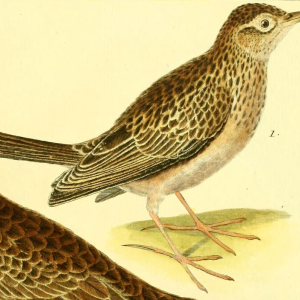
Peale continued: "[No.] 268 is a young bird; it is brown, mixed with ferruginous and black; and barred with rust colour & white all over the bird. This [specimen] I received from the south of France. [No.] 269. I take to also be a young Cuckoo; the general colour is the same as the other, but the bars are fine white lines, most likely only a difference in age. This [specimen] I received from England." In the same lecture, Peale described a specimen that may have been partially leucistic: "No. 272. Pied Cuckoo, received from Paris Mus. I call it pied because of the white patches on its head. Coucou [french]. Cuculus canorus Linn." (ANSP Archives, coll. 40)
Peale wrote, in "A Walk Through the Philad[elphi]a Museum" (1805–1806): "The Common Cuckow of Europe (C. Canorus) here is a variety of them, some are young birds, known by the being more [spotted]." (Historical Society of Pennsylvania, coll. 0481)
Notes:
Palisot de Beauvois (1752-1820), the French naturalist, approached Peale about a specimen exchange in October 1794, to which Peale replied: “You desire to know if I would be willing to exchange Birds and other subjects of natural history to supply the public museum at Paris [i.e., Muséum national d'histoire naturelle, known to Peale as the "Paris Museum"]—My first Object is to furnish my [own] Museum with all the Various Animals in the several classes and other objects of Natural History belonging to America, and secondly, while I am engaged in this labour, to prepare duplicates with the view of exchanging them for the subjects of the other quarters of the Globe—by which means I hope to inrich my Museum in a mode which I conceive will be most agreable to the Amateurs of this delightful Science on the other side of the Water, who may be desirous of possessing those of America—I mean by a reciprocal exchange of Subject for subject.” (Miller 1988, Selected Papers, Vol. 2, part 1, Yale University Press) / https://en.wikipedia.org/wiki/National_Museum_of_Natural_History,_France For more discussion about Beauvois’s time in Philadelphia, and how he helped Peale catalogue the taxidermy collection, see Matthew R. Halley, 2022, “Rediscovery of the holotype of the American Goshawk, Accipiter gentilis atricapillus (Wilson, 1812), and a commentary about Alexander Wilson’s contributions to the Peale Museum. Proceedings of the Academy of Natural Sciences of Philadelphia 167: 233–240. / https://doi.org/10.1635/053.167.0114 The specimen exchange with the Paris Museum eventually came to pass in the late 1790s, as Peale corresponded with Étienne Geoffroy Saint-Hilaire (1772-1844). On April 30, 1797, in a letter accompanying two cases of specimens, Peale wrote: “I have many Birds which is not described in Catesby, and several, which are not to be found in any of the authors on Natural History duplicates of which I will send you, with all such articles as you may want, and in my power to procure ... I have imbraced [sic] the first coming of the birds this season, and daily with one of my Sons hunt & preserve all we can. We have already mounted a tolerable number of the small birds in a handsome condition—and by constantly shooting ourselves, we are able to gain a knowledge of their manners.” (Miller 1988: 198–199) Peale wrote to Pierre-Auguste Adet (1763-1834) on 31 May 1798: “with my Son Titian I continue my hunting excursions to collect & preserve Subjects with equal diligence … this year add so many new subjects yet we have got some that are nondescripts—and that while I am increasing my store we find by practice proved—I am anxious to hear from Mr. Geoffroy whether he wishes Birds mounted in the manner of those I have sent or whether he would prefer them without being fixed with wires and mounted on Sticks.” (Miller 1988: 215). Peale wrote to Geoffrey on 13 July 1802: “Sir, Your favor of the 26 Feby and the Package of Birds I have received—they were in very good condition one or two only excepted.” (Miller 1988: 440)
Specimen Type:
Dead/preserved
Current Common Name:
Common Cuckoo
Current Scientific Name
Cuculidae | Cuculus canorus