Object Status:
Extant
Accession Date:
19 August 1789
Primary Source Reference:
Pennsylvania Packet, 19 August 1789.
Additional Source Text:
On 19 August 1789, in a notice in the Pennsylvania Packet (Philadelphia) announced the Museum's acquisition of "That rare and beautiful Bird called the Bird of Paradise, from the Molucca, or Spice Islands, in the East-Indies," donated by Mrs. Sarah Chew Elliott O'Donnell (1766-1857).
Charles Willson Peale (1741-1827) visited the O'Donnells in June 1791, writing in his diary: "I went to Captn. O'Donnel's ... Neither Mr. or Mrs. O'Donnel gave any invitation to Mrs. Peale to visit them. This I conceive a great want of politeness as well as respect to me, as especially as I am painting this picture without any expectation of reward. It is true that I had received many articles for my Museum of them, and when I received the Cokatoo, and made the promise of doing this picture in return, altho I did not consider the bird to be worth such a price, yet as I had before recieved the bird of paradise and several other articles [from them], I do not begrudge my labour in this picture" (American Philosophical Society Library, Peale-Sellers Family Collection, Mss.B.P31).
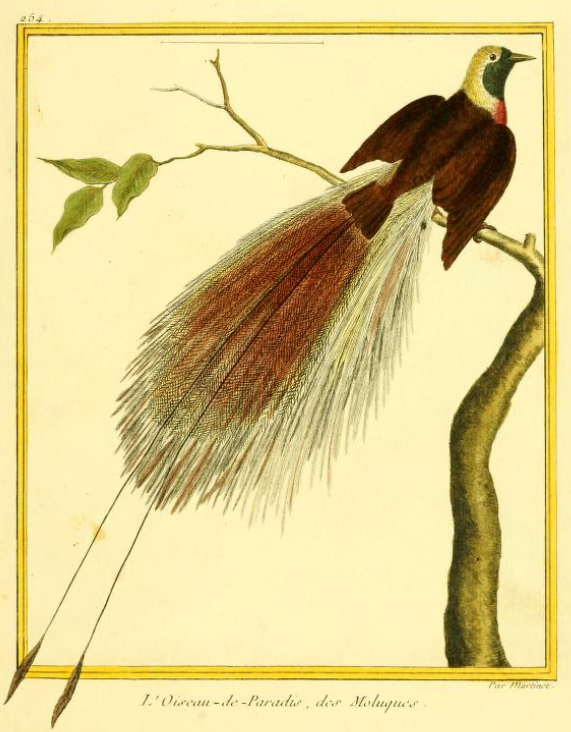
Peale wrote, in his 17th Lecture (ca. 1799): "No. 238. Greater Bird of Paradise. Paradisea. Linn. L'oiseau de Parad. Buff. [pl. enl.] 254. The body is about the size of a thrush. The length, from the end of the bill to the end of the tail about one foot; the Bill greenish yellow, 1½ Inch long; the eyes small; the head, which is likewise small in proportion to the bird, the throat, and neck, are covered with very short dense, stiff feathers; those on the head and hind part of the neck are of a pale gold-colour; the base of the bill is surrounded with black feathers, appearing like velvet, changing in different lights to green; the forepart of the neck is green-gold; the lower part of the neck behind, the back, wings, and tail, are chesnut; breast deeper chestnut, verging to purple; from under the wings spring a great quantity of feathers, with the webs so loose as to appear like a herring-bone, some of them near 18 Inches in length; these are of different colours, some chestnut and purplish, others yellowish, and a few almost white; from the lower part of the back arise two feathers without webs, except for 4 Inches next [to] the base, and the same at the tips; these appear to be the two middle tail feathers, and are of the same colour as the rest of the tail, the feathers of which are 6 Inches long, and even at the ends; the feet stout, and a brown colour. The female is said to be like the male, except that the long wire-like feathers of the tail have webs shorter than those of the male. Among those I possess I find a little difference in the brightess of these long breast feathers, which may be a difference of sex, or perhaps of age." (Academy of Natural Sciences of Drexel University Archives, coll. 40)
Peale continued: "In flying they are observed to take advantage fo the wind, when it blows moderately; but when in distress, from shifting of the wind, or blowing too strong, croak like Ravens. Sometimes, by the shifting of the winds, their long breast feathers are disshevelled, which quite hinders their flight; in that case, they are lost in the water, or fall on the ground and cannot rise again without gaining an eminence; in this state, they are watched by the natives, who secure many, and kill them on the spot, as they cannot be kept alive by […], and the traffic in these is one part of their trade. They are likewise taken with bird lime, when they settle in trees, or shot with blunt arrows. They are sold at Banda, and its neighborhood, for half a dollar each; but the people of Aroo are content with a spike-nail." (ANSP Archives, coll. 40)
Peale continued: "The true food of these birds is not certain, since the accounts given by authors differ widely. Some say, that they feed on the red berries of the Waringa Tree (Forrest, p. 136); others, that they are fond of eating nutmegs (Travernier, Vol. II. p. 311); some, that their food is large butterflies (Linnaeus); and others aver, that they chase small birds (Bontius); which last circumstance is not improbable as their feet and bill are sufficiently stout; and they are known to defend themselves courageously whenever they are taken alive. I am sorry that I have it not in my power to shew you some others of this genus of birds. Some described in Latham are suberbly elegant. I may hope, in some future lecture, to have the good fortune to add of these, and many species of birds for want which I am enduced to pass by, because description without the object [specimen] is not worth your sacrifice of time." (ANSP Archives, coll. 40)
Peale wrote, in "A Walk Through the Philad[elphi]a Museum" (1805–1806): "The following genus Paradisea, Bird of Paradise, belongs chiefly to New Guinea, from whence in the dry season it migrates into the adjacent Islands. For a long time it was believed that it had no feet, the Indians who sold them, favored that opinion & generally cut them off. But in this before us we find the feet are large, there is several species. This is the greater bird of Paradise (Paradisea Apoda) those long feathers come from the breast, the tail in short & even at the end, but two Very long wire-like feathers arises a little above the tail. In flying they are observed to take the advantage of the wind, when it blows moderately. Otherwise those long breast feathers would hinder their flight. These birds are skined, their feet pulled off, and a stick stuck through them, thus, they are sold as egrets — worn by the Japanese, Chinese, and Persians &c and the grandees of India not only ornament themselves with these beautiful plumes but adorn their Horses with the same. European Ladies may plume themselves to an immaginary heigth, yet native charms need no borrowed Feathers." (Historical Society of Pennsylvania, coll. 0481)
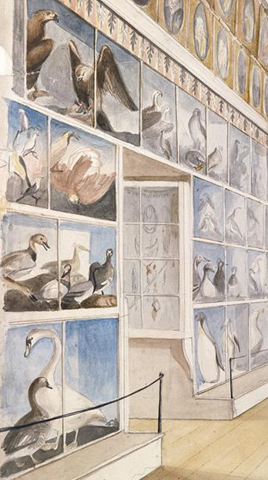
Peale's specimens are visible in his oil painting, "The Artist in His Museum" (1822), and in a watercolor of the same scene prepared by Peale and his son Titian Ramsay Peale (1799–1885), shown here.
On 13 June 1817, "A Bird of Paradise" was donated by Captain Babcock, which presumably applies to this species (Peale Museum Accessions Book, HSP, coll. 0481). The donor was possibly Capt. R. Babcock, owner and captain of the merchant ship Eliza (port of Calcutta), who died in Bombay in 1825 at the age of 51. See The Oriental Herald and Journal of General Literature, 6 (1825): 405; Reports and Papers on the Impolicy of Employing Indian Built Ships in the Trade of the East-India Company (London, 1809), p. 240.
Another "Bird of Paradise" specimen was deposited by an unknown donor on 4 July 1818; and "A Bird of Paradise, prepared as a Plume, worn by the Malay Women" was donated on 14 January 1820 (Accessions Book, HSP, coll. 0481).
Notes:
Two specimens of this species are visible in the Peales' watercolor painting of the Long Room interior at the Pennsylvania State House (shown here), executed ca. 1820, in the third display case from the bottom, to the left of the doorway (Detroit Institute of Arts, 57.262).
Specimen Type:
Dead/preserved
Current Common Name:
Greater Bird-of-Paradise
Current Scientific Name
Paradisaeidae | Paradisaea apoda