Object Status:
Extant
Accession Date:
By 1799
Primary Source Reference:
Charles Willson Peale, Lecture on Natural History 29. (ca. 1799). Academy of Natural Sciences of Drexel University Archives, coll. 40. / https://ansp.org/research/library/archives/0000-0099/coll0040/
Additional Source Text:
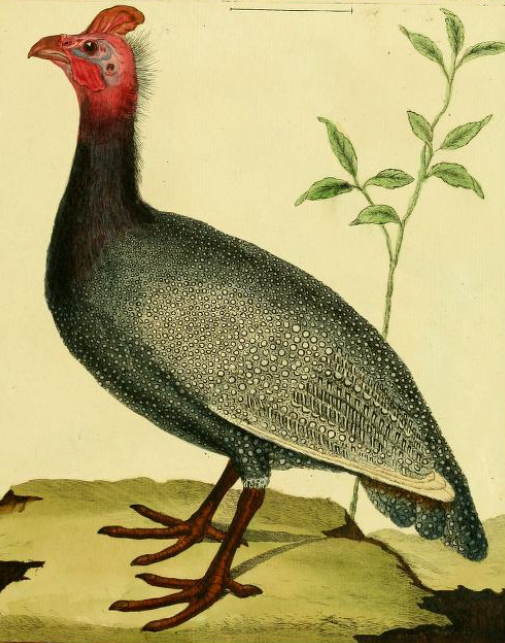
Charles Willson Peale (1741-1827) wrote, in his 29th Lecture (ca. 1799): "We will proceed to the next genus. Numida, Guinea Hen or Pintado, the characters of which are so striking that no one will mistake them. The bill convex, strong, and short; at the base a carunculated cere, in which the nostrils are placed. Head and neck naked, slightly beset with bristles. A horn, reflected, and large, on the head, except in one species, which has [a] crest instead of a horn; tail short, pointing downwards. / The plumage of the Pintado, though not decorated with rich and dazzling colours, is remarkably beautiful. It is of a bluish-grey ground, sprinkled with considerable regularity, with white roundish speckles, resembling pearls. Hence some of the […] have bestowed on this bird the name of Pearled-hen. Buffon says, "that the Pintado which was anciently reared with so much care at Rome, was afterwards entirely lost in Europe. We can discover no trace of it in the writings of the middle ages; and we find it only began to be spoken of, after the Europeans had visited the western coast of Africa, in their voyages to India by the Cape of Good Hope. But not only have they diffused these birds through Europe, but transported them into America." (Academy of Natural Sciences of Drexel University Archives, coll. 40)
Peale continued: "It is a noisey Bird; its cry is sharp, and by its continuance, becomes so troublesome, that, though the flesh is very delicate, and much superior to that of the ordinary poultry, Buffon says, most of the American planters have given over breeding it. The Pintado is a lively, restless, and turbulent bird, that dislikes to remain in the same place, and contrives to become master of the poultry-yard. It can intimidate even the Turkies; for, though much smaller, it gains the ascendency over them by the more dint of petulance. 'The Pintado [says Father Margat, fide Buffon] wheels sometimes round, gives twenty strokes with his bill, before these heavy birds are roused to defence.' The Hens of Numidia seem to have the same mode of fighting which the historian […] imputes to the cavalry of that country. [Margat also says] 'Their charge is sudden and irregular; if they meet with resistance, they retreat, but in an instant they renew the attack.' To this example we might add many others, tending to prove the influence of climate on the instincts of the animals, as well as on the national genius of the Inhabitants. The Elephant joines to strength and industry, a slavish disposition; the Camel is laborious, patient, and sober; and, in those enervating regions, even the Dog forgets to bite." (ANSP Archives, coll. 40)
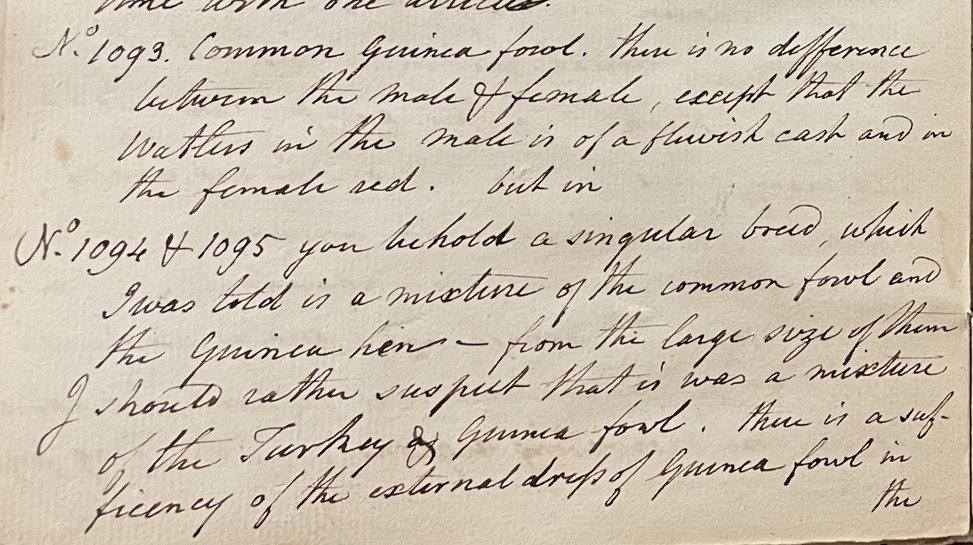
Peale continued: "The Pintado is one of those birds which seek, by weltering in the dust, to rid themselves of insects. They also scrape the ground like common hens, and roam in numerous flocks. Bodies of 2 or 3 hundred together are sometimes seen in the Isle of May; and the inhabitants hunt them with a grey-hound, and without tother weapons than sticks. Buffon is very lengthy on this subject. I have selected what I thought most interesting, for other particulars I must refer you to him, as I have already engrossed a sufficiency of your time with one article. / No. 1093. Common Guinea fowl. There is no difference between the male & female, except that the wattles in the male is of a [blueish] cast and in the female red." (ANSP Archives, coll. 40)
On 1 July 1808, a donation by Thomas Ash of "A Guinea fowl, with 4 legs" was entered into the Peale Museum Accessions Book (Historical Society of Pennsylvania, coll. 0481).
Specimen Type:
Dead/preserved
Current Common Name:
Helmeted Guineafowl
Current Scientific Name
Numididae | Numida meleagris