Object Status:
Extant
Accession Date:
By 1799
Primary Source Reference:
Charles Willson Peale, Lecture on Natural History 33. (ca. 1799). Academy of Natural Sciences of Drexel University Archives, coll. 40. / https://ansp.org/research/library/archives/0000-0099/coll0040/
Additional Source Text:
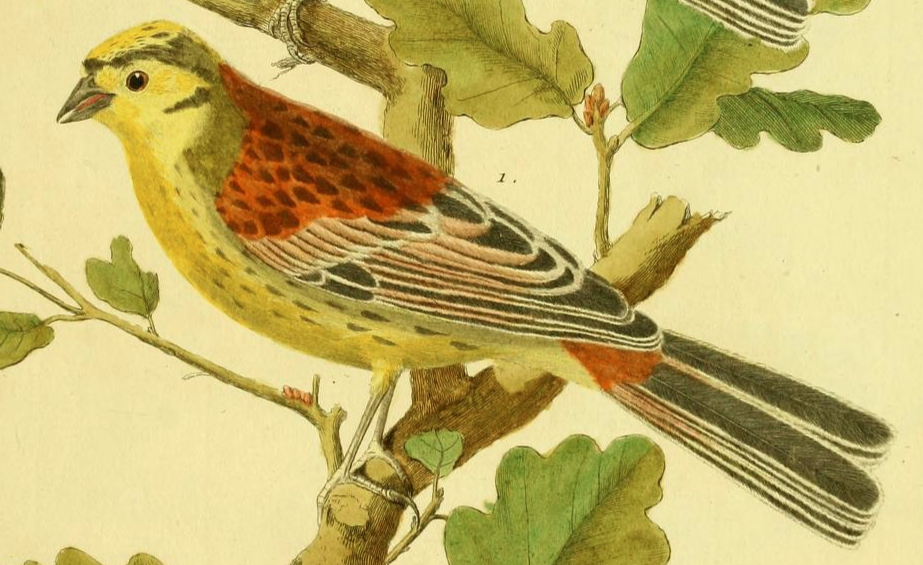
Charles Willson Peale (1741-1827) wrote, in his 33rd Lecture (ca. 1799): "No. 1474. Yellow Bunting. the crown of the head a light yellow; chin, throat and below the breast yellow; breast streaked with orange Red; lower part of the back rufous; tail brown, the 2 outermost feathers white near the end. Emberiza citronella Linn. Bruant Buff. pl. enl. 30. f. 1. Yellow bunting Pennant & Latham. No. 1475. Female. the colours are much duller, it has very little yellow on the head. These are the most common of British birds. Known by every school boy to make a nest composed of Hay, straw, &c. lined with hair or wool, generally on the ground, though now and then in a very low bush. have generally 4 or 5 Eggs, marked with brown or blackish stripes. a nest of their Eggs are placed between them with the specimens before us. They are not in much estimation either for the cage or table in England." (Academy of Natural Sciences of Drexel University Archives, coll. 40)
Peale evidently had duplicate specimens because he wrote the following note in his 1801 diary: "Cock Yellow Hammer - given to Mr. Maccabbin of Annapolis, May 9 1799" (American Philosophical Society Library, Peale-Sellers Family Collection, Mss.B.P31).
Peale wrote, in "A Walk Through the Philad[elphi]a Museum" (1805–1806): "Here we see the … Yellow Hammer (E. Citrinella). They inhabit Europe generally." (Historical Society of Pennsylvania, coll. 0481)
A mounted specimen of "Emberiza citronella (Yellow hammer)" from Europe was listed in "A Catalogue of Duplicate Specimens...", May 1822. [unpublished] American Philosophical Society Library (Mss.B.P31).
Specimen Type:
Dead/preserved
Current Common Name:
Yellowhammer
Current Scientific Name
Emberizidae | Emberiza citrinella