Object Status:
Unlocated
Accession Date:
By 1824
Primary Source Reference:
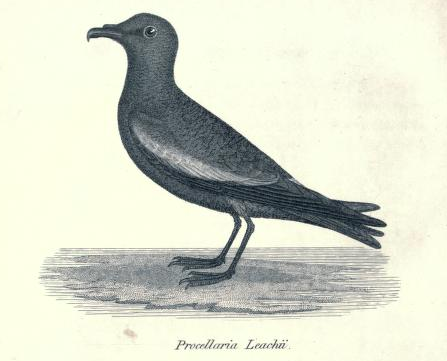
Charles Lucien Bonaparte (1824). An account of four species of Stormy Petrels. Journal of the Academy of Natural Sciences of Philadelphia 3: 229, Plate 9 / https://www.biodiversitylibrary.org/item/79390#page/245/mode/1up
Additional Source Text:
Charles Lucien Bonaparte (1803–1857), referring to specimens in the "Philadelphia Museum, and [his private] collection", published the first identifiable account of this species in "An account of four species of stormy petrels", 1824, Journal of the Acad. Nat. Sci. Phila., 3: 229 / https://www.biodiversitylibrary.org/item/79390#page/243/mode/1up
However, numerous early donations of petrels, some of which may have been of this species, cannot be confidently identified. Notices in Dunlap's American Daily Advertiser record donations of "The Pedata Bird, commonly called the sea-pidgeon" on 28 August 1792, by Jacob Betterton, and "The Storm-petrel, commonly called mother Cary's chicken" and "The Sea Swallow" on 25 January 1794. In the New-York Gazette, the donation of a "Sea-Bird" was noted on 31 August 1795. A notice ran in the Pennsylvania Herald and General Advertiser (Philadelphia) on 8 August 1787, about a vagrant (and apparently leucistic) bird, "Which was driven by the storm, a few days since, to this city, and picked up in one of the streets, almost dead with fatigue. It is of a whitish colour, and in form resembles the pigeon, except that its feet are webbed, like those of a duck; and the size of the bird, though evidently of full growth, is no larger than that of a swallow."
Charles Willson Peale (1741-1827) and his son Titian (1780–98) collected five 'Mother Carrys Chickens' in late summer 1793, at Cape Henlopen, Delaware, of which the elder Peale wrote in his diary on 25 August: "these birds are curious, having only one nostril which round is a round pipe placed on the top of its beak. I find that they have no gizzard but a stomack like the Hawks & other carnivorous birds, the feet webbed. it is curious to see them as it were resting with their feet on the Water, as they pick up the fat which we threw overboard for them being a light bird a small motion of their wings suspends them, while their feet touchs the Tops of the waves. They must I suppose come to the shore to lay their Eggs, however they are seldom seen there, We find them at great distances from the land and generally in bad weather. I do not find any difference in the appearance between the Cocks & hens, some I found had very small Eggs in them, but I could not be certain whether the others were Cocks or not" (Miller 1988: 54, Selected Papers, Vol. 2, part 1, Yale University Press).
In his 23rd Lecture (ca. 1799), Peale copied verbatim from John Latham's (1740-1837) account of the "Stormy Petrel", published in Latham, 1785, General synopsis of Birds vol. 3, pt. 2, p. 411-412 (London).
The "Skeleton of a Procellaria Petrel" donated by Samuel Coates (Peale Museum Accessions Book (Historical Society of Pennsylvania, coll. 0481), 21 Feb 1806) was probably the same one mentioned in Aurora General Advertiser on 28 November 1806.
"The Head of the Petrel" donated by F. V. Riviere, as recorded in the Peale Museum Accessions Book on 21 February 1806, also cannot be identified.(HSP, coll 0481)
An unmounted specimen of "Procellaria pelagica (Mother Cary's Chick)", which may have refered to this species (or Wilson's Storm Petrel, Oceanites oceanites), was listed in "A Catalogue of Duplicate Specimens...", May 1822. [unpublished] American Philosophical Society Library (Mss.B.P31).
Notes:
After Peale's Museum closed, a portion of Peale's bird collection was purchased in 1850 by Moses Kimball (1809–95), who displayed it at his "Boston Museum". An advertisement in the Boston Transcript, printed 1 October 1850, stated that Kimball had acquired "One Half of the celebrated Peale's Philadelphia Museum". The other half of Peale's birds had been sold to the circus promoter P. T. Barnum (1810–91) and would be subsequently destroyed in a fire at his "American Museum" in New York City in July 1865. When the Boston Museum closed, Kimball's Peale remnants passed temporarily to the Boston Society of Natural History, who disposed of them to Charles J. Maynard (1845-1929), a local taxidermist. The specimens were stored in a barn in Massachusetts for several years, then eventually were deposited at the Museum of Comparative Zoology (MCZ), Harvard University. By the time the collection was catalogued by Walter Faxon (1848-1920) at MCZ, in 1914, in virtually every case the original mounts and labels had been disassociated from the specimens, and an untold number were lost. Walter Faxon, "Relics of Peale's Museum," Bulletin of the Museum of Comparative Zoology, 59, no. 3 (July 1915): 128, speculated that MCZ 67814 (shown here), a data-deficient specimen from the Boston Museum collection, was "Probably the specimen drawn by Titian R. Peale to illustrate Procellaria leachii Temm. for Bonaparte's [1824] paper". Faxon's claim may be true, but the pose of the bird is not identical and the editor (MRH) is unaware of any non-circumstantial evidence. / https://www.biodiversitylibrary.org/page/6339801#page/178/mode/1up Peale's collecting efforts at Cape Henlopen were overlooked by compilers of Delaware bird records, prior to this study (Gene K. Hess, in litt. 10 February 2024).
Specimen Type:
Dead/preserved
Current Common Name:
Leach's Storm Petrel
Current Scientific Name
Hydrobatidae | Oceanodroma leucorhoa
Repository:
Museum of Comparative Zoology, Harvard University (MCZ 67814)