Object Status:
Extant
Accession Date:
By 1799
Primary Source Reference:
Charles Willson Peale, Lecture on Natural History 26. (ca. 1799). Academy of Natural Sciences of Drexel University Archives, coll. 40. / https://ansp.org/research/library/archives/0000-0099/coll0040/
Additional Source Text:
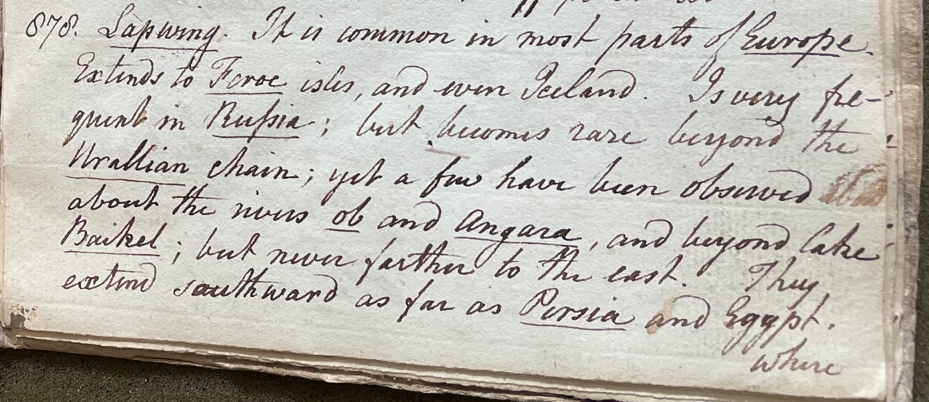
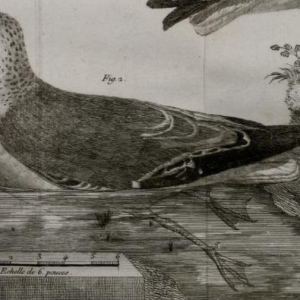
Charles Willson Peale (1741-1827) wrote, in his 26th Lecture (ca. 1799): "878. Lapwing. It is common in most parts of Europe, extends to Faroe isles, and even Iceland; is very frequent in Russia; but becomes rare beyond the Urallian chain; yet a few have been observed about the rivers Ob and Angara, and beyond Lake Baikal; but never farther to the east. They extend southward as far as Persia and Egypt, where they winter; but unable to bear the great heats of the summer, migrate to the countries about Woronesch and Astra[…]. Appears in Lombardy in April; retires in September. Continues in England and probably in France, the whole year; but constantly shifts its quarters in search of food, worms and Insects. In France, multitudes are taken fro the table in clap-nets, into which they are allured by the playing of a mirror, and the addition of some stuffed birds. It is frequently kept in gardens, of which it is a useful inhabitant, freeing them from worms and slugs, and in time becoming tolerably familiar. During frosty and hard weather, this pretty gardener will feed on bits of pudding, meat, and such like, but ever forsaking those when worms can be had, its most esteemed food." (Academy of Natural Sciences of Drexel University Archives, coll. 40)
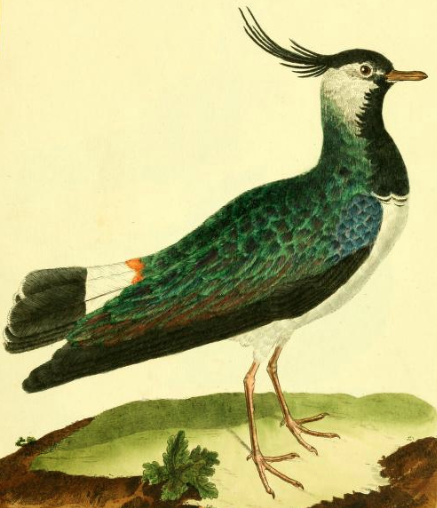
Peale continued: "The crown of the head is glossy-greenish black; at the back part springs a crest composed of narrow feathers, some of which are 4 Inches in length, and turn upwards at the ends; round the eye and sides of the neck white; beneath the eye a streak of black; forepart of the neck as far as the breast, black; the back & wings, dark green; the first glossed with purple & the last with blue; under parts of the body white; upper tail coverts pale rufous; tail white, for half way next [to] the base, the end black; legs brownish red. Tringa vanellas Linn. Vanneau Buff. pl. enl. 242. No. 879. Female. In these birds there is a small variety, two of them have some grey lines crossing their backs. This I conceive is only a difference of age. It is said the male & female are alike, but the latter rather smaller." (ANSP Archives, coll. 40)
Peale wrote, in "A Walk Through the Philad[elphi]a Museum" (1805–1806): "The lapwing (Tringa vanellus) is another species of bird spread generally over Europe. In France, multitudes are taken for the Table in [class-nets], into which they are lured by the placing of a Mirror, and the addition of some stuffed Birds. It is frequently kept in Gardens, of which it is an useful inhabitant, freeing them from Worms and slugs, and in time becoming tolerably familiar." (Historical Society of Pennsylvania, coll. 0481)
A mounted specimen of "Tringa vanellus (Lapwing)" from Europe was listed in "A Catalogue of Duplicate Specimens...", May 1822. [unpublished] American Philosophical Society Library (Mss.B.P31).
Specimen Type:
Dead/preserved
Current Common Name:
Northern Lapwing
Current Scientific Name
Charadriidae | Vanellus vanellus