Object Status:
Extant
Accession Date:
By 1799
Primary Source Reference:
Charles Willson Peale, Lecture on Natural History 31. (ca. 1799). Academy of Natural Sciences of Drexel University Archives, coll. 40. / https://ansp.org/research/library/archives/0000-0099/coll0040/
Additional Source Text:
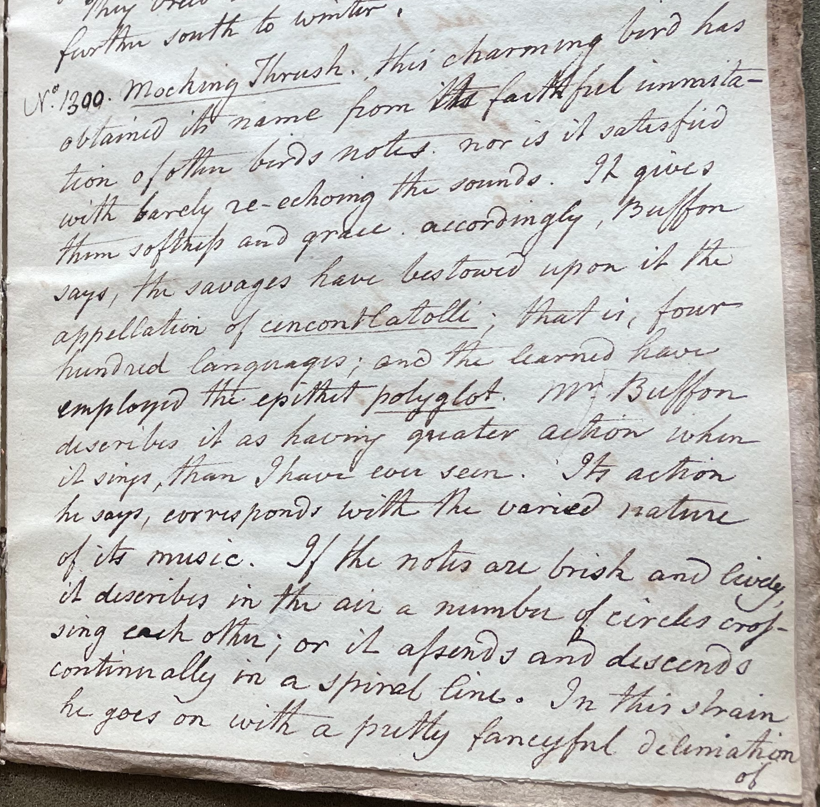
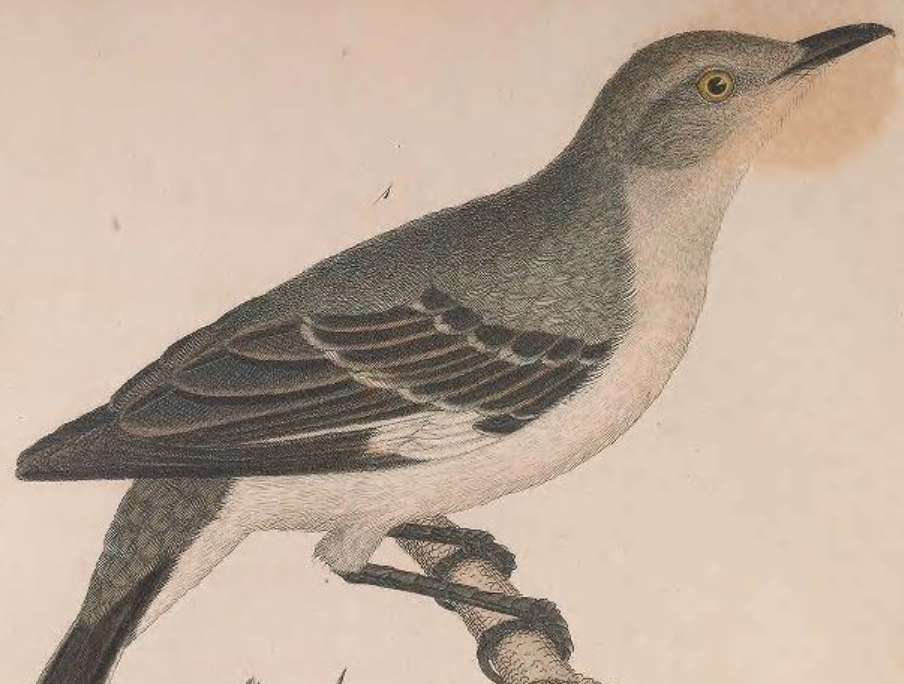
Charles Willson Peale (1741-1827) wrote, in his 31st Lecture (ca. 1799): "No. 1300. Mocking Thrush. this charming bird has obtained its name from the faithful imitation of other birds notes. nor is it satisfied with barely re-echoing the sounds. It gives them softness and grace. accordingly, Buffon says, the savages have bestowed upon it the appellation of [conconhatolli]; that is, four hundred languages; and the learned have employed the epithet polyglot." (Academy of Natural Sciences of Drexel University Archives, coll. 40)
Peale continued: "Mr. Buffon describes it as having greater action when it sings, than, I have ever seen. Its action he says, corresponds with the varied nature of its music. If the notes are brisk and lively, it describes in the air a number of circles corssing each other; or it assends and descends continually in a spiral line. In this strain he goes on with a pretty fancyful delimitation of its moovments, which may be considered as dreams in his closset. we know it is a spritely bird, and that it chiefly sings sitting on the branches of trees, and perhaps not much while flying. I am credibly informed that in Georgia it always sings when the moon is up & is silent at other times. Altho' the plumage is not rich, yet it is handsome by a fine turned figure and graceful motions." (ANSP Archives, coll. 40)
Peale continued: "The upper part of the body is brownish ash-colour; the under pale, or nearly white, outer feathers of the tail white, a white bar on the wings. Turdus orpheus polyglottus Linn. Le Moqueur Buff. [No.] 1301. Female, very much like the male, if there is any difference the white of this is less pale than the other. Some authors have described another of this species found in Jamaica, which they say is a little larger. I suspect it is the same bird and not a variety." (ANSP Archives, coll. 40)
Alexander Wilson (1766-1813) described this species under the name"Mocking-bird / Turdus polyglottus" in American Ornithology vol. 2 (1810, Pl. 10), where "Peale's Museum No. 5288" was cited (Wilson 1810: 13). / https://www.biodiversitylibrary.org/item/175511#page/19/mode/1up (text) / https://www.biodiversitylibrary.org/item/175511#page/8/mode/1up (plate)
A mounted specimen of "Turdus polyglottos (Mocking Bird)" was listed in "A Catalogue of Duplicate Specimens...", May 1822. [unpublished] American Philosophical Society Library (Mss.B.P31).
Specimen Type:
Dead/preserved
Current Common Name:
Northern Mockingbird
Current Scientific Name
Mimidae | Mimus polyglottos