Object Status:
Extant
Accession Date:
By 1799
Primary Source Reference:
Charles Willson Peale, Lecture on Natural History 34. (ca. 1799). Academy of Natural Sciences of Drexel University Archives, coll. 40. / https://ansp.org/research/library/archives/0000-0099/coll0040/
Additional Source Text:
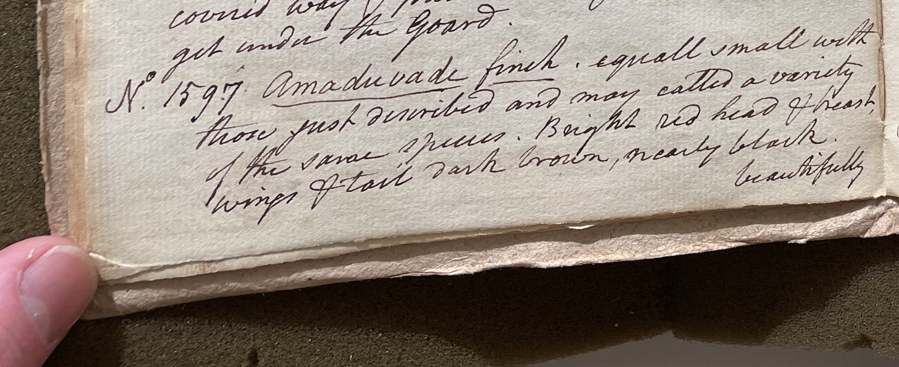
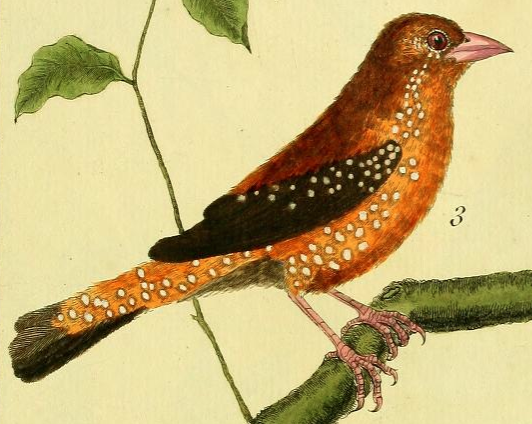
Charles Willson Peale (1741-1827) wrote, in his 34th Lecture (ca. 1799): "No. 1597. Amaduvade finch. equall small with those just described [Red-billed Firefinch, Lagonosticta senegala] and may [be] called a variety of the same species. Bright red head & near wings & tail dark brown, nearly black, beautifully spotted with white on the breast & covertures of the wings." Fringilla amandava Linn. Le Bengali pequeté Buff pl. enl. 115. f. 3." (Academy of Natural Sciences of Drexel University Archives, coll. 40)
Peale continued: "No. 1598. Female. Brown on the back, light on the breast, reddish on the upper part of the tail & dark brown at the tip, a few spots of white on the wings. Inhabit Bengal, Java, Malacca, and other parts of Asia. These birds are familiar and may live 5 or 6 years in a cage. Female as well as the male sing. Their notes are extremely musical though feeble. No. 1599. Is a male undergoing the change of plumage, some of the feathers on the breast is red, others yellow & some white, and it has those elicate small white spots on the wings & tail. It is remarked that these birds undergo considerable variety of change on the colours of their plumage in different seasons, &c." (ANSP Archives, coll. 40)
Peale wrote, in "A Walk Through the Philad[elphi]a Museum" (1805–1806): "… the Amanavade finch (F. Amandava) having a rich red dress strewed well round white spots" (Historical Society of Pennsylvania, coll. 0481).
Specimen Type:
Dead/preserved
Current Common Name:
Red Avadavat
Current Scientific Name
Estrildidae | Amandava amandava