Object Status:
Extant
Accession Date:
By 1799
Primary Source Reference:
Charles Willson Peale, Lecture on Natural History 14. (ca. 1799). Academy of Natural Sciences of Drexel University Archives, coll. 40. / https://ansp.org/research/library/archives/0000-0099/coll0040/
Additional Source Text:
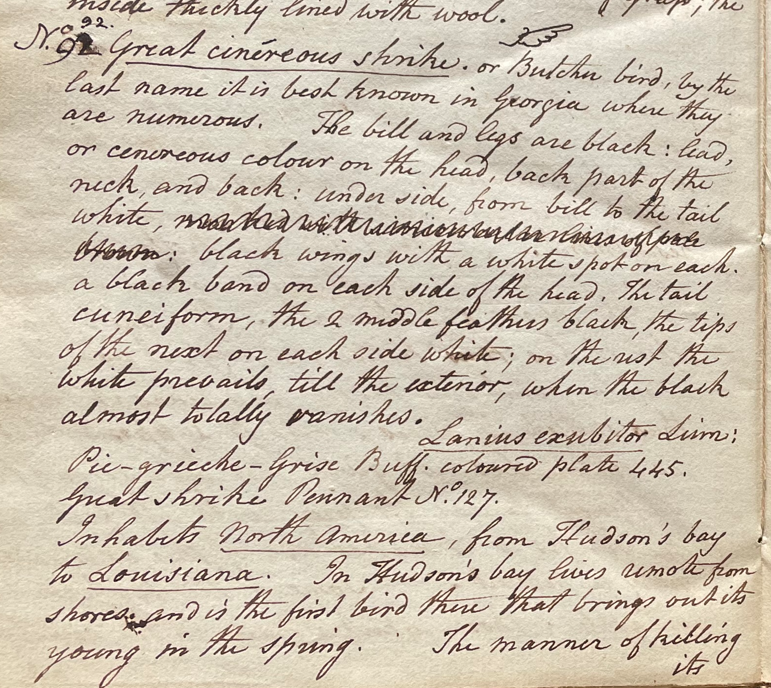
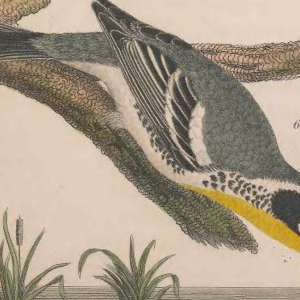
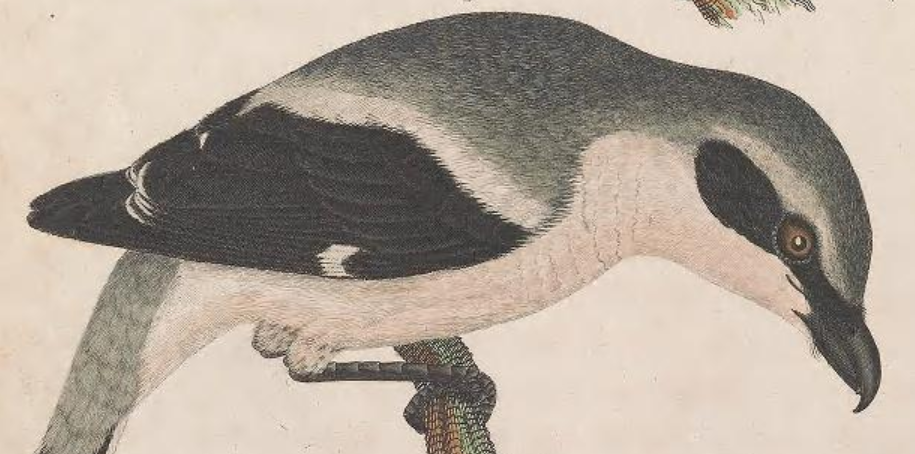
Charles Willson Peale (1741-1827) wrote, in his 14th Lecture (ca. 1799): "No. 92. Great Cinereous Shrike, or Butcher Bird, by the last name it is best known in Georgia where they are numerous. The bill and legs are black; lead, or cinereous colour on the head, back part of the neck, and back; underside, from bill to the tail white; black wings with a white spot on each; a black band on each side of the head. The tail cuneiform, the 2 middle feathers black, the tips of the next on each side white; on the rest the white prevails, till the exterior, when the black almost totally vanishes. Lanius exubitor Linn. Pie-griêche grise Buff. coloured plate 445. Great Shrike Pennant No. 127. (Academy of Natural Sciences of Drexel University Archives, coll. 40)
Peale continued: "Inhabits North America, from Hudson's Bay to Louisiana. In Hudson's bay lives remote from shores and is the first bird there that brings out its young in the spring. The manner of killing its prey is singular, and that of devouring it, not less extraordinary; small birds it will seize by the throat, and strangle; which probably is the reason the germans also call this bird Wurchangl, or the suffocating angel. It feeds on small birds, young nestlings, beetles and caterpillars." (ANSP Archives, coll. 40)
Peale continued: "I kept one alive a considerable length of time; it was seemingly content and we were often amused to see it stick its food in the wires of the cage; it preferred flesh; when grasshoppers were given, it did not eat them amediately [sic], after sticking them round the cage, but when we left the room it devoured them. Perhaps while we were present, it still expected we would give it meat, therefore, did not, then, eat the insects. There are some singular things related of this bird, such as its bateing [sic] a number of thorns in an orchard with grasshoppers, in order to intice small birds that feed on such Insects to come, while it was watching to catch them." (ANSP Archives, coll. 40)
Peale wrote, in "A Walk Through the Philad[elphi]a Museum" (1805–1806): "…The Germans call it Wurchangl, or the suffocating Angel, because it seizes small birds by the throat … In Russia they often train the great Shrike to catch small birds; said to emitate [sic] their voices, to decoy them within reach." (Historical Society of Pennsylvania, coll. 0481)
Alexander Wilson (1766-1813) described this species under the name "Loggerhead Shrike / Lanius carolinensis" in American Ornithology vol. 3 (Pl. 22), where "Peale's Museum, No. 557" was cited (Wilson 1811: 57). / https://www.biodiversitylibrary.org/item/175516#page/69/mode/1up (text) / https://www.biodiversitylibrary.org/item/175516#page/60/mode/1up (plate)
Unmounted specimens of "Lanius ludovicianus (Loggerhead Sh.)" from Florida and Missouri were listed in "A Catalogue of Duplicate Specimens...", May 1822. [unpublished] American Philosophical Society Library (Mss.B.P31).
Notes:
According to Wilson (1808, American Ornithology vol. 1), there were specimens of both L. ludovicianus and Northern Shrike (L. borealis) in the Philadelphia Museum, which Peale thought were the two sexes of one American species with a broad distribution “from Hudson’s Bay to Louisiana.” He suspected that this species was conspecific with the Great Grey Shrike (L. excubitor) of Eurasia. Wilson (1808) distinguished the two American species, correcting Peale’s error, but was unable to compare American specimens of “L. excubitor?” to specimens from Europe, which Peale apparently lacked in his collection.
Specimen Type:
Live (later taxidermied)
Current Common Name:
Loggerhead Shrike
Current Scientific Name
Laniidae | Lanius ludovicianus