Object Status:
Extant
Accession Date:
By 1799
Primary Source Reference:
Charles Willson Peale, Lecture on Natural History 35. (ca. 1799). Academy of Natural Sciences of Drexel University Archives, coll. 40. / https://ansp.org/research/library/archives/0000-0099/coll0040/
Additional Source Text:
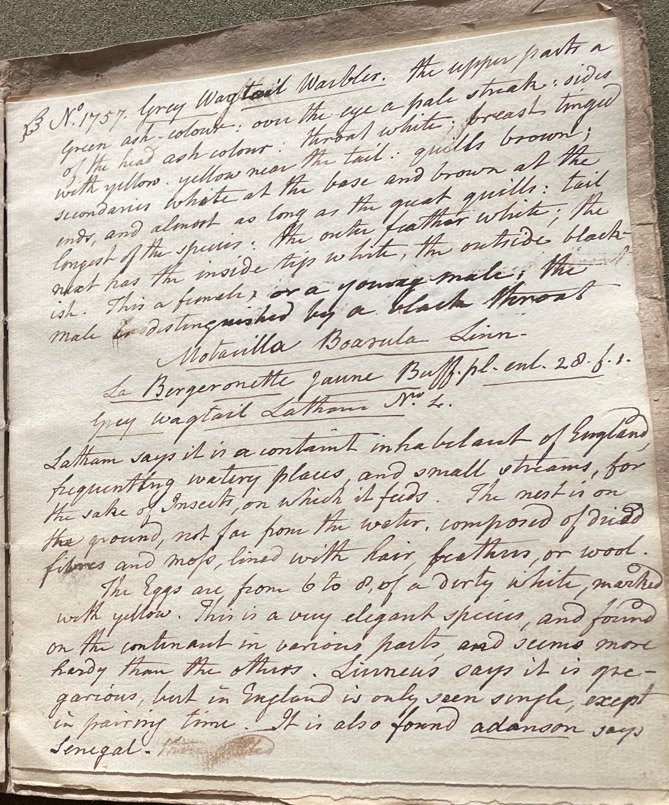
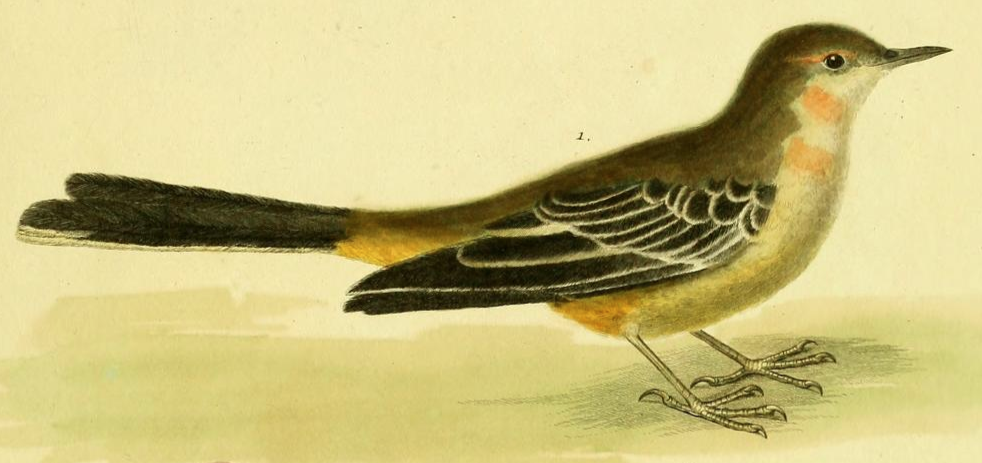
Charles Willson Peale (1741-1827) wrote, in his 35th Lecture (ca. 1799): "No. 1757. Grey Wagtail Warbler. the upper parts a green ash-colour; over the eye a pale streak; sides of the head ash colour; throat white; breast tinged with yellow; yellow near the taik; quills brown; secondaries white at the base and brown at the ends, and almost as long as the great quills; tail longest of the species [of Wagtails]; the outer feathers white; the next has the inside tip white, the outside blackish. This is a female, or a young male. The [adult] male is distinguished by a black throat. Motacilla Boarula Linn. Le Bergeronette Jaune Buff. pl. enl. 28. f. 1. Grey Wagtail Latham No. 4." (Academy of Natural Sciences of Drexel University Archives, coll. 40)
Peale continued: "Latham says it is a continant inhabitant of England, frequenting watery places, and small streams, for the sake of Insects, on which it feeds. The nest is on the ground, not far from the water, composed of dried fibres and moss, lined with hair, feathers, or wool. The Eggs are from 6 to 8, of a dirty white, marked with yellow. This is a very elegant species, and found on the continant in various parts, and seems more hardy than the others. Linnaeus says it is gregarious, but in England is only seen single, except in pairing time. It is also found Adamson says [in] Senegal." (ANSP Archives, coll. 40)
Peale wrote, in "A Walk Through the Philad[elphi]a Museum" (1805–1806): "Grey Wagtail (M. Boarula). It is according to Adamson found in Senegal." (Historical Society of Pennsylvania, coll. 0481)
Specimen Type:
Dead/preserved
Current Common Name:
Grey Wagtail
Current Scientific Name
Motacillidae | Motacilla cinerea