Object Status:
Unlocated
Accession Date:
By 1799
Primary Source Reference:
Charles Willson Peale, Lecture on Natural History 25. (ca. 1799). Academy of Natural Sciences of Drexel University Archives, coll. 40. / https://ansp.org/research/library/archives/0000-0099/coll0040/
Additional Source Text:
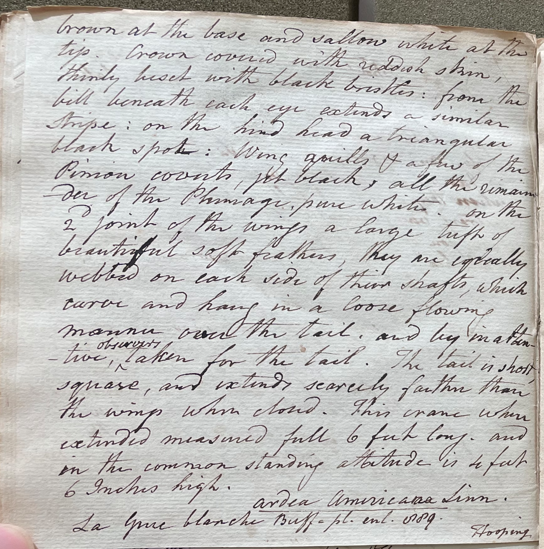
Charles Willson Peale (1741-1827) wrote, in his 25th Lecture (ca. 1799): "632. Hooping Crane. The bill 6 Inches long, brown at the base and sallow white at the tip. Crown covered with reddish skin, thinly beset with black bristles; from the bill beneath each eye extends a similar stripe; on the hind head a triangular black spot; wing quills & a few of the Pinion coverts, just black; all the remainder of the Plumage pure-white. On the 2 joints of the wings a large tuft of beautiful soft feathers; they are equally webbed on each side of their shafts, which curve and hang in a loose flowing manner over the tail, and by inattentive observers taken for the tail. The tail is short, square, and extends scarcely farther than the wings when closed. This crane when extended measured full 6 feet long, and in the common standing attitude is 4 feet 6 inches high. Ardea Americana Linn. La Grue blanche Buff. pl. enl. 889. Hooping Crane Penn. Latham, Edwards & Catesby. These several authors have described it as having the beak serrated near the tip. This is not the case in the subject before us. Pennant says 'the webs of the tertials are elegantly loose and unconnected, and, falling over the primaries almost conceal them'." (Academy of Natural Sciences of Drexel University Archives, coll. 40)
Peale continued: "This is only of those loose feathers a tuft at the 2d. joint of the wing and they do not fall over the primaries, but backward. Latham is still more incorrect, for he says, 'on the rump the feathers are tufted, and hang curved downwards, as in the Common Crane.' It migrates from florida to Hudsons Bay, where it breeds. They are very shy bird and difficult to be shot. Pennant says, 'They make a remarkable hooping noise, which makes him immagine these to have been the birds whose clamor Captain Philip Amidas (the first English man who ever set foot on North America) so graphically describes, on his landing on the Isle of Wokokou, off the coast of North Carolina. When, says he, such a flock of Cranes (the most white) arose under us, with such a cry, redoubled by many echoes, as if an armie of men had shouted all together'." (ANSP Archives, coll. 40)
Peale continued: "This was in the month of July [a footnote indicates this information was sourced from "Smith's History of Virginia"], which proves, that in those early days this species bred in the then desert parts of the southern provinces, till driven away by population, as was the case with the Common Crane in England; which abounded in their undrained fens, till cultivation forced them entirely to quit that Kingdom. In the French Encyclopedia, it is said that many are killed and carryed to market at Louisana, and so esteemed as to obtain a ready sale, that the hunters are in the habit of cutting off the legs as soon as they kill them, to render them less […] to carry, which is the cause, […] to large size of the bird that they seldom find the skin in France." (ANSP Archives, coll. 40)
A slip of loose paper tucked into Peale's 36th lecture contains a list of waterbirds with the following entry: "Hooping Crain (A. americana)" (ANSP Archives, coll. 40).
Alexander Wilson (1766-1813) described this species under the name "Whooping Crane / Ardea americana" in American Ornithology vol. 8, published posthumously (Pl. 64), where "Peale's Museum, No. 3704" was cited (Wilson 1814: 20). / https://www.biodiversitylibrary.org/item/175758#page/28/mode/1up (text) / https://www.biodiversitylibrary.org/item/175758#page/8/mode/1up (plate)
Titian Ramsay Peale (1799-1885) deposited "1 Whooping Crane" specimen on 23 March 1821, after returning from the Long Expedition, according to the Peale Museum Accessions Book, p. 112 (Historical Society of Pennsylvania, coll. 0481).
An unmounted specimen of "Ardea Americana (Whooping Crane)" from Missouri was listed in "A Catalogue of Duplicate Specimens...", May 1822. [unpublished] American Philosophical Society Library (Mss.B.P31).
Notes:
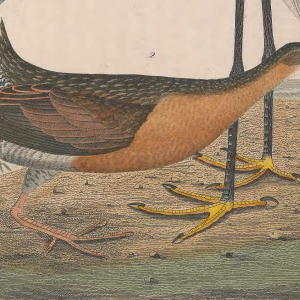
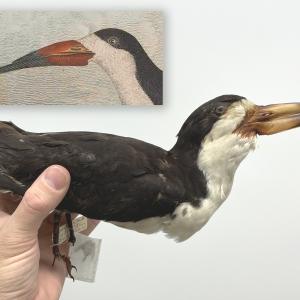
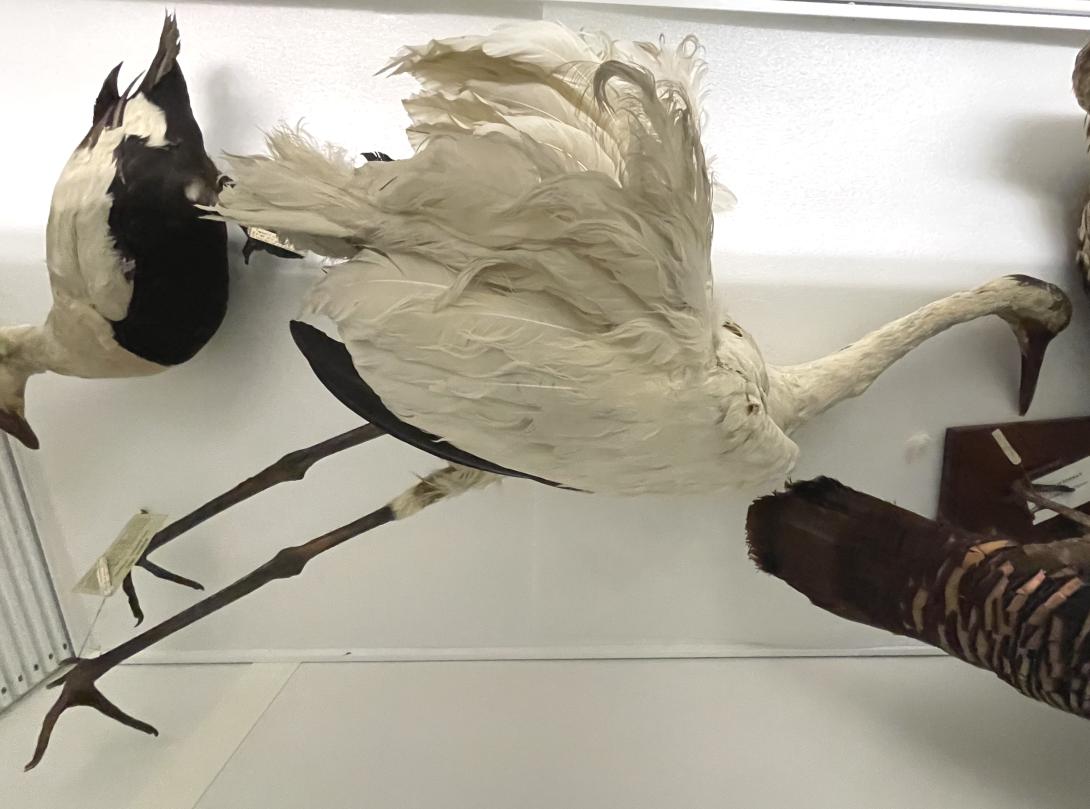
After Peale's Museum closed, a portion of Peale's bird collection was purchased in 1850 by Moses Kimball (1809–95), who displayed it at his "Boston Museum". An advertisement in the Boston Transcript, printed 1 October 1850, stated that Kimball had acquired "One Half of the celebrated Peale's Philadelphia Museum". The other half of Peale's birds had been sold to the circus promoter P. T. Barnum (1810–91) and would be subsequently destroyed in a fire at his "American Museum" in New York City in July 1865. When the Boston Museum closed, Kimball's Peale remnants passed temporarily to the Boston Society of Natural History, who disposed of them to Charles J. Maynard (1845-1929), a local taxidermist. The specimens were stored in a barn in Massachusetts for several years, then eventually were deposited at the Museum of Comparative Zoology (MCZ), Harvard University. By the time the collection was catalogued by Walter Faxon (1848-1920) at MCZ, in 1914, in virtually every case the original mounts and labels had been disassociated from the specimens, and an untold number were lost. Walter Faxon, "Relics of Peale's Museum," Bulletin of the Museum of Comparative Zoology, 59, no. 3 (July 1915): 131, contended that MCZ 67828 (shown here), a data-deficient specimen from the Boston Museum collection, "is the bird figured by Wilson." Faxon (1915) also acknowledged that, if that claim was true, then Wilson made a "bad drawing ... very poor," noting that "the wings [of Wilson's figured bird] are more closely applied to the sides than they are in the specimen." / https://www.biodiversitylibrary.org/page/6339801#page/181/mode/1up Wilson (1814: 20, American Ornithology, vol. 8) did not state whether he collected this species, or whether he used Peale's specimen as a model, stating only that "A few sometimes make their appearance in the marshes at Cape May", New Jersey. Wilson (1810: viii, vol. 2) had previously stated that "no drawings have been, or will be made for this work, from any stuffed subjects, where living specimens of the same can be procured; yet the former serve a very important purpose; they enable the author to ascertain the real existence and residence of such subjects" / https://www.biodiversitylibrary.org/item/175511#page/14/mode/1up Faxon (1915) apparently overlooked Titian Peale's "1 Whooping Crane" specimen from the Long Expedition, which was recorded in the Accessions Book on 23 March 1821 (Historical Society of Pennsylvania, coll. 0481) and the "Catalogue of Duplicate Specimens..." in May 1822 (APS Library, Mss.B.P31). However, the latter source states that this specimen was "unmounted". This lends credibility to the claim that MCZ 67828, which is mounted, was Peale's original specimen, which was "from the Capes of Delaware" according to Dr. James Mease, 1811: 312, A Picture of Philadelphia (Philadelphia: B&T Kite), a contributor to Peale's Museum. Here, for simplicity, we state that Titian R. Peale (1799-1885) deposited the Long Expedition specimens at Peale's Museum. However, it should be noted that the specimens did not belong to Titian, and were not his to give away. Officially, they were the property of the United States government, and as such were formally deposited by Major Stephen Harriman Long (1784-1864), who led the government-sponsored expedition. The Peale Museum Accessions Book, pp. 112-113 (Historical Society of Pennsylvania, coll. 0481) contains an "Invoice of Zoological Specimens and Drawings prepared by Titian Peale, Assistant Naturalist for the Exploring Expedition, and deposited in the Philadelphia Museum by Majr. S. H. Long, Maj. U.S. Engr. pursuant to instructions of the Secretary of War." At the conclusion of the invoice, "Rubens Peale [1784-1865], manager" signed the following statement: "Received, Philadelphia Museum, March 23d. 1821. of Majr. S. H. Long, the several articles, specified in the above Invoice, as a deposit for safe keeping, preservation and Exhibition; and I hereby promise, as agent for the Institution to hold the said articles subject to the orders of the War Department, thru the said Maj. Long." (HSP, coll. 0481)
Specimen Type:
Dead/preserved
Current Common Name:
Whooping Crane
Current Scientific Name
Gruidae | Grus americana
Repository:
Museum of Comparative Zoology, Harvard University (MCZ 67828)