Object Status:
Extant
Accession Date:
By 1799
Primary Source Reference:
Charles Willson Peale, Lecture on Natural History 24. (ca. 1799). Academy of Natural Sciences of Drexel University Archives, coll. 40. / https://ansp.org/research/library/archives/0000-0099/coll0040/
Additional Source Text:
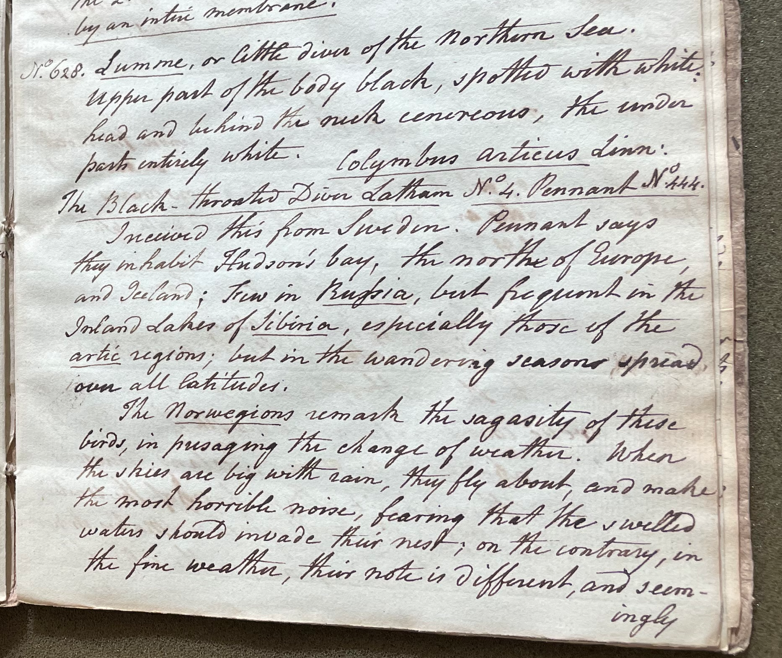
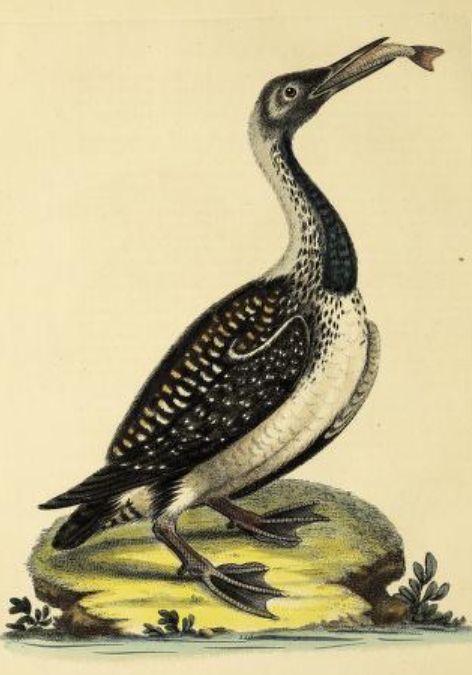
Charles Willson Peale (1741-1827) wrote, in his 24th Lecture (ca. 1799): "No. 628. Lumme, or little diver of the Northern Sea. upper part of the body black, spotted with white; head and behind the neck cinereous, the under parts entirely white. Colymbus articus Linn. The Black-throated Diver Latham No. 4. Pennant No. 444. I received this from Sweden." (Academy of Natural Sciences of Drexel University Archives, coll. 40)
Peale continued: "Pennant says they inhabit Hudson's bay, the northe of Europe, and Iceland; Few in Russia, but frequent in the Inland Lakes of Sibiria, especially those of the artic regions; but in the wandering seasons spread over all latitudes. The Norwegions remark the sagacity of these birds, in presaging the change of weather. When the skies are big with rain, they fly about, and make the most horrible noise, feating that the swelled waters should invade their nest; on the contrary, in the fine weather, their note is different, and seemingly in an exulting strain. The Norwegions think it impious to destroy, or even to disturb, this species. The swedes have less superstition; they dress the skins; which, when prepared, show in the clearest manner, on the inside, the quincuncial disposition of feathers. They are exceedingly tough, and are used for gun-cases and facings for winter caps." (ANSP Archives, coll. 40)
Peale wrote, in "A Walk Through the Philad[elphi]a Museum" (1805–1806): "The Lumme (C. Articus) or little diver of the Northern Sea is from Sweden. said to inhabit Hudsons bay, the north of Europe & Iceland. The Norwegions remark the sagasity of these birds, in presaging the change of weather. When the skies are big with rain, they fly about, and make the most terrible noise, fearing that the swelled waters should invade their nest; on the contrary, in the fine weather, their note is different, and seemingly in exulting strain. The Norwegions think it impious to destroy, or even to disturb, this species. / The Swedes have less superstition: they dress the skins which, when prepared, shew in the clearest manner, on the inside, the quincuncial disposition of feathers. They are exceedingly tough, and are used for Gun-cases & facings of winter Caps." (Historical Society of Pennsylvania, coll. 0481)
Notes:
A letter from Rev. Nicholas Collin (1746-1831) to Charles W. Peale, dated 2 June 1793, confirms that “Mr. Gustavus Von Carlson (President of one of the supreme courts of Justice) has charged himself with the exchange of Birds. This eminent ornithologist owns a precious Cabinet of Birds, containing more than 800 species; & has by testamentary disposition generously bequeathed the whole to the said [Swedish] Academy of Sciences. You will therefore be pleased to send in future the birds directly to him. He has already in return, forwarded several of the most valuable Swedish Birds…” (Miller 1988: 49, Selected Papers, Vol. 2, part 1, Yale University Press).
Specimen Type:
Dead/preserved
Current Common Name:
Black-throated Loon
Current Scientific Name
Gaviidae | Gavia arctica
Category:
Collection: