Object Status:
Unlocated
Accession Date:
By 29 August 1793
Primary Source Reference:
Charles Willson Peale, "Register of birds" in 1793 diary. American Philosophical Society Library, Peale-Sellers Family Collection (Mss.B.P31).
Additional Source Text:
Charles Willson Peale (1741-1827) wrote in a "Register [list] of birds" in his 1793 diary, during a collecting trip to Cape Henlopen, Delaware: "[29 August 1793]: Black head sea gull. I find that most of these birds have pin feathers, so that we are about 2 weeks too early to have them in hansome condition" (American Philosophical Society Library, Peale-Sellers Family Collection, Mss.B.P31).
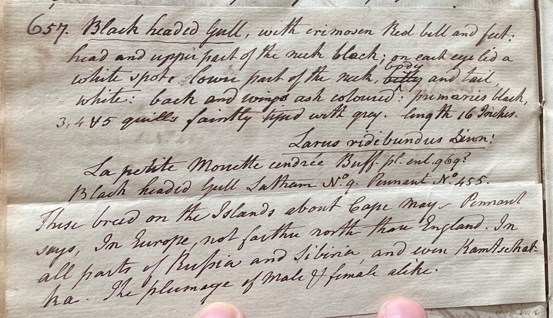
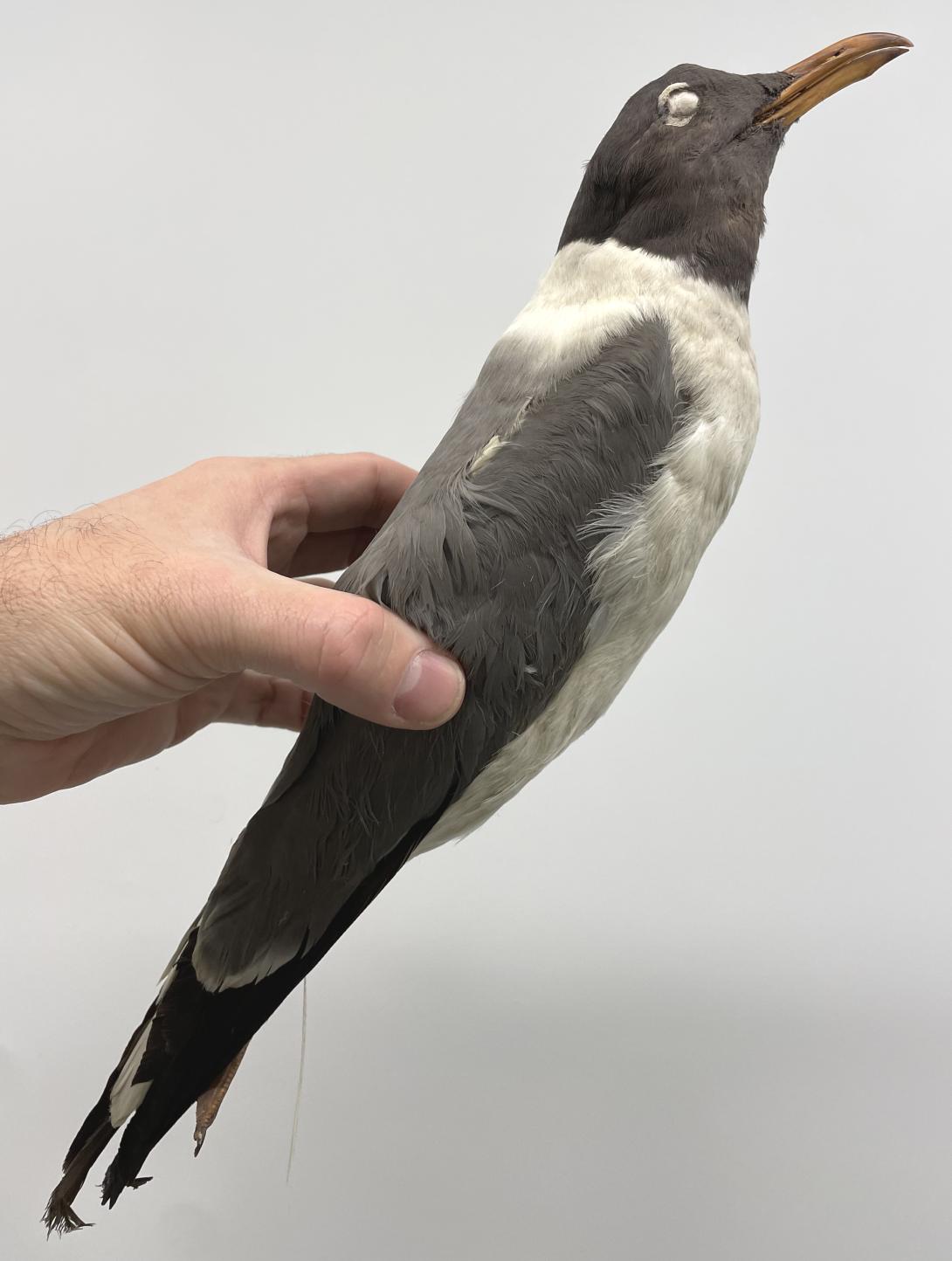
Peale wrote, in his 24th Lecture (ca. 1799): "No. 657. Black headed gull. with crimson Red bill and feet; head and upper part of the neck black; on each eyelid a white spot; lower part of the neck, belly body and tail, white; back and wings ash coloured; primaries black; 3, 4, & 5 quills faintly tipped with grey. Length 16 Inches. Larus ridibundus Linn. La petite Mouette cendrée Buff. pl. enl. 969? Black headed gull Latham No. 9. Pennant No. 455. These breed on the Islands about Cape May. Pennant says, In Europe, not farther north than England. In all parts of Russia and Sibiria, and even Kamtschatka. The plumage of Male & female alike" (Academy of Natural Sciences of Drexel University Archives, coll. 40).
Peale also described an immature bird, earlier in the same lecture, which he evidently thought was a different species: "[No.] 564. Barred Tail gull. Bill black 1 ½ Inch long; front, throat and belly breast white; back of the head and neck speckled with brown and white; a line of white above and below the Eye lids; back and upper wing coverts cinereous; sides of the breast the same, only lighter; Tail cinereous at the base, and a brown bar One inch & a half wide at the end; the outer quill on each side white; feet dusky. Found at Cape May, where they breed in June. I do not know that it is described." (ANSP Archives, coll. 40)
Alexander Wilson (1766-1813) described this species under the name "Black-headed Gull / Larus ridibundus" in American Ornithology vol. 9, published posthumously (Pl. 74), where "Peale Museum, No. 3381" was cited (Wilson 1814: 89). / https://www.biodiversitylibrary.org/item/175518#page/97/mode/1up (text) / https://www.biodiversitylibrary.org/item/175518#page/86/mode/1up (plate)
George Ord (1781-1866), who edited Wilson's posthumous volumes and published a second edition (1824-25), cited the same Peale number (3381) under the name "Laughing Gull / Larus atricilla, in Volume 9 of the second edition, known as the Supplement to the American ornithology of Alexander Wilson (1825, Philadelphia). / https://www.biodiversitylibrary.org/item/227703#page/265/mode/1up
Notes:
After Peale's Museum closed, a portion of Peale's bird collection was purchased in 1850 by Moses Kimball (1809–95), who displayed it at his "Boston Museum". An advertisement in the Boston Transcript, printed 1 October 1850, stated that Kimball had acquired "One Half of the celebrated Peale's Philadelphia Museum". The other half of Peale's birds had been sold to the circus promoter P. T. Barnum (1810–91) and would be subsequently destroyed in a fire at his "American Museum" in New York City in July 1865. When the Boston Museum closed, Kimball's Peale remnants passed temporarily to the Boston Society of Natural History, who disposed of them to Charles J. Maynard (1845-1929), a local taxidermist. The specimens were stored in a barn in Massachusetts for several years, then eventually were deposited at the Museum of Comparative Zoology (MCZ), Harvard University. By the time the collection was catalogued by Walter Faxon (1848-1920) at MCZ, in 1914, in virtually every case the original mounts and labels had been disassociated from the specimens, and an untold number were lost. Walter Faxon, "Relics of Peale's Museum," Bulletin of the Museum of Comparative Zoology, 59, no. 3 (July 1915), curiously failed to mention MCZ 76056-76058, three adult (i.e., black-headed) specimens from the Boston Museum collection, which were reportedly acquired from Peale's Museum. None of the specimens has locality data. Peale's collecting efforts at Cape Henlopen were overlooked by compilers of Delaware bird records, prior to this study (Gene K. Hess, in litt. 10 February 2024). Witmer Stone (1866-1939) was also unaware of the extent of Peale's collecting effots at Cape May, New Jersey, while preparing his classic work, Bird studies at Old Cape May, Philadelphia: Delaware Valley Ornithological Club). In his second volume, Stone (1937: 547) assumed that Wilson's (1814) posthumous account was the earliest available for this species. Peale had noted in his lecture account (ca. 1799): "These breed on the Islands about Cape May ... Found at Cape May, where they breed in June. I do not know that it is described."
Specimen Type:
Dead/preserved
Current Common Name:
Laughing Gull
Current Scientific Name
Laridae | Leucophaeus atricilla
Repository:
Museum of Comparative Zoology, Harvard University (MCZ 76056–76058)