Object Status:
Extant
Accession Date:
By 1799
Primary Source Reference:
Charles Willson Peale, Lecture on Natural History 23. (ca. 1799). Academy of Natural Sciences of Drexel University Archives, coll. 40. / https://ansp.org/research/library/archives/0000-0099/coll0040/
Additional Source Text:
Charles Willson Peale (1741-1827) wrote, in his 23rd Lecture (ca. 1799): "No. 590. Great White Pelican. plumage white with a faint rose tinct. brightest under the wings; naked face, of a flesh colour; wing quills black; feet lead colour. Pelicanus onocrotalus Linn. Great White Pelican Latham No. 1. Pennant No. 505. Le Pelican Buff. pl. enl. 87. This Pelican was shot in the mouth of Chester River Maryland. It is accidental that they are found in the Chessapeak Bay, one some years past was taken as high as the Susquehannah. They only seldom ouster into our Rivers, although they are every summer known to be along the sea coast, especially off Egg harbour. One also wandered up the Hudson as high as Albany some years ago." (Academy of Natural Sciences of Drexel University Archives, coll. 40)
Peale continued: "The Pelican, Buffon says, equals, or even surpasses the bulk of the swan, and would be the largest of all aquatic birds, were not the Albatross thicker, and the Flamingo much taller on its legs. Those of the Pelican, on the contrary, are very low; but the wings are so broad as to extend 11 or 12 feet. It therefore supports itself easily, and for a length of time, in the air. It ballances itself with alertness, and never changes its place but to dart directly downwards on its prey, which cannot escape; for the violence of the dash, and its wide-spread wings, which strike and cover the face of the water, make it boil and whirl, and at the same time stun the fish, and deprive it of flight. Such is the mode of fishing when alone; but in large flocks they vary their manoevres, and act in concert; they range themselves in a line and swim in company, forming a large circle, which they contract by degrees to inclose the fishes, and they share the capture at their convenience." (ANSP Archives, coll. 40) Peale continued: "These birds spend in fishing, the hours of the morning and evening, when the finny tribe are most in motion; and chuse the places where they are most plentiful. It is amusing to behold them sweeping the water, rising a few fathoms above it, falling with their neck extended and their sack half full; then ascending with effort to drop again, and continuing this excertion till their wide boag is intirely filled. Now they retire to eat, and digest at leisure on some cliffs, when they remain tranquil and drowsy till evening." (ANSP Archives, coll. 40)
Peale continued: "It appears to me, says Buffon, that this instinct of the Pelican, of not swallowing its prey at first, but collecting a provision, might be turned to account; and that, like the cormorant, it might be made a domestic fisher; indeed travellers affirm, that the Chinese have actively succeeded. Labat relates, that the savages trained a Pelican, which they dispatched in the morning, after having stained it red with rocou, and that it returned in the evening to their Hut with his sack full of Fish, which they made it disgorge. The Pelican carries the fish entire to its young. To disgorge the it presses the pouch against its breast; and this very natural act may have given rise to the fable so generally told, that the Pelican opens its breast to nourish its offspring with its blood." (ANSP Archives, coll. 40)
Peale continued: "I have heard that its affection to its young is so great, that if they are taken from the nest and placed in a yard joining the [Manshion], that the dame will come there to feed them. It soon becomes familiar with man. I [kept] one alive a considerable time in my yard. No bird could be tamer than [it] was, but with difficulty it was brought to eat meat." (ANSP Archives, coll. 40)
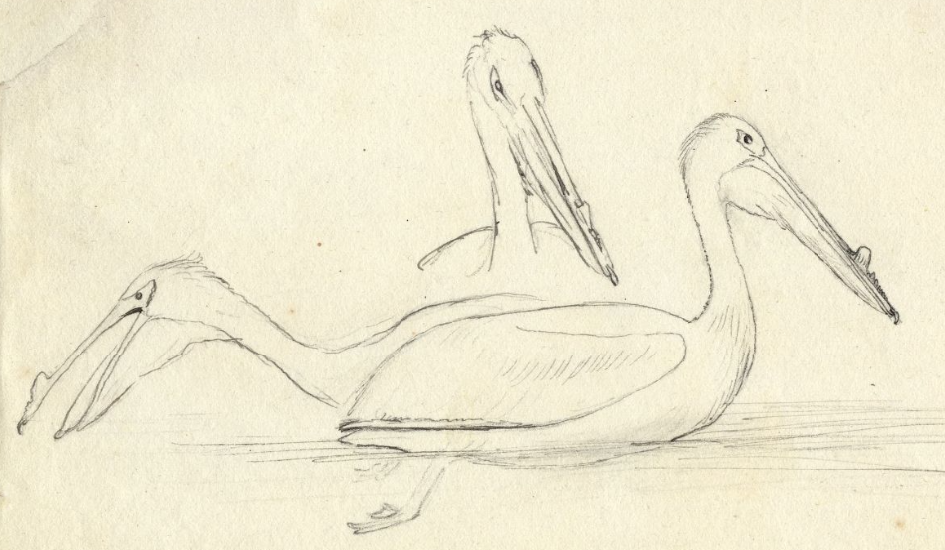
Titian Ramsay Peale (1799-1885) deposited "1 [unfinished drawing of] White Pelican" on 23 March 1821, after returning from the Long Expedition, as recorded in the Peale Museum Accessions Book (Historical Society of Pennsylvania, coll. 0481). It is not known whether a preserved skin of this bird survived the journey. However, on 9 January 1822, a notice in Poulson's American Daily Advertiser mentioned Titian's donation of a skull of a "Rough billed Pelican."
An unmounted male specimen of "Pelicanus erythrorhynchos (Rough billed Pelican)" from Missouri, possibly from the Long Expedition, was listed in "A Catalogue of Duplicate Specimens...", May 1822. [unpublished] American Philosophical Society Library (Mss.B.P31).
Notes:
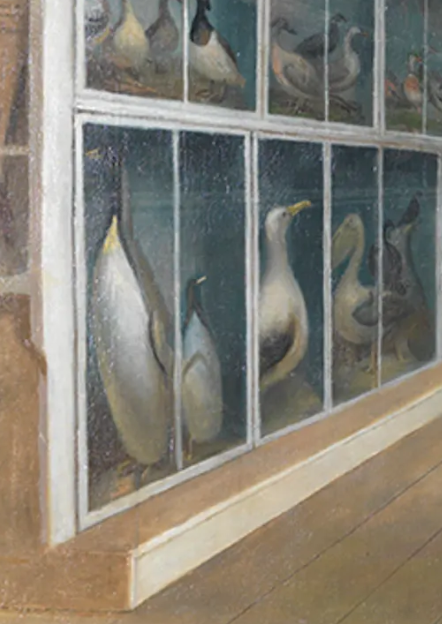
A specimen of this species is visible in C. W. Peale's "The Artist in His Museum" (1822), in the second floor-level case to the right of the door (Pennsylvania Academy of Fine Art, 1878.1.2), as shown here. Here, for simplicity, we state that Titian R. Peale (1799-1885) deposited the Long Expedition specimens at Peale's Museum. However, it should be noted that the specimens did not belong to Titian, and were not his to give away. Officially, they were the property of the United States government, and as such were formally deposited by Major Stephen Harriman Long (1784-1864), who led the government-sponsored expedition. The Peale Museum Accessions Book, pp. 112-113 (Historical Society of Pennsylvania, coll. 0481) contains an "Invoice of Zoological Specimens and Drawings prepared by Titian Peale, Assistant Naturalist for the Exploring Expedition, and deposited in the Philadelphia Museum by Majr. S. H. Long, Maj. U.S. Engr. pursuant to instructions of the Secretary of War." At the conclusion of the invoice, "Rubens Peale [1784-1865], manager" signed the following statement: "Received, Philadelphia Museum, March 23d. 1821. of Majr. S. H. Long, the several articles, specified in the above Invoice, as a deposit for safe keeping, preservation and Exhibition; and I hereby promise, as agent for the Institution to hold the said articles subject to the orders of the War Department, thru the said Maj. Long." (HSP, coll. 0481)
Specimen Type:
Live (later taxidermied)
Current Common Name:
American White Pelican
Current Scientific Name
Pelecanidae | Pelecanus erythrorhynchos