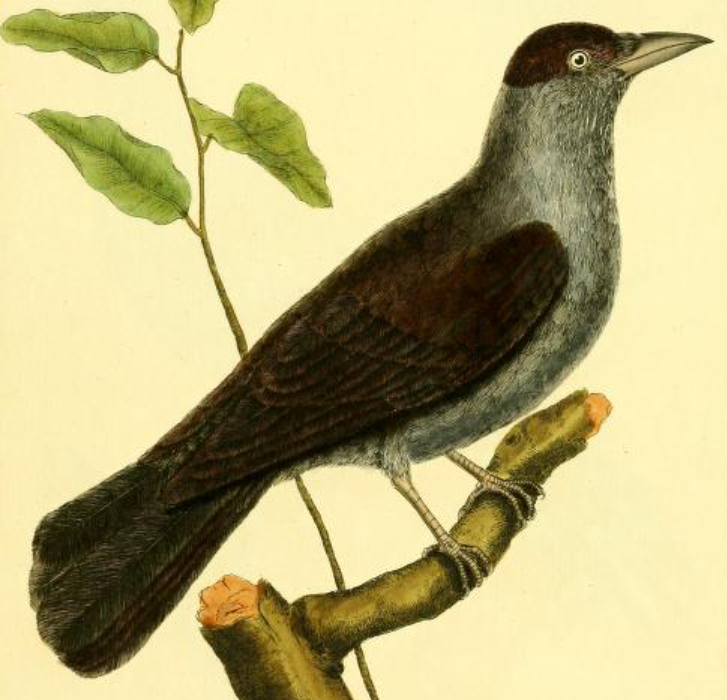
Object Status:
Extant
Accession Date:
By 1799
Primary Source Reference:
Charles Willson Peale, Lecture on Natural History 17. (ca. 1799). Academy of Natural Sciences of Drexel University Archives, coll. 40. / https://ansp.org/research/library/archives/0000-0099/coll0040/
Additional Source Text:
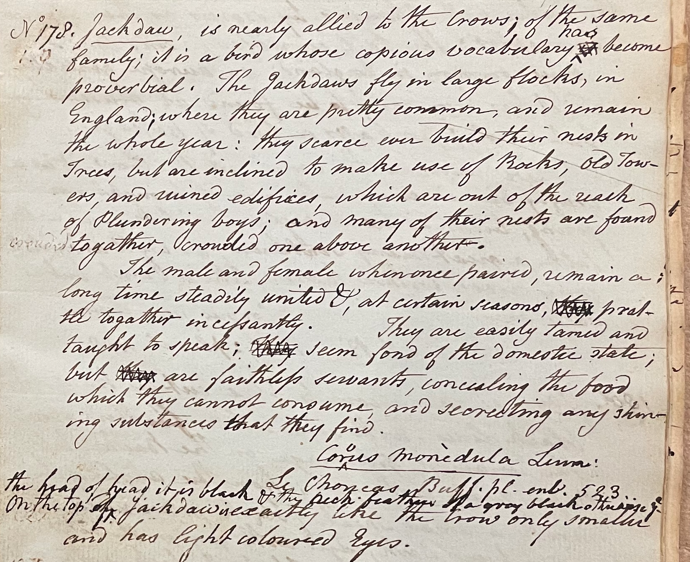
Charles Willson Peale (1741-1827) wrote, in his 17th Lecture (ca. 1799): "No. 178. Jackdaw, is nearly allied to the Crows, of the same family. It is a bird whose copious vocabulary has become proverbial. The Jackdaws fly in large flocks, in England, where they are pretty common, and remain the whole year; they scarce ever build their nests in trees, but are inclined to make use of Rocks, old towers, and ruined edifices, which are out of the reach of plundering boys; and many of their nests are found togather, crowded one above another." (Academy of Natural Sciences of Drexel University Archives, coll. 40)
Peale continued: "The male and female when once paired, remain a long time steadily united &, at certain seasons, prattle togather incessantly. They are easily tamed and taught to speak; seem fond of the domestic state; but are faithless servants, concealing the food which they cannot consume, and secreting any shining substances that they find. Corvus monèdula Linn. Le Choucas Buff. pl. enl. 523. The hind of [its] head is black & the neck feathers of a grey black. On the top the Jackdaw is exactly like the crow, only smaller and has light coloured Eyes." (ANSP Archives, coll. 40)
Peale wrote, in "A Walk Through the Philad[elphi]a Museum" (1805–1806): "the Jackdaw (Corvus Monedula) is distinguishable from our black birds by the cheeks & hind part of the head being of a greyish ash Colour." (Historical Society of Pennsylvania, coll. 0481)
Specimen Type:
Dead/preserved
Current Common Name:
Western Jackdaw
Current Scientific Name
Corvidae | Corvus monedula