Object Status:
Extant
Accession Date:
By 1799
Primary Source Reference:
Charles Willson Peale, Lecture on Natural History 24. (ca. 1799). Academy of Natural Sciences of Drexel University Archives, coll. 40. / https://ansp.org/research/library/archives/0000-0099/coll0040/
Additional Source Text:
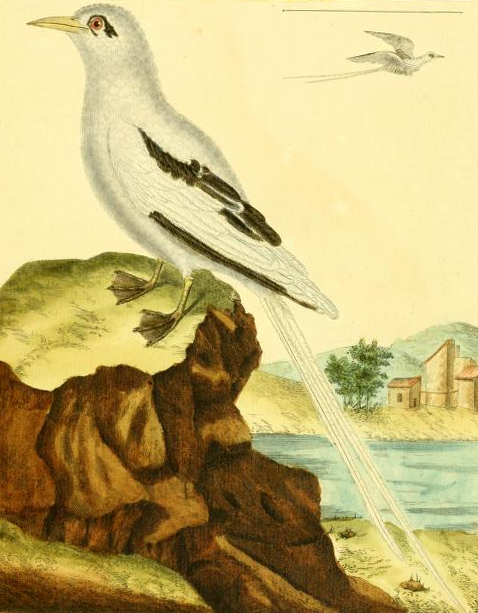
Charles Willson Peale (1741-1827) wrote, in his 24th Lecture (ca. 1799): "624. Common Tropic Bird. About the size of a Pigeon; the bill near 3 Inches long, yellow, at present, though probably red when living; the head, neck, and under parts of the body, are white; near the base of the upper mandible begins a streak of black, which curves round the upper part of the Eye, and ends a little way behind in a strait direction; the back, rump, and scapulars, are white, crossed with curved streaks of black. the lesser coverts white, some of them transversely marked with black; greater quills back, margined on the inside, with white; tail cuneiform, with 2 long feathers, shortly webbed, extending far beyond the others. Phaeton aethereus Linn. Paille en queue de l'Isle de France Buff. pl. enl. 369. Common Tropic Bird Latham No. 1. 13." (Academy of Natural Sciences of Drexel University Archives, coll. 40)
Peale continued: "These birds are sometimes observed to rest on the surface of the water; and have been now and then seen, in cam weather, upon the backs of the drowsy Tortoises, floating in the sea, so that they have been easily taken by the long boat manned. on shore they will perch on trees; and are said to breed in the woods, on the ground beneath them. As the Tropic Bird sheds the long feathers every year, the Inhabitants of such Isles as they frequent collect and make use of them by way of ornament in various manners; they are worn in the capes of the Sandwich Islanders, being in great Plenty at Taboora, as also in various parts of their dress; but in none more conspicuous than in the mourning garment of otahaite [Tahiti], in which Island numbers are picked up in the mountainous parts, where it also breeds. their flesh cannot be called good, but was found sufficiently acceptable to those who had long been confined to salt provisions, and in which circumstances the sailors did not dispise it." (ANSP Archives, coll. 40)
Peale wrote, in "A Walk Through the Philad[elphi]a Museum" (1805–1806): "The tail of the next genus Phaeton or Tropic bird, is equally striking as the darters long neck. They chiefly live within the Tropics, and are often seen upon the backs of sleeping Tortoises. They are poetically said to attend the Car of the Sun under the burning Zone, defined by the Tropics: flying perpetually amid the tepid Zephers, without straying beyond the virge of the eliptic, it informs the navigation of his approach to the flaming barriers of the Solar track. / Here are some variety of this small family — No. [blank] was taken off its nest by the Gentleman who presented it to the Museum." (Historical Society of Pennsylvania, coll. 0481)
There are several donations in the Peale Museum Accessions Ledger that presumably refer to specimens of this species, including "A Tropic bird" donated by "Capt. Farris" on 17 February 1806, a "Phaeton Aethereus or Tropic bird. Female" donated by F. V. Riviere on 21 Feb 1806, and a "Tropic bird" donated by Captain J. W. Cox on 17 April 1807. (Historical Society of Pennsylvania, coll. 0481)
Specimen Type:
Dead/preserved
Current Common Name:
White-tailed Tropicbird
Current Scientific Name
Phaethontidae | Phaeton lepturus