Object Status:
Extant
Accession Date:
By 1799
Primary Source Reference:
Charles Willson Peale, Lecture on Natural History 29. (ca. 1799). Academy of Natural Sciences of Drexel University Archives, coll. 40. / https://ansp.org/research/library/archives/0000-0099/coll0040/
Additional Source Text:
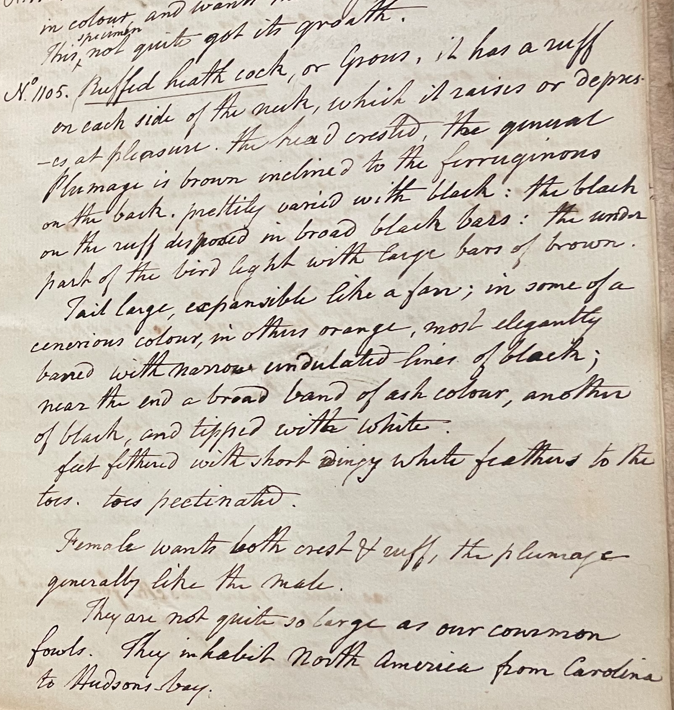
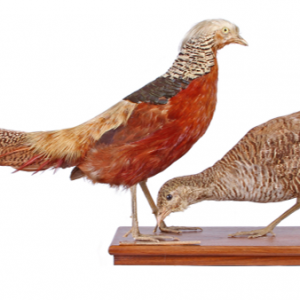
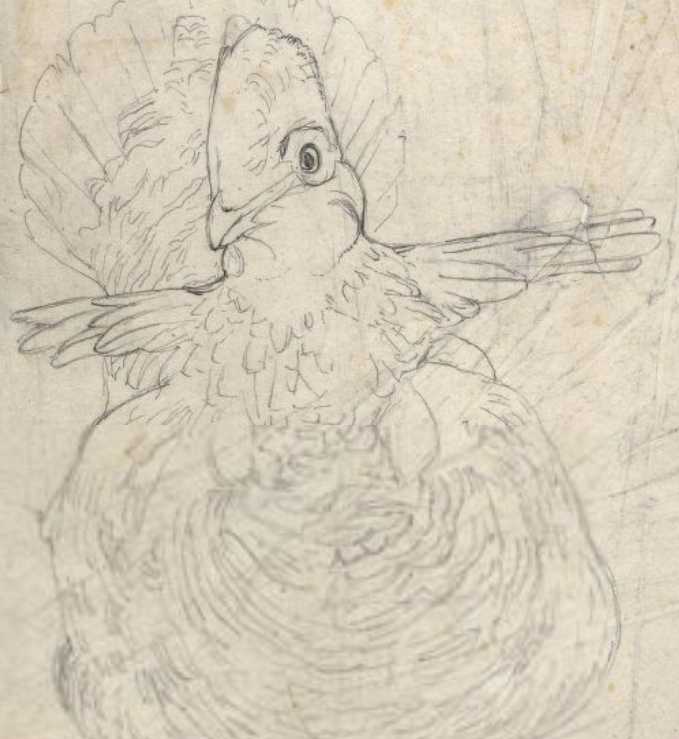
Charles Willson Peale (1741-1827) wrote, in his 29th Lecture (ca. 1799): "No. 1105. Ruffed heath cock, or Grous. It has a ruff on each side of the neck, which it raises or depresses at pleasure; the head crested; the general plumage is brown inclined to the ferruginous on the back, prettily varies with black; the black on the ruff [dispersed] in broad black bars; the under part of the bird light with large bars of brown; tail large, expansible like a fan; in some of a cenerious colour, in others range, most elegantly barred with narrow undulated lines of black; near the end a broad band of ash colour, another of black and tipped with white; feet feathered with short dingy white feathers to the toes; toes pectinated. Female wants both crest & ruff, the plumage generally like the male. They are not quite so large as our common fowls. They inhabit North America from Carolina to Hudsons Bay." (Academy of Natural Sciences of Drexel University Archives, coll. 40)
Peale continued: "A letter of Mr. Bartram to Mr. Edwards [quoted by the latter man] describes their manners very accurately: 'It is (says Mr. B.) a fine bird when his gaity is displayed; that is, when he spreads his tail like that of a turkey cock, and erects a circle of feathers round his neck like a ruff, walking very stately with an even pace, and making a noise something like a Turkey; at which time the hunter must fire immediately at him, or he flies away directly 2 or 3 hundred yards, before he lights on the ground. There is something very remarkable in what we call thumping; which they do with their wings, by clapping them against their sides, as the hunters say. They stand on old fallen tree, that has lain for many years on the ground, where they begin their strokes gradually, at about two seconds of time distant from each other, and repeat them quicker and quicker, until they make a noise like thunder at a distance; which continues, from the beginning, about a minut; then ceaseth for about 6 or 8 minutes before it begins again. The sound is heard near half a mile, by which means they are discovered by the hunters, and many of them killed. I have shot many of them in this position, but never saw them thump; they mostly see me first, and so left off. They commonly exercise in thumping spring and fall, at about nine or ten in the morning, and four or five in the afternoon. Their food is chiefly berries and seeds of the country; their flesh is white, and choise food. I believe they breed but once a year, in the spring, and hatch twelve or fourteen at a brood; which keep in company till the spring the following. Many have attempted to raise the young ones, and to tame them; but to no purpose. When hatched under a hen, they escape into the woods soon after they are hatched, where they find means to subsist, or perish.' (ANSP Archives, coll. 40)
Peale continued: "At some seasons of the year, they feed on the Laurel, and it is supposed, that at such times it is unsafe to eat them, altho the Laurel distilled makes a most deadly poison, yet as the Bird after eating them thrives, and I believe they have too much sense to eat any thing hurtful to them. If the internal parts are well cleaned, it is not probable that any injury will arise from our eating the flesh of this bird. Tetrao umbellus Linn. Coq de brayire à paise Buff. Ruffed Heathcock Pennant & Edwards. Ruffed Grouse Latham p. 738." (ANSP Archives, coll. 40)
Peale wrote, in "A Walk Through the Philad[elphi]a Museum" (1805–1806): "The Ruffed heath cock (T. Umbellus) is commonly called here a Pheasant. They inhabit North America from Carolina to Hudsons bay. The thumping as it is called of these birds, is curious — They stand on stump or fallen old tree, and beat with their wings against their sides, so loud as to heard at a considerable distance. At some seasons of the year they feed on the Laurel, it is supposed at such times it is unsafe to eat them, as the Laurel when distilled make a most deadly poison. / The female is without the Ruff — she is sometimes seen with a number of Chickens [sic] of like these following her in the woods and when frightened they scatter and hide themselves under leaves." (Historical Society of Pennsylvania, coll. 0481)
An undated list of 21 bird specimens in Peale's handwriting includes an unidentified "Grouse" (American Philosophical Society Library, Mss.B.P31).
Alexander Wilson (1766-1813) described this species under the name "Ruffed Grous / Tetrao umbellus" in American Ornithology vol. 6 (Pl. 49), where "Peale's Museum, No. 4702" was cited (Wilson 1812: 45). / https://www.biodiversitylibrary.org/item/175484#page/65/mode/1up (text) / https://www.biodiversitylibrary.org/item/175484#page/64/mode/1up (plate)
Notes:
Peale used the common name "Ruffed Heath Cock" of Edwards, G. (1758). Gleanings of Natural History Part 1, Plate 248. / https://www.biodiversitylibrary.org/item/258100#page/168/mode/1up
Specimen Type:
Dead/preserved
Current Common Name:
Ruffed Grouse
Current Scientific Name
Phasianidae | Bonasa umbellus