Object Status:
Extant
Accession Date:
By 1799
Primary Source Reference:
Charles Willson Peale, Lecture on Natural History 17. (ca. 1799). Academy of Natural Sciences of Drexel University Archives, coll. 40. / https://ansp.org/research/library/archives/0000-0099/coll0040/
Additional Source Text:
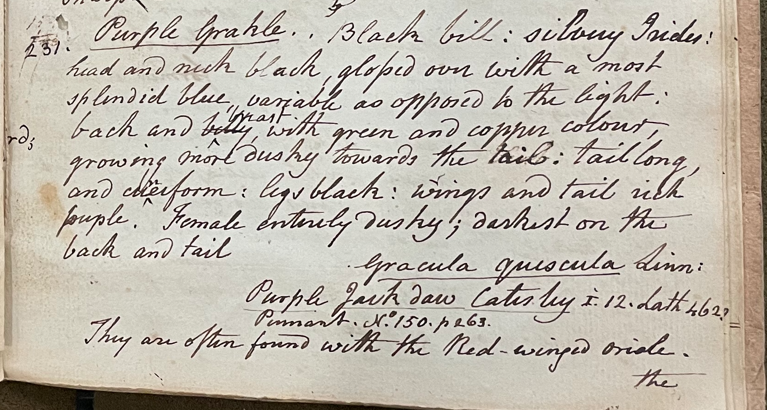
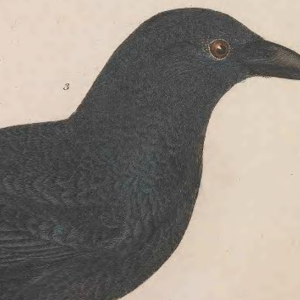
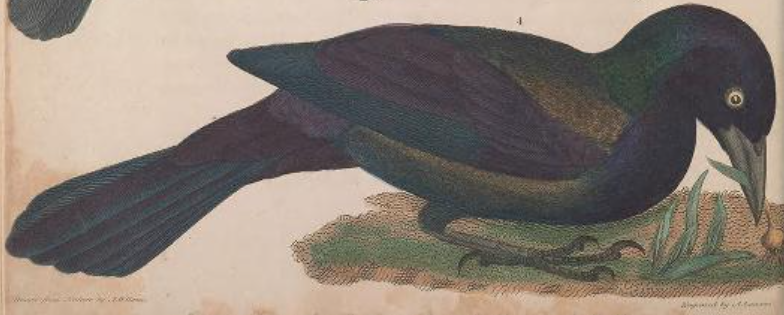
Charles Willson Peale (1741-1827) wrote, in his 17th Lecture (ca. 1799): "No. 231. Purple Grakle. Black bill; silvery irides; head and neck black, glossed voer with a most splendid blue, variable as opposed to the light; back and belly breast with green and copper colour, growing more dusky towards the tail; tail long, and cuneiform; legs black; wings & tail rich purple. Female entirely dusky, darkest on the back and tail. Gracula quiscula Linn. Purple Jackdaw Catesby I. 12. Lath. 462. Pennant No. 150. p. 263. They are often found with the Red-winged Oriole, the red-winged blackbird [i.e., Agelaius phoeniceus]. These are all commonly called blackbirds." (Academy of Natural Sciences of Drexel University Archives, coll. 40)
Peale continued, with a lengthy quote taken from Thomas Pennant, 1785, Arctic Zoology vol. 2, p. 256 (London: Henry Hughs): "Pennant speaking of the red wing black bird, says, 'The farmers sometimes attempt their destruction, by steeping maise in a decoction of white halebore before they plant it. The birds which eat this prepared corn are seized with a vertigo, and fall down; which sometimes drives the rest away. This potion is particularly aimed against the Purple Grakles, or Purple Jackdaw, which consorts in myriads with this species (Marsh-blackbird) as if in conspiracy against the labours of the husband-man. Some of the colours (continues Pennant) have established a reward of 3 pence a doz. for the [extermination] of the jackdaws; and in New England, the intent was almost effected, to the cost of the inhabitants, who at length discovered that providence had not formed even these seemingly distructive birds in vain. Notwithstanding they caused such havock among the grain, they made ample recompence by clearing the ground of noxious worms (the caterpillar of the Bruchus pisi, or Pease beetle, in particular, see Kalm I. 173. 176) with which it abounds. As soon as the birds were destroyed, the reptiles had full leave to multiply; the consequence was the total loss of the grass, in 1749; when the New Englanders, late repentants, were obliged to get their Hay from Pennsylvania, and even from Great Britain'." Peale then concluded, in his own words: "They migrate from the northern to the southern states at the approach of winter, but continue in Carolina the whole year. They are also found in Mexico, and in the Island of Jamaica. 232. Female." (ANSP Archives, coll. 40)
Peale wrote, in "A Walk Through the Philad[elphi]a Museum" (1805–1806): "The Purple Grakle (Gracula quiscula) is an american bird, which often resorts with the redwing Oriole, and are troublesome to farmers at the time of planting Corn (maise). Mr. Pennant says a reward was given for the extirpation of Jackdaws; and in new England, the intent was almost effected, to the cost of the inhabitants; who at length discovered that providence had not formed even these seemingly distructive birds in vain. Notwithstanding they cause such havock among the grain, they made ample recompence, by cleaning the ground of noxious Worms with which it abounds as soon as the birds were destroyed, the reptiles had full leave to multiply; the consequence was the total loss of the grass, in 1749; when the new Englanders, late repentants, were obliged to get their Hay from Pennsylvania, and even from great Britain. They migrate from the Northern to the southern states at the approach of winter, but continue in Carolina the whole year. They are also found in Mexico, and in the Island of Jamaica." (Historical Society of Pennsylvania, coll. 0481)
Alexander Wilson (1766-1813) described a male of this species under the name "Purple Grakle / Gracula quiscala" in American Ornithology vol. 3 (Pl. 21), where "Peale's Museum, No. 1582" was cited (Wilson (1811: 44). / https://www.biodiversitylibrary.org/item/175516#page/54/mode/1up (text) / https://www.biodiversitylibrary.org/item/175516#page/42/mode/1up (plate)
Charles Lucien Bonaparte (1803-1857) described this species under the name "Common Crow-Blackbird Quiscalus versicolor in his continuation of American Ornithology vol. 1 (1825, Pl. 5), where "Peale's Museum, No. 1578, Male; [and] No. 1579, Female; [and] No. 1602, whitish variety" were cited (Bonaparte 1825: 42). / https://search.library.wisc.edu/digital/AFKPEJIASN54OC8L/pages/ATO2KNTR…
Specimen Type:
Dead/preserved
Current Common Name:
Common Grackle
Current Scientific Name
Icteridae | Quiscalus quiscula