Object Status:
Extant
Accession Date:
By 1799
Primary Source Reference:
Charles Willson Peale, Lecture on Natural History 19. (ca. 1799). Academy of Natural Sciences of Drexel University Archives, coll. 40. / https://ansp.org/research/library/archives/0000-0099/coll0040/
Additional Source Text:
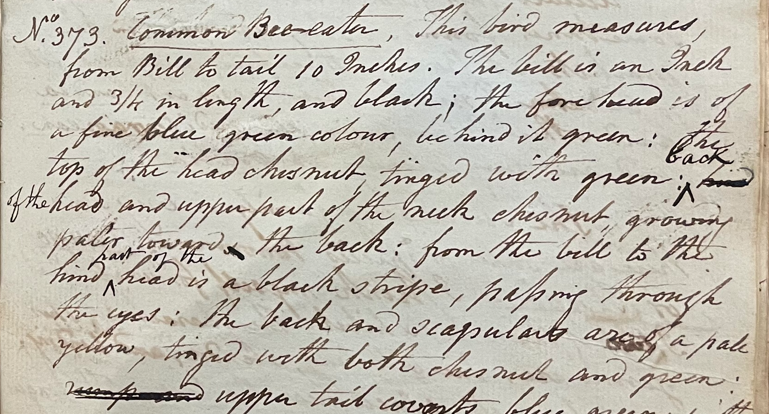
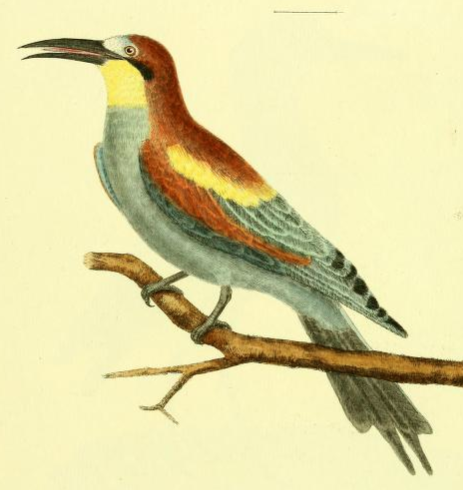
Charles Willson Peale (1741-1827) wrote, in his 19th Lecture (ca. 1799): "373. Common Bee-eater. This bird measures, from Bill to tail, 10 Inches. The bill is an Inch and ¾ in length, and black; the forehead is of a fine blue-green colour, behind it green; the back, top of the head chesnut, tinged with green; the back of the head and upper part of the neck chesnut, growing paler toward the back; from the bill to the hind part of the head is a black stripe, passing through the eyes; the back and scapulars are a pale yellow, tinged with both chesnut and green; upper tail coverts blue green with a yellowish tinge; the throat is yellow; the under parts of the body blue green; wing coverts dull green and Rufous; quills sea green & Rufous, the 2 middle feathers exceed the outer ones by ¾ of an Inch." (Academy of Natural Sciences of Drexel University Archives, coll. 40)
Peale continued: "Merops apiaster Linn. Le guêpier Buff. pl. enl. 938. Common Bee-eater Latham. I received this [specimen] from Sweden where they are sometimes found. They are seen in the markets at Rome, therefore supposed fit to be eaten. They make their nests at Candia and other Islands in the Mediterranean, and are very plenty at Arabia." (ANSP Archives, coll. 40)
Peale wrote, in "A Walk Through the Philad[elphi]a Museum" (1805–1806): "And nearly allied to Kingfishers is the genus Merops, Bee-eater. They also make their nests in holes on banks of rivers. But in their food they differ. The Bee-eaters are particularly [fond] of wasps and Bees whence its name. / They gay contrasted colours of these specimens, large as well as small, are so distinct as almost to give them the appearance of being painted, and they are rendered still more striking when we compare them with the brown dress, and naked head of the Horned Bee-eater (M. corniculatus) [i.e., Noisy Friarbird, Philemon corniculatus—not actually a bee-eater], all of them are from New Holland except the Common Bee-eater (M. apiaster) No. 2250 & 2251. They inhabit Europe as well as Assia and Africa." (Historical Society of Pennsylvania, coll. 0481)
Notes:
A letter from Rev. Nicholas Collin (1746-1831) to Charles W. Peale, dated 2 June 1793, confirms that “Mr. Gustavus Von Carlson (President of one of the supreme courts of Justice) has charged himself with the exchange of Birds. This eminent ornithologist owns a precious Cabinet of Birds, containing more than 800 species; & has by testamentary disposition generously bequeathed the whole to the said [Swedish] Academy of Sciences. You will therefore be pleased to send in future the birds directly to him. He has already in return, forwarded several of the most valuable Swedish Birds…” (Miller 1988: 49, Selected Papers, Vol. 2, part 1, Yale University Press).
Specimen Type:
Dead/preserved
Current Common Name:
European Bee-eater
Current Scientific Name
Meropidae | Merops apiaster