Object Status:
Extant
Accession Date:
By 1799
Primary Source Reference:
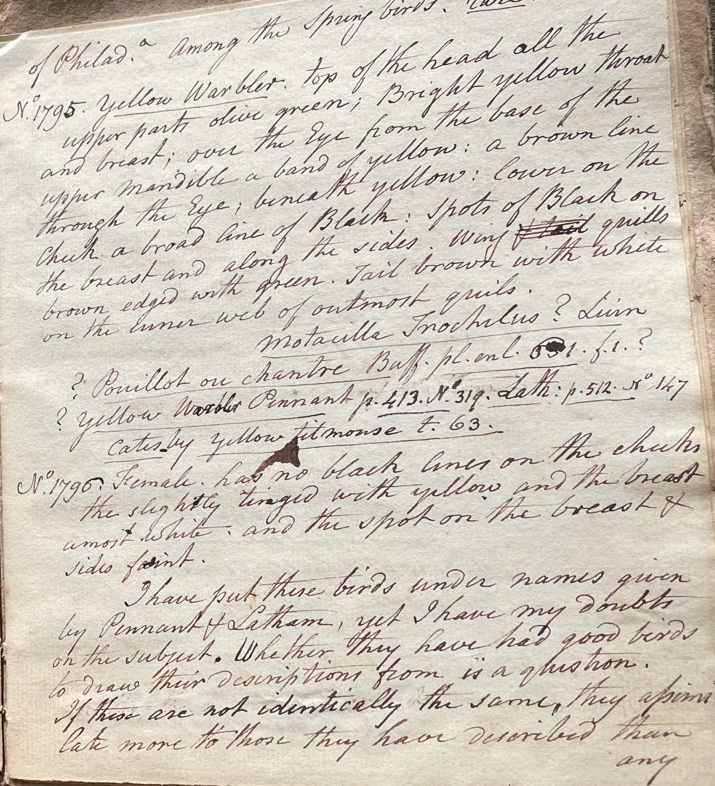
Charles Willson Peale, Lecture on Natural History 36. (ca. 1799). Academy of Natural Sciences of Drexel University Archives, coll. 40. / https://ansp.org/research/library/archives/0000-0099/coll0040/
Additional Source Text:
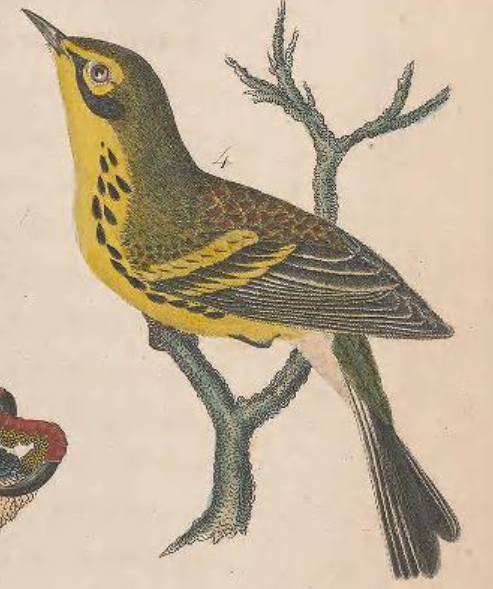
Charles Willson Peale (1741-1827) wrote, in his 36th Lecture (ca. 1799): "No. 1795. Yellow Warbler. top of the head all the upper parts olive green; Bright yellow throat and breast; over the Eye from the base of the upper mandible a band of yellow; a brown line through the Eye; beneath yellow; lower on the cheek a broad line of Black; spots of Black on the breast and along the sides; wing quills brown edged with green; tail brown with white on the inner web of outmost quills. Motacilla trochilus? Linn. ? Pouillot ou chantre Buff. pl. enl. 631. f. 1. ? ? Yellow Warbler Pennant p. 413. No. 319. Lath. P. 512. No. 147 Catesby Yellow titmouse t. 63. No. 1796. Female, has no black lines on the cheeks, […] slightly tinged with yellow and the breast almost white; and the [spots] on the breast & sides faint." (Academy of Natural Sciences of Drexel University Archives, coll. 40)
Peale continued: "I have put these birds under names given by Pennant & Latham, yet I have my doubts on the subject. Whether they have had good birds to draw their descriptions from is a question. If these are not identically the same, they assimilate more to those they have described than any other I have meet with. Mr. Pennant says they "Inhabit North Carolina; breeds there, and disappears in Winter, retiring to Jamaica and other Islands. It is […] he says, almost an universal bird found in most parts of Europe. Bears all climates from the East Indies rope. Feeds on Insects." A comparative view of these birds will be [the] only way to elucidate this subject, and when my collection is more complete. If I do not those that follow me may know whether our birds & the Europeans are the same. I confess I doubt it." (ANSP Archives, coll. 40)
Alexander Wilson (1766-1813) described this species under the name "Prairie Warbler / Sylvia minuta" in American Ornithology vol. 3 (Pl. 25), where "Peale's Museum, No. 7784" was cited (Wilson 1811: 87). / https://www.biodiversitylibrary.org/item/175516#page/105/mode/1up (text) / https://www.biodiversitylibrary.org/item/175516#page/97/mode/1up (plate)
Notes:
Peale's description in the 36th Lecture is a close match for Prairie Warbler, and does not match any other species; the only missing character is the reddish streaks on the back.
Specimen Type:
Dead/preserved
Current Common Name:
Prairie Warbler
Current Scientific Name
Parulidae | Setophaga discolor