Object Status:
Extant
Accession Date:
By 1799
Primary Source Reference:
Charles Willson Peale, Lecture on Natural History 34. (ca. 1799). Academy of Natural Sciences of Drexel University Archives, coll. 40. / https://ansp.org/research/library/archives/0000-0099/coll0040/
Additional Source Text:
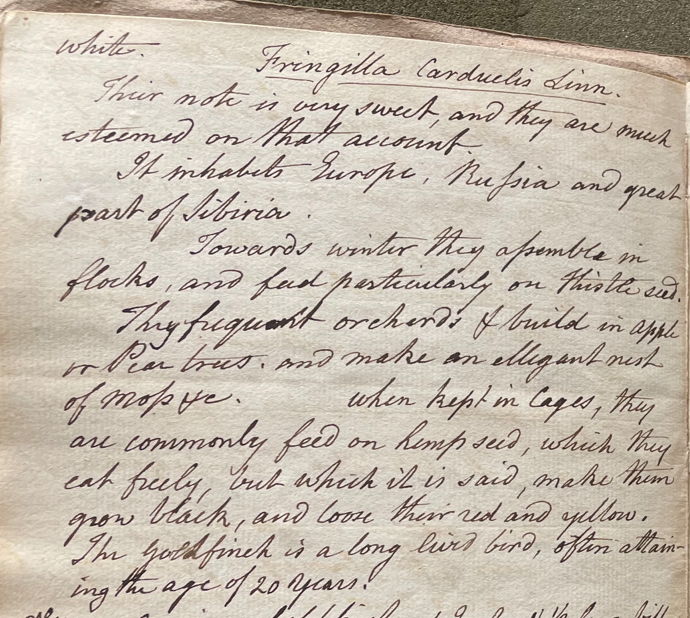
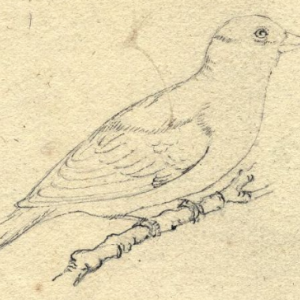
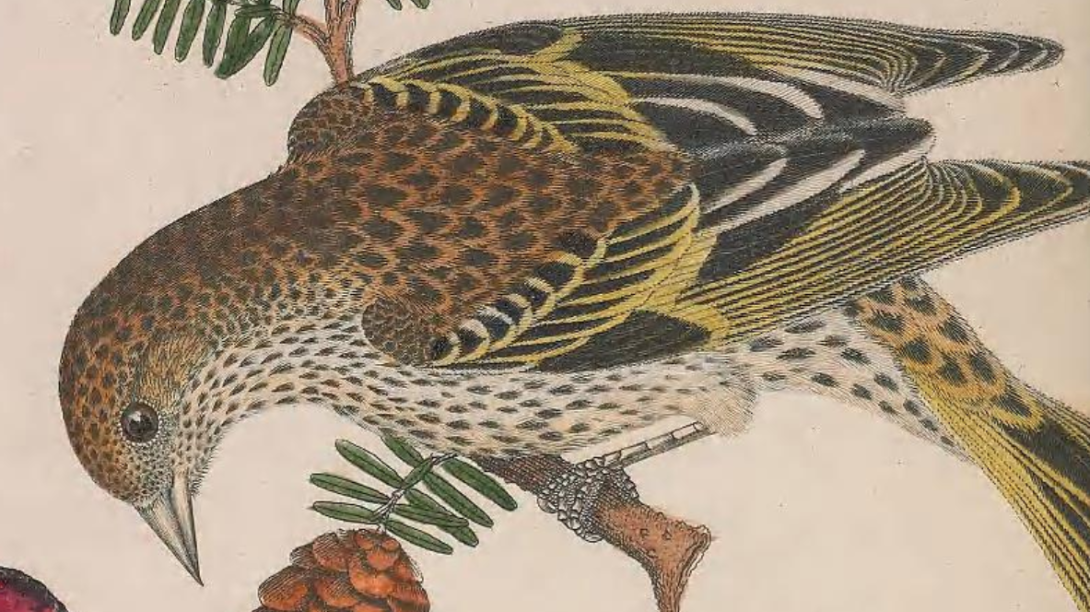
Charles Willson Peale (1741-1827) wrote, in his 34th Lecture (ca. 1799): "No. 1569. Goldfinch, or Thistlefinch. It is considered as the most beautiful of European hard-billed small birds. The bill is white tipt with black; the base of the bill encircled with rich scarlet; cheeks white; crown black. Primaries dusky marked with a rich yellow spot. Tail black tipt with white. Fringilla carduelis Linn. Their note is very sweet, and they are much esteemed on that account. It inhabits Europe, Russia and great part of Sibiria. Towards winter they assemble in flocks, and feed particularly on Thistle seed. They frequent orchards & build in apple or pear trees, and make an elligant nest of moss &c. When kept in Cages, they are commonly feed on hempseed, which they eat freely, but which it is said, make them grow black, and loose their red and yellow. The goldfinch is a long lived bird, often attaining the age of 20 years." (Academy of Natural Sciences of Drexel University Archives, coll. 40)
Peale wrote, in "A Walk Through the Philad[elphi]a Museum" (1805–1806): "In the first Case we see a variety of the Sparrows of Europe; The European Goldfinch (F. Carduelis) is [conspicuous] by its contrast of bright colours. next to it varieties of those charming Songsters the Canary birds (F. Canaria). It is deserving of remark that Birds domesticated are generally very subject to produce varieties, which is not the case in the State of Nature." (Historical Society of Pennsylvania, coll. 0481)
A mounted specimen of "Fringilla carduelis (Gold finch)" from Europe was listed in "A Catalogue of Duplicate Specimens...", May 1822. [unpublished] American Philosophical Society Library (Mss.B.P31).
Specimen Type:
Dead/preserved
Current Common Name:
European Goldfinch
Current Scientific Name
Fringillidae | Carduelis carduelis