Object Status:
Extant
Accession Date:
By 1799
Primary Source Reference:
Charles Willson Peale, Lecture on Natural History 36. (ca. 1799). Academy of Natural Sciences of Drexel University Archives, coll. 40. / https://ansp.org/research/library/archives/0000-0099/coll0040/
Additional Source Text:
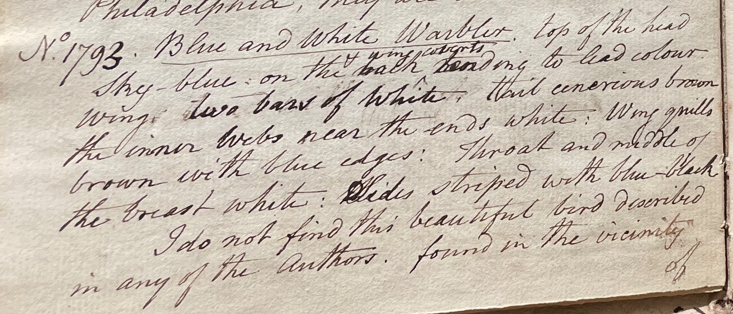
Charles Willson Peale (1741-1827) wrote, in his 36th Lecture (ca. 1799): "No. 1793. Blue and White Warbler. top of the head sky-blue; on the back & wings tending to lead colour; wing [with] two bars of white; tail cenerious brown, the inner webs near the ends white; wing quills brown with blue edges; throat and middle of the breast white; sides striped with blue-black. I do not find this beautiful bird described in any of the Authors. found in the vicinity of Philad[elphi]a. Among the spring birds. Rare." (Academy of Natural Sciences of Drexel University Archives, coll. 40)
According to Burns (1932: 29, Wils. Bull. 44: 23–35), Peale wrote in (a now unlocated page of) "A Walk Through the Philad[elphi]a Museum" (1805–1806): "Blue and white warbler, also a nondescript, a beautiful bird, rare." An extant draft copy reads: "Blue & White Warbler (also nondescript & beautiful bird)." (Historical Society of Pennsylvania, coll. 0481)
Alexander Wilson (1766-1813) described this species under the name "Caerulean Warbler / Sylvia cerulea" in American Ornithology vol. 2 (Pl. 17), where "Peale's Museum No. 7309" was cited (Wilson 1810: 138). Wilson wrote: "Except my friend Mr. Peale, I know of no other naturalist who seems to have hitherto known of its existence." / https://www.biodiversitylibrary.org/item/175511#page/161/mode/1up (text) / https://www.biodiversitylibrary.org/item/175511#page/152/mode/1up (plate)
Wilson (1811) also described an immature individual under the name "Blue-green Warbler / Sylvia rara" in American Ornithology vol. 3 (Pl. 27), where "Peale's Museum No. 7788" was cited. Of this specimen, he stated that it was "the only one of its sort I have yet met with, [it was] shot on the banks of the Cumberland river [Tennessee], about the beginning of April … whether male or female I am uncertain … the specimen has been deposited in Mr. Peale's museum." (Wilson 1811: 119) / https://www.biodiversitylibrary.org/item/175516#page/141/mode/1up
Titian Ramsay Peale (1799-1885) or Thomas Say (1787-1834) collected a male at Engineer Cantonment in May 1820, during the Long Expedition, which was described by Say under the name "Sylvia bifasciata" in Edwin James, 1823, Account of an Expedition from Pittsburgh to the Rocky Mountains..., vol. 1, p. 170 (Philadelphia). Say (in James 1823) wrote: "This species seems to approach very closely to S. caerulea." / https://www.biodiversitylibrary.org/item/124314#page/188/mode/1up
Charles Lucien Bonaparte (1803-1857) described an adult female under the name "Coerulean Warbler / Sylvia azurea" in his continuation of American Ornithology vol. 2 (1828, Pl. 11), where he treated S. bifasciata Say, 1823, and "S. coerulea" [sic] Wilson, 1811, as synonyms of S. azurea Stephens. Bonaparte (1828: 27) cited "Peale's Museum, No. 7309, Male; [and] No. 7310, Female." His plate was based on a drawing by Alexander Rider, engraved by Alexander Lawson (ca. 1772-1846). / https://search.library.wisc.edu/digital/AFKPEJIASN54OC8L/pages/ATBWVO2N…
Bonaparte (1828: 27) wrote: "The merit of having discovered this bird [species], is entirely due to the Peale family, whose exertions have contributed so largely to extend the limits of Natural History. The male, which he has accurately described, and figured, was made known to Wilson by the late venerable Charles Willson Peale, who alone, and unaided, accomplished an enterprise, in the formation of the Philadelphia Museum, that could hardly have been exceeded under the fostering hand of the most powerful government. To the no less zealous researches of Mr. Titian Peale, the discovery of the female is recently owing, who moreover evinced its sagacity by determining its affinities, and pointing out its true place in the system … the specimen here presented [Peale Museum, No. 7310] was procured on the banks of the Schuylkill [river], near Mantua village, on the first of August, 1825" (Bonaparte 1828: 27). Mantua is now considered a neighborhood of Philadelphia.
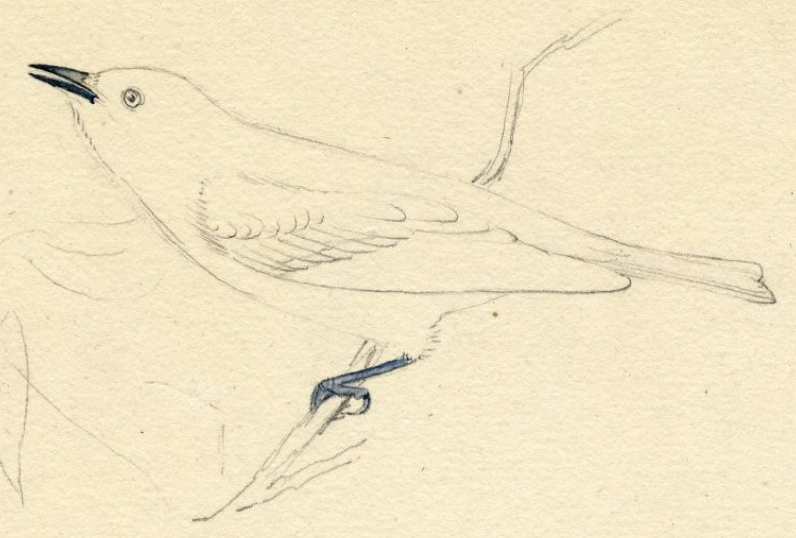
Titian created an unfinished sketch of the Mantua specimen (shown here), which is extant in the American Philosophical Society Library (Mss.B.P.31.15d). It is unknown why Titian did not complete this drawing, or why Rider's drawing was chosen to be the model for Bonaparte's (1828) plate. Titian's drawing was executed on wove paper with no watermark and bears the following inscription: "summer dress of / female Caerulean Warbler / shot Aug. 1st 1825 dear Mantua / length 4 3/4 in; Extent 8 1/4 inches / It [was] warbling in a [...] note not unlike the voice of blue grey flycatcher [i.e., Blue-gray Gnatcatcher, Polioptila caerulea]" (APS Library, Mss.B.P.31.15d)
Specimen Type:
Dead/preserved
Current Common Name:
Cerulean Warbler
Current Scientific Name
Parulidae | Setophaga cerulea