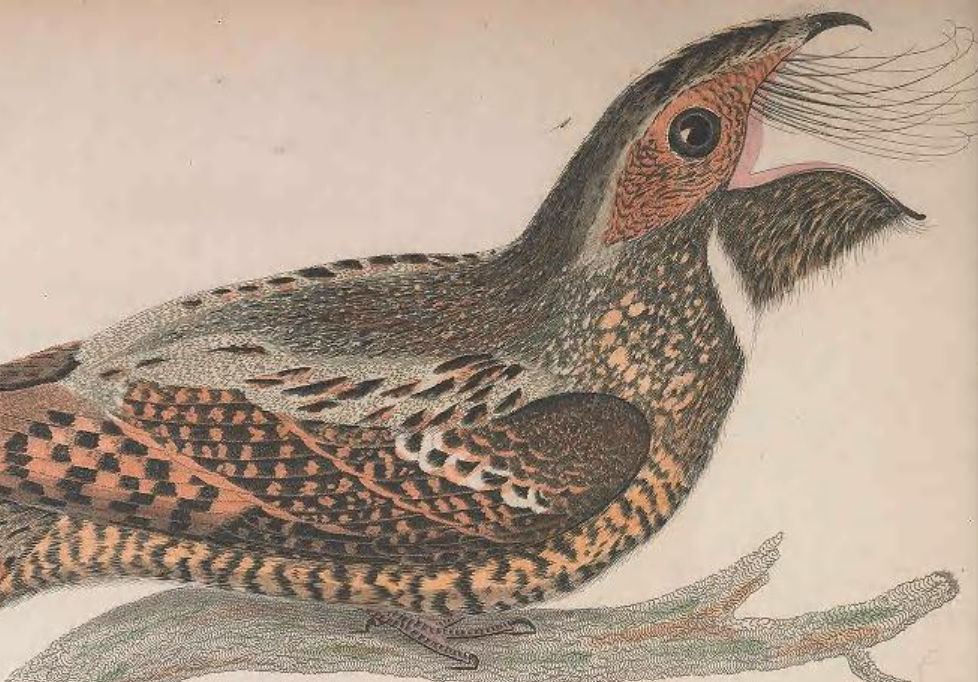
Object Status:
Extant
Accession Date:
By 1799
Primary Source Reference:
Charles Willson Peale, Lecture on Natural History 39. (ca. 1799). Academy of Natural Sciences of Drexel University Archives, coll. 40. / https://ansp.org/research/library/archives/0000-0099/coll0040/
Additional Source Text:
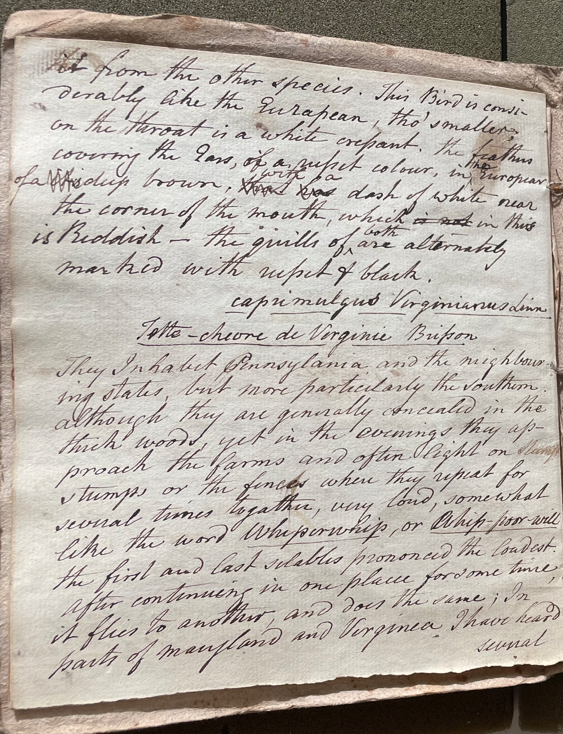
Charles Willson Peale (1741-1827) wrote, in his 39th Lecture (ca. 1799): "No. 1975. Whip-poor-will. I rather chuse to retain this common name, since it is considerably like the notes of this bird, and also distinguishes it from the other species. This bird is considerably like the European [Nightjar, Caprimulgus europaeus], tho' smaller. On the throat is a white cressent; the feathers covering the Ears, of a russet colour, in the European of a deep brown, with a dash of white near the corner of the mouth, which in this is Reddish. The quills of both are alternately marked with russet & black. Caprimulgus Virginianus Linn. Tette-cheore de Virginie Brisson." (Academy of Natural Sciences of Drexel University Archives, coll. 40)
Peale continued: "They Inhabit Pennsylvania and the neighboring states, but more particularly the southern. Although they are generally concealed in the thick woods, yet in the evenings they approach the farms and often light on stumps or the fences where they repeat for several times together, very loud, somewhat like the word whiperwhip, or whip-poor-will, the first and last syllables prononced the loudest. After continuing in one place for some time, it flies to another [perch] and does the same. In parts of Maryland and Virginia, I have heard several of them cry togather or in a small distance from each other. They do not cry those notes the whole summer; some weeks there is an intermission, perhaps in time of incubation." (ANSP Archives, coll. 40)
Peale continued: "It is difficult to find them, as their colour so much resembles the bark of many trees, and they generally sit on large limbs, squatted close & length ways, as I mentioned before. Many people suppose these and what is called the Night Hawk to be the same bird, therefore I have sought information from many old experienced hunters, some of whom have shoot this species of bird in the moment of their crying Whip-poor-will, and all declare them to be distinct species. They make a sort of nest with leaves on the ground, and lay 2 Eggs, which is much larger than those of the Night Hawk. I don't know if there is any difference between the male & female in their plumage." (ANSP Archives, coll. 40)
Peale wrote in a letter to his son, Rembrandt Peale (1778 –1860), on 8 May 1805, "[I have collected] some other more common birds [in Maryland] but one though very often heard yet seldom taken, the Wippoor will (APS Library, Mss.B.P31: Peale-Sellers Family Collection).
Alexander Wilson (1766-1813) described this species under the name "Whip-poor-will / Caprimulgus vociferus" in American Ornithology vol. 5 (Pl. 41), where "Peale's Museum, No. 7721, male, [and] 7722, female" were cited (Wilson (1812: 71). / https://www.biodiversitylibrary.org/item/175520#page/85/mode/1up (text) / https://www.biodiversitylibrary.org/item/175520#page/84/mode/1up (plate)
An unmounted male specimen of "Caprimulgus vociferus (Whip poor will)" was listed in "A Catalogue of Duplicate Specimens...", May 1822. [unpublished] American Philosophical Society Library (Mss.B.P31).
Notes:
Wilson was evidently unaware of Peale's Lecture manuscript, because he wrote in his account of the Whip-poor-will, in American Ornithology vol. 5 (1812: 78): "Tho this noted bird has been so frequently mentioned by name, and its manners taken notice of by almost every naturalist who has written on our birds, yet personally it has never yet been described by any writer with whose works I am acqainted. Extraordinary as this may seem, it is nevertheless true; and in proof I offer the following facts." / https://www.biodiversitylibrary.org/item/175520#page/93/mode/1up
Specimen Type:
Dead/preserved
Current Common Name:
Eastern Whip-poor-will
Current Scientific Name
Caprimulgidae | Antrostomus vociferus