Object Status:
Extant
Accession Date:
By 1799
Primary Source Reference:
Charles Willson Peale, Lecture on Natural History 36. (ca. 1799). Academy of Natural Sciences of Drexel University Archives, coll. 40. / https://ansp.org/research/library/archives/0000-0099/coll0040/
Additional Source Text:
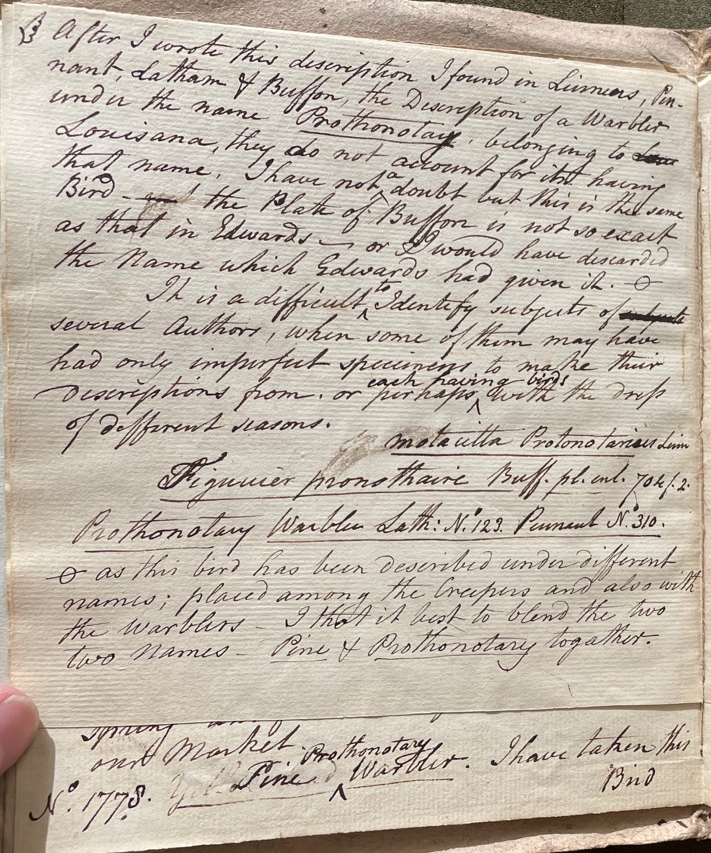
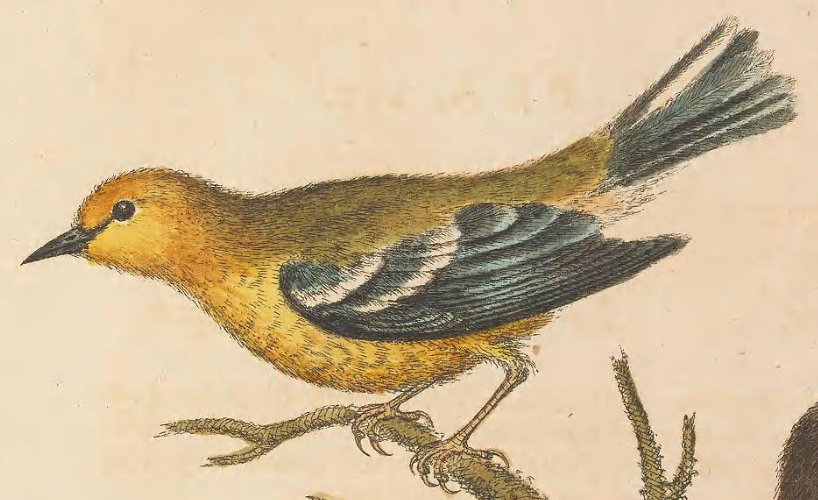
Charles Willson Peale (1741-1827) wrote, in his 36th Lecture (ca. 1799): "No. 1778. Pine [Prothonotary] Warbler. I have taken this Bird from among the Creepers, because I do not find the characters agree with that genus—the bill is not long & slender, or curved so much as the Creepers, nor is the hind toe large, the claw long and hooked. Mr. Edwards called it a Creeper, and others have been so complasant as to continue his name. The head, throat and breast is bright yellow; back olive green, wings and tail ceneareuous [sic], wings with white bars & the inner webs of outer featers of the tail white. It is the Certhia Pinus of Linn. Pine Warbler Pennant & Latham. Pine Creeper Edwards No. 277." (Academy of Natural Sciences of Drexel University Archives, coll. 40)
Peale continued: "No. 1779. Female, the yellow on the head is not so bright or the back so green, otherwise marked much alike. It appears in Pennsylvania from the south in April; feeds on Insects and breeds of trees and stays with us the summer. Inhabits the softer climate of Carolina the whole winter; and is seen creeping about the trees especially the firs & pines, with other congenerous birds, which associate in that season in small flights." (ANSP Archives, coll. 40)
Peale then inserted a footnote: "After I wrote this description, I found in Linnaeus, Pennant, Latham & Buffon, the Description of a Warbler under the name Prothonotary, belonging to Louisana. they do not account for its having that name. I have not a doubt but this is the same Bird. The Plate of Buffon is not so exact as that in Edwards, or I would have discarded the name which Edwards had given it. Motacilla protonotarious Linn. Figuier pronothaire Buff. pl. enl. 704. f. 2. Prothonotary Warbler Lath, No. 123. Pennant No. 310. As this bird has been described under different names; placed among the Creepers and also with the warblers, I thought it best to blend the two names, Pine & Prothonotary together." (ANSP Archives, coll. 40)
Alexander Wilson (1766-1813) distinguished the Blue-winged Warbler (from the Prothonotary amalgamation) under the name "Blue-winged Yellow Warbler / Sylvia solitaria" in American Ornithology vol. 2 (Pl. 15), where "Peale's Museum No. 7307" was cited (Wilson 1810: 109). / https://www.biodiversitylibrary.org/item/175511#page/125/mode/1up (text) / https://www.biodiversitylibrary.org/item/175511#page/118/mode/1up (plate)
Notes:
The description in Peale’s lecture (ca. 1799) clearly refers to the species now known as Blue-winged Warbler. However, he evidently confused (like authors before him, see Storrs L. Olson & James L. Reveal, 2009, "Nomenclatural history and a new name for the Blue-winged Warbler (Aves: Parulidae)", Wils. J. Orn. 121: 618-620) the identities of three species now known as Blue-winged Warbler (now Vermivora cyanoptera), Pine Warbler (Setophaga pinus), and Prothonotary Warbler (Protonotaria citrea). Thus, Peale retroactively inserted the name “Prothonotary” between “Pine” and “Warbler” in his lecture. / https://doi.org/10.1676/09-003.1
Specimen Type:
Dead/preserved
Current Common Name:
Blue-winged Warbler
Current Scientific Name
Parulidae | Vermivora cyanoptera