Object Status:
Extant
Accession Date:
By 1799
Primary Source Reference:
Charles Willson Peale, Lecture on Natural History 33. (ca. 1799). Academy of Natural Sciences of Drexel University Archives, coll. 40. / https://ansp.org/research/library/archives/0000-0099/coll0040/
Additional Source Text:
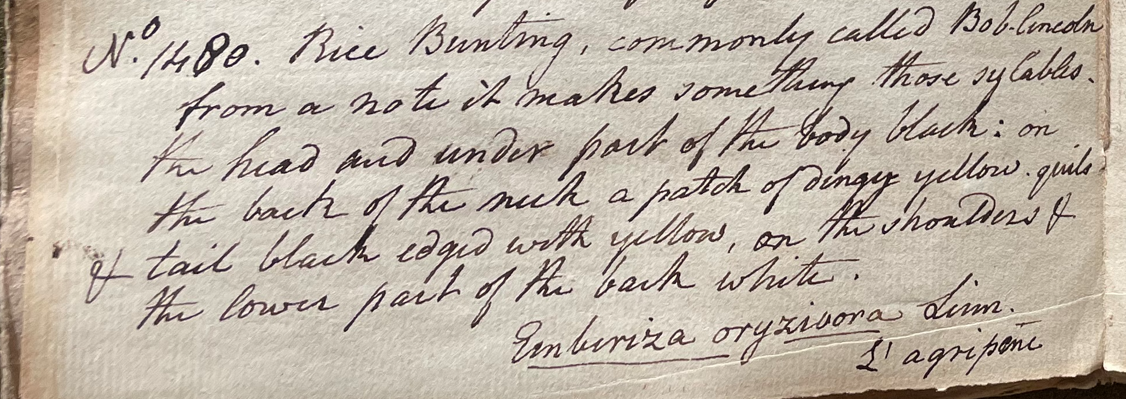
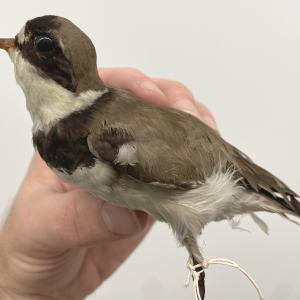
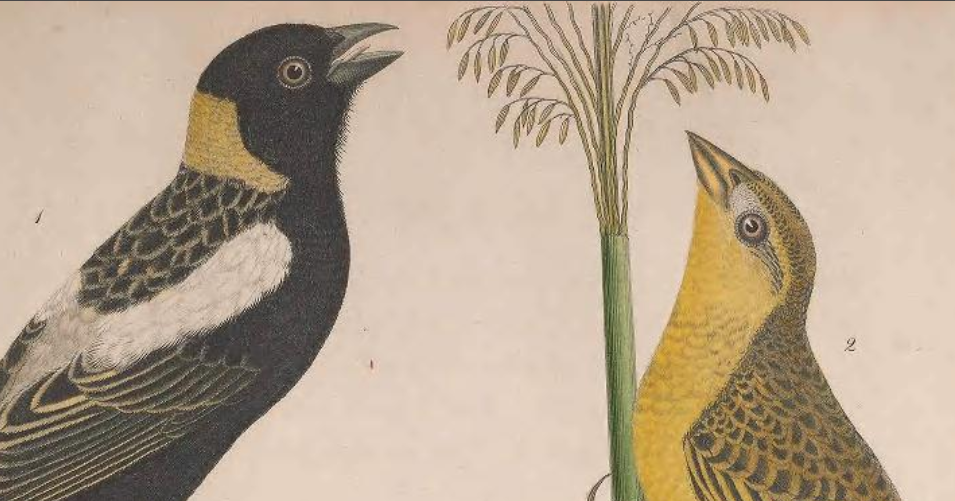
Charles Willson Peale (1741-1827) wrote, in his 33rd Lecture (ca. 1799): "No. 1480. Rice Bunting, commonly called Bob-lincoln, from a note it makes something [like] those syllables. the head and under part of the body black; on the back of the neck a patch of dingy yellow; quils & tail black edged with yellow; on the shoulders & the lower part of the back white. Emberiza oryzivora Linn. L'agripene, ou l'ortolan de Riz Buff. No. 1481. Female, the general Plumage is a yellowish brown striped with black. Called Reed birds. These birds inhabit in vast numbers the Island of Cuba, where they commit great ravages among the early crops of rice, which precede those of Carolina. from Cuba, they pass over the sea in numerous flights, directly north and [are] very often heard by sailors on their passage." (Academy of Natural Sciences of Drexel University Archives, coll. 40)
Peale continued: "They arrive in Carolina in Sepr. while the rice is yet milky; and commit such devastations, that 40 acres of that grain have been totally ruined by them in a short time. They arrive very lean; but soon grow so fat, as to fly with difficulty; and, when shot, often burst with the fall. They continue in Carolina not much above 3 weeks, and retire by the time the rice begins to harden. Catesby remarks that, among miriads which pay their autumnal visit there is never found a single cock bird, but that both sexes make them a transit visit in the spring. The males visit us in the latter part of May and first of June, at which time we scarcely ever find the female. about the first of Sepr., when the seed of the Reeds begin to ripen, we have numbers brought into our Market therefore in this place they obtain the name of Reed birds. from finding an abundance othis kind of wild oats on all our marshes, they soon become equally fat as those feeding on the Rice in Carolina." (ANSP Archives, coll. 40)
Peale wrote, in "A Walk Through the Philad[elphi]a Museum" (1805–1806): "The reed bird as it is called, in Carolina Rice bird (Emberiza oryzivora) They fatten on the seed of our wild oats to such a degree, that they are like a lump of fat; the skins will often burst by the fallings of Birds that are shot. It is a singular fact that the male bird visits us in flocks in the spring with scarcely a female ever to be seen amongst them. / They go farther northward to breed — after which that beautiful black head & breast of the male, with a russet patch on the back of the head, is totally changed to the striped plumage like the female." (Historical Society of Pennsylvania, coll. 0481)
Alexander Wilson (1766-1813) described this species under the name "Rice Bunting / Emberiza oryzivora" in American Ornithology vol. 2 (Pl. 12), where "Peale's Museum No. 6026" was cited (Wilson 1810: 48). / https://www.biodiversitylibrary.org/item/175511#page/56/mode/1up (text) / https://www.biodiversitylibrary.org/item/175511#page/57/mode/1up (plate)
Three mounted specimens of "Emberiza oryzivora (Reed birds)" were listed in "A Catalogue of Duplicate Specimens...", May 1822. [unpublished] American Philosophical Society Library (Mss.B.P31).
Notes:
By dissecting "many hundreds of" Bobolinks, Wilson was able to correct Catesby's (1731) error and clarify the non-breeding plumages of males and females. Wilson (1810: 51) wrote: "The internal organization of undomesticated birds, of all kinds, undergoes a remarkable change, every spring and summer; and those who wish to ascertain this point by dissection will do well to remember, that in this bird those parts that characterize the male are, in autumn, no larger than the smallest pin’s head, and in young birds of the first year can scarcely be discovered; tho in spring their magnitude in each is at least one hundred times greater. To an unacquaintance with this extraordinary circumstance I am persuaded has been owing to the mistake of Mr. Catesby that the females only return in the Fall; for the same opinion I long entertained myself, till a more particular examination shewed me the source of my mistake. Since that, I have opened and examined many hundreds of these birds, in the months of September and October, and, on the whole, have found about as many males as females among them." / https://www.biodiversitylibrary.org/item/175511#page/61/mode/1up Louis Pierre Vieillot (1748-1831) also solved the riddle of the Rice Bunting plumages, prior to and independently of Wilson, as discussed by Rick Wright, 2020, "Where the boys are: Who figured out the Bobolink?" Birding [2020]: 62-64. / https://www.birdpop.org/docs/pubs/Pyle_2020_The_Molts_and_Plumages_of_B…
Specimen Type:
Dead/preserved
Current Common Name:
Bobolink
Current Scientific Name
Icteridae | Dolichonyx oryzivorus