Object Status:
Extant
Accession Date:
By 1799
Primary Source Reference:
Charles Willson Peale, Lecture on Natural History 25. (ca. 1799). Academy of Natural Sciences of Drexel University Archives, coll. 40. / https://ansp.org/research/library/archives/0000-0099/coll0040/
Additional Source Text:
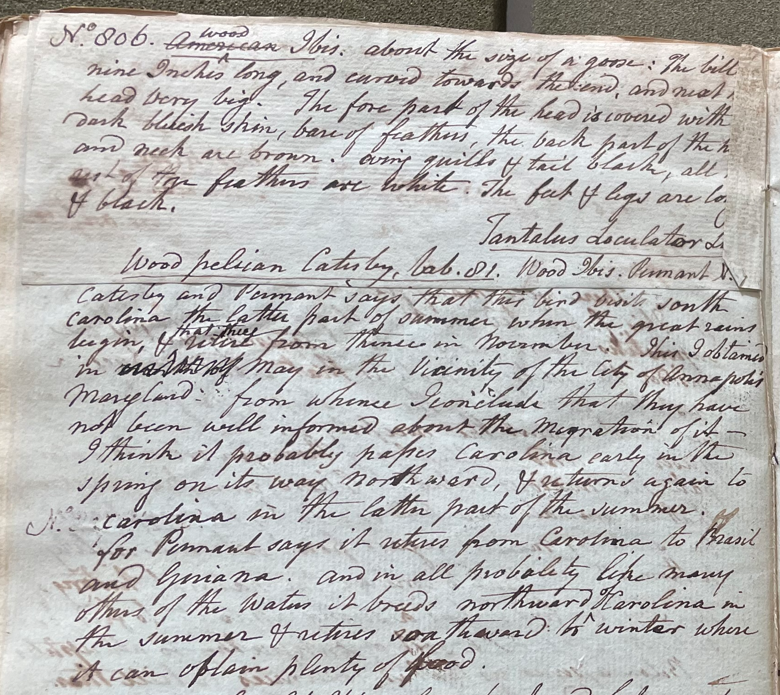
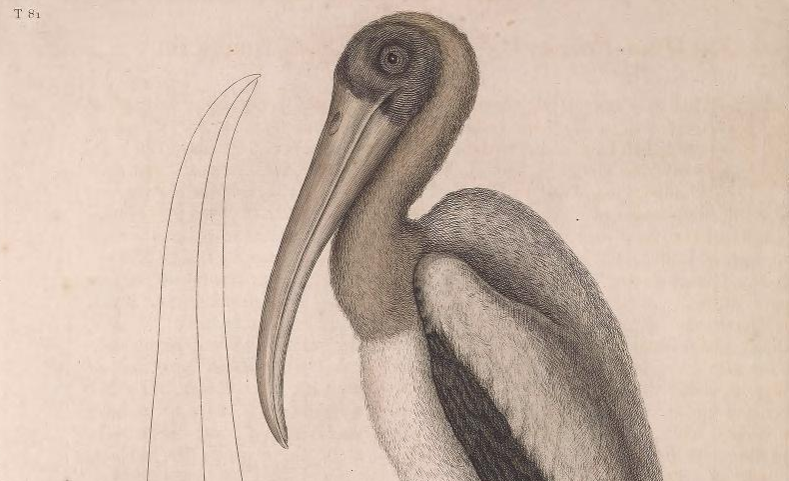
Charles Willson Peale (1741-1827) wrote, in his 25th Lecture (ca. 1799): "No. 806. American Wood Ibis. about the size of a goose. The bill nine Inches long, and curved towards the end, and next [to] the head very big. The fore part of the head is covered with a dark black skin, bare of feathers, the back part of the head and neck are brown; wing quills & tail black, all the rest of the feathers are white. The feet & legs are long & black. Tantalus Loculator Linn. Wood Pelican Catesby, Tab. 81. Wood Ibis. Pennant No. 360." (Academy of Natural Sciences of Drexel University Archives, coll. 40)
Peale continued: "Catesby and Pennant says that this bird visits South Carolina the latter part of summer, when the great rains begin, & that they retire from thence in November. This [specimen] I obtained in May in the vicinity of the City of Annapolis, Maryland, from whence I conclude that they have not been well informed about the migration of it. I think it probably passes Carolina early in the spring on its way northward, & returns again to Carolina in the latter part of the summer. For Pennant says it retires from Carolina to Brasil and Guiana, and in all probility [sic] like many others of the Waters it breeds northward of Carolina in the summer & retires southward in winter where it can obtain plenty of food." (ANSP Archives, coll. 40)
Rubens Peale (1784–1865) wrote to his father from London, on 6 September 1802: "Among the Birds [in a private collection] there are the Great Vulture, Wood Ibis (N 806) Cassowarys and a Great number of Parrots" (Miller 1988: 455, Selected Papers, Vol. 2, Part 1, Yale University Press).
Peale wrote, in "A Walk Through the Philad[elphi]a Museum" (1805–1806): "The Wood Ibis (T. Loculator) is considerably like the Egyptian Ibis — They are common in Georgia & sometimes seen more northerly." (Historical Society of Pennsylvania, coll. 0481)
Alexander Wilson (1766-1813) described this species under the name "Wood Ibis / Tantalus loculator" in American Ornithology vol. 8, published posthumously (Pl. 66), where "Peale's Museum, No. 3862" was cited (Wilson 1814: 39). / https://www.biodiversitylibrary.org/item/175758#page/51/mode/1up (text) / https://www.biodiversitylibrary.org/item/175758#page/50/mode/1up (plate)
Specimen Type:
Dead/preserved
Current Common Name:
Wood Stork
Current Scientific Name
Ciconiidae | Mycteria americana