Object Status:
Extant
Accession Date:
By 1799
Primary Source Reference:
Charles Willson Peale, Lecture on Natural History 34. (ca. 1799). Academy of Natural Sciences of Drexel University Archives, coll. 40. / https://ansp.org/research/library/archives/0000-0099/coll0040/
Additional Source Text:
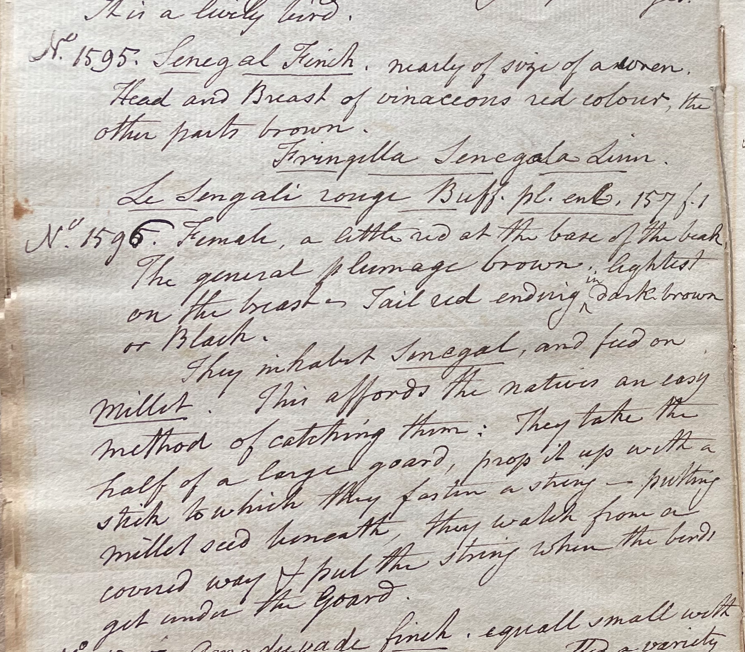
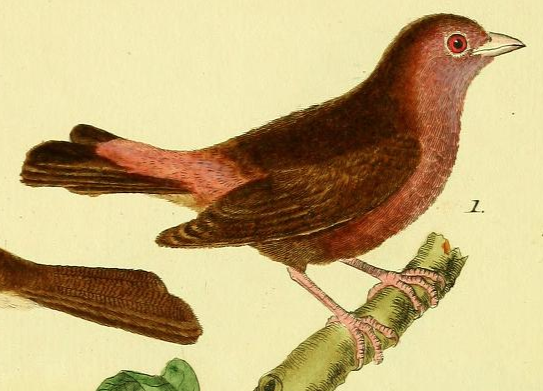
Charles Willson Peale (1741-1827) wrote, in his 34th Lecture (ca. 1799): "No. 1595. Senegal Finch. Nearly the size of a wren. Head and Breast of vinacious red colour, the other parts brown. Fringilla senegala Linn. Le Sengali rouge Buff. pl. enl. 157. f. 1. No. 1596. Female, a little red at the base of the back. The general plumage brown, lightest on the breast. Tail red ending in dark brown or black. They inhabit Senegal, and feed on Millet. This affords the natives an easy method of catching them. They take the half of a large goard, prep it up with a stick to which they fasten a string, putting millet seed beneath, they watch from a covered way & pull the string when the birds get under the goard." (Academy of Natural Sciences of Drexel University Archives, coll. 40)
Peale wrote, in "A Walk Through the Philad[elphi]a Museum" (1805–1806): "… the Senegal Finch (F. Senegala) also handsome birds are brought to us in Cages from the east India's." (Historical Society of Pennsylvania, coll. 0481)
Bellvue Soisson donated "Cinigal [Senegal] Finches, living" on 21 May 1805, according to the Peale Museum Accessions Book, p. 5 (HSP, coll. 0481).
Specimen Type:
Dead/preserved
Current Common Name:
Red-billed Firefinch
Current Scientific Name
Estrildidae | Lagonosticta senegala