Object Status:
Extant
Accession Date:
By 1799
Primary Source Reference:
Charles Willson Peale, Lecture on Natural History 35. (ca. 1799). Academy of Natural Sciences of Drexel University Archives, coll. 40. / https://ansp.org/research/library/archives/0000-0099/coll0040/
Additional Source Text:
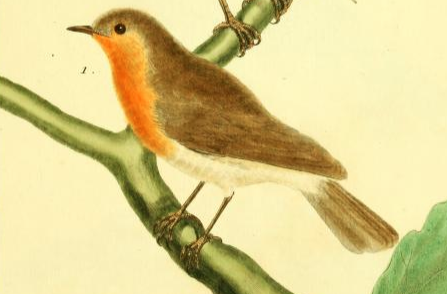
Charles Willson Peale (1741-1827) wrote, in his 35th Lecture (ca. 1799): "No. 1758. Red breast Warbler. the upper parts are greenish ash colour; the forehead, throat, neck and breast, rufous orange. Motacilla Rubecula Linn. Le rouge-gorge Buff. pl. enl. 361. f. 1. Insects are their general food; but in defect of these they will feed on many other things. No bird is so tame and familiar as this, closely attending the heels of the gardiner when he is using his spade, for the sake of worms; and frequently in winter entering houses where windows are open, when they pick up the crumbs from the table while the family is at dinner." (Academy of Natural Sciences of Drexel University Archives, coll. 40)
Peale continued: "Thomson says: 'The Red-breast, sacred to the household gods, wisely regardful of the embroiling sky, in joyless fields, and thorny thickets, leaves his shivering mates, and pays to trusted man his annual visit. Half afraid, he first against the window beats; then, brisk, alights on the warm hearth; then, hopping o'er the floor, eyes all the smiling family askance, and picks, and starts, and wonders where he is; till more familiar grown, the table-crumbs attract his slender feet.' This European bird has long been a favorite in many countries, and from its familiarity the people about Born-holm call it Tommi-liden; in Norway, Peter Ronsmad; the Germans, Thomas Gierdet, and in England, the Robin Red breast. No. 1759. Female. upper parts of the plumage brown; under parts sallow white." (ANSP Archives, coll. 40)
Peale wrote, in "A Walk Through the Philad[elphi]a Museum" (1805–1806): "Red-breast Warbler (M. rubecula) no bird is so tame & familiar as this; closely attending the heels of the gardiner when he is using his spade, for the sake of worms; and frequently in winter entering houses where windows are open, when they pick up the crumbs from the table while the family is at dinner. Beautifully described by Thomson. It is not only a favorite in Britain but in most parts of Europe." (Historical Society of Pennsylvania, coll. 0481)
Specimen Type:
Dead/preserved
Current Common Name:
European Robin
Current Scientific Name
Muscicapidae | Erithacus rubecula