Object Status:
Extant
Accession Date:
By 1799
Primary Source Reference:
Charles Willson Peale, Lecture on Natural History 17. (ca. 1799). Academy of Natural Sciences of Drexel University Archives, coll. 40. / https://ansp.org/research/library/archives/0000-0099/coll0040/
Additional Source Text:
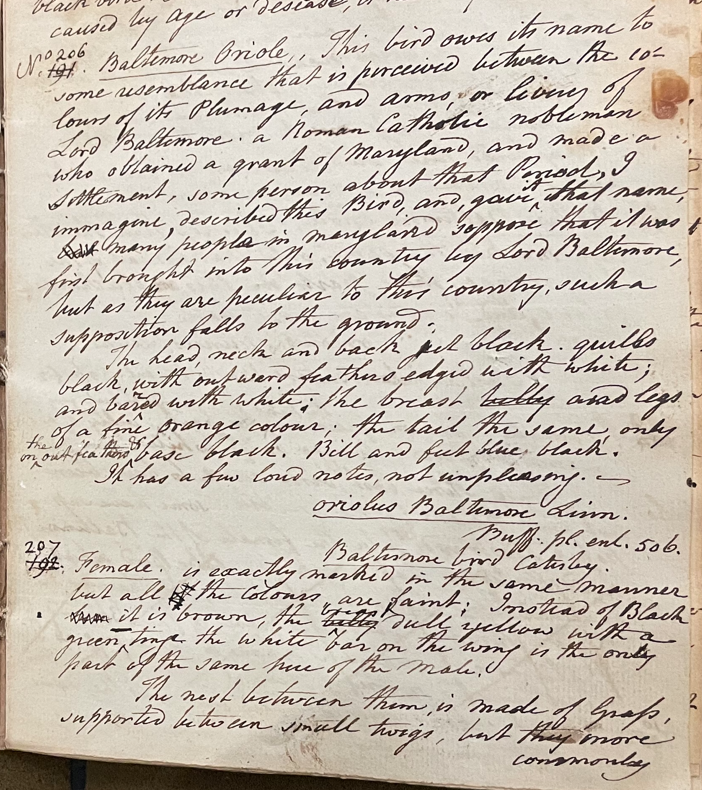
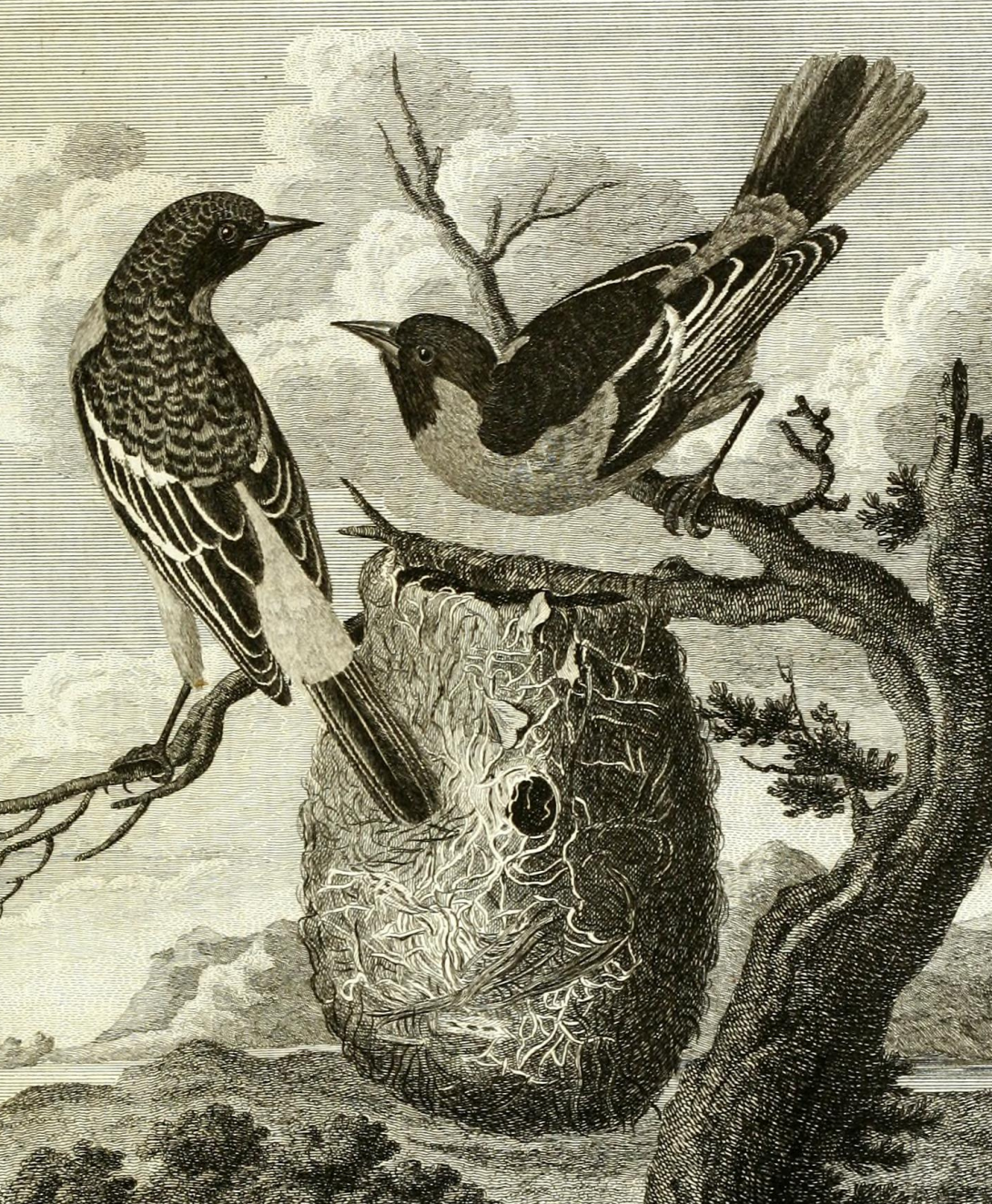
Charles Willson Peale (1741-1827) wrote, in his 17th Lecture (ca. 1799): "No. 197. 206. Baltimore Oriole. This bird owes its name to some resemblance that is perceived between the colours of its plumage, and arms or livery of Lord Baltimore, a Roman Catholic nobleman who obtained a grant of Maryland, and made a settlement. Some person about that Period, I immagine, described this Bird, and gave it that name. Many people in Maryland suppose that it was first brought to this county by Lord Baltimore, but as they are peculiar to this country, such a supposition falls to the ground. The head, neck and back jet black; quills black, with outward feathers edged with white; and barred with white; the breast belly and legs of a fine orange colour; the tail the same, only the [inner] feathers & base black; bill and feet blue black. It has a few loud notes, not unpleasing. Oriolus Baltimore Linn. Buff. pl. enl. 506. Baltimore bird. Catesby. 192." (Academy of Natural Sciences of Drexel University Archives, coll. 40)
Peale continued: "207. Female. is exactly marked in the same manner but all the colours are faint; instead of Black it is brown, the breast dull yellow with a green tinge; the white bar on the wing is the only part of the same hue of the male. The nest between them is made of grass, supported between small twigs, but [they] more commonly make them of [tow], hemp, and threads which they pick up in the settlements; they are not a shy bird and when unmolested will build their nests on trees near Dwellings; it appears that they do not always observe the same form in the structure of their nests, for some of them are made to hang much more than others. They breed here, but leave us in the winter and migrate to a warmer climate." (ANSP Archives, coll. 40)
Peale wrote, in "A Walk Through the Philad[elphi]a Museum" (1805–1806): "Before we leave this genus, it is deserving of Notice that authors have been under the mistake of making the black throat, the female of the Bastard Baltimore (oriolus Spurius). Here we see the proper female to each of them. / an oppinion has taken place with many, more especially in Maryland, that the Baltimore Oriole was originally brought into this Country by Lord Baltimore, and that in consequence it has received that name, but when it is known that no bird like it is found in Europe, such an Idea must fall to the ground. / The fact is, that when he came to his government of Maryland his servants were dressed in a livery of Yellow and black, & the first inhabitants settling there finding a bird with those colours, had given it the name of Baltimore." (Historical Society of Pennsylvania, coll. 0481)
Alexander Wilson (1766-1813) described this species under the name "Baltimore Oriole / Oriolus baltimore" in American Ornithology vol. 1 (Pl. 1), where "Peale's Museum No. 1506" was cited (Wilson 1808: 23). / https://www.biodiversitylibrary.org/item/175530#page/37/mode/1up (text) / https://www.biodiversitylibrary.org/item/175530#page/8/mode/1up (plate)
Two unmounted specimens of "Oriolus Baltimorus (Baltimore Oriole)" were listed in "A Catalogue of Duplicate Specimens...", May 1822. [unpublished] American Philosophical Society Library (Mss.B.P31).
Specimen Type:
Dead/preserved
Current Common Name:
Baltimore Oriole
Current Scientific Name
Icteridae | Icterus galbula