Object Status:
Extant
Accession Date:
By 1799
Primary Source Reference:
Charles Willson Peale, Lecture on Natural History 35. (ca. 1799). Academy of Natural Sciences of Drexel University Archives, coll. 40. / https://ansp.org/research/library/archives/0000-0099/coll0040/
Additional Source Text:
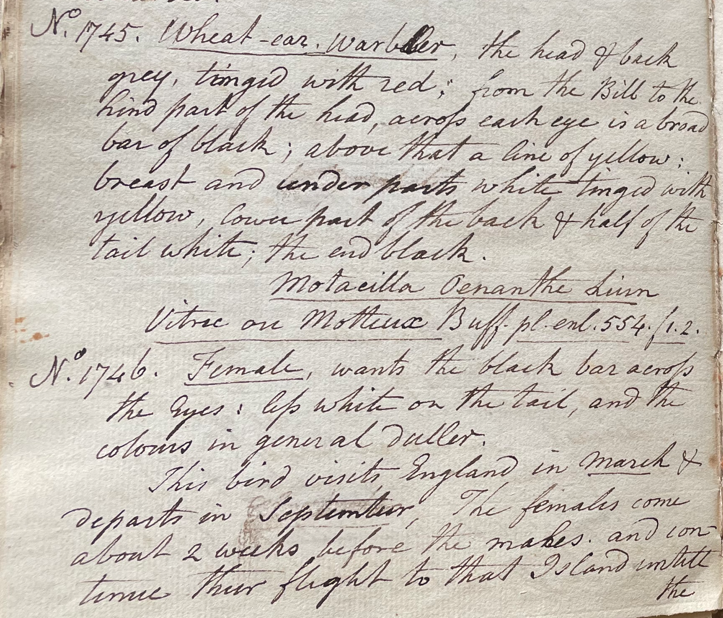
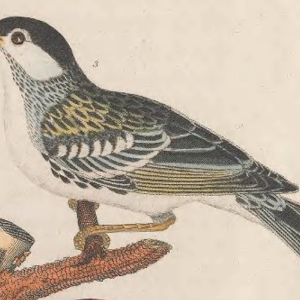
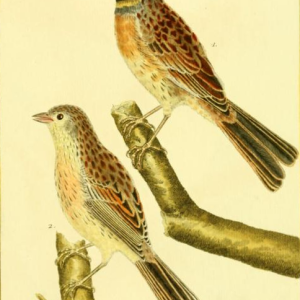
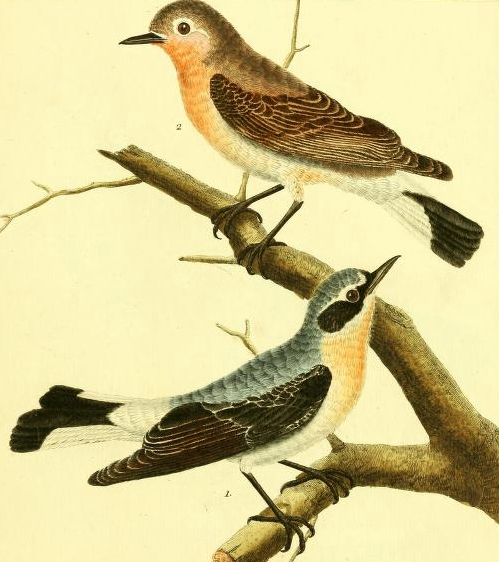
Charles Willson Peale (1741-1827) wrote, in his 35th Lecture (ca. 1799): "No. 1745. Wheat-ear Warbler. The head & back grey, tinged with red; from the bill to the hind part of the head, across each eye is a broad bar of black; above that a line of yellow; breast and underparts white tinged with yellow; lower part of the back & half of the tail white; the end black. Motacilla Oenanthe Linn. Vitrec ou Moteux Buff. pl. enl. 554. f. 1. 2. No. 1746. Female, wants the black bar across the eyes; less white on the tail, and the colours in general duller. This bird visits England in March & departs in September. The females come about 2 weeks before the males, and continue their flight to that island until the middle of May." (Academy of Natural Sciences of Drexel University Archives, coll. 40)
Peale continued: "In some parts of England they are in vast plenty; and are much esteemed. About Eastbourn, in Sussex, they are taken in snares made of hair, placed beneath a long turf; being very timid birds, the motion of a cloud or the appearance of a Hawk, will drive them for shelter into these traps. The numbers annually ensnared in that district alone amount to about 1840 Doz, which usually sell at 6d pr. dozen. [A note inserted here mentions that this information was sourced from 'British Zool.']. Quantities are eaten by the inhabitats; others are pickled and sent to the London poulterers; and many are potted, being as much esteemed in England as the Ortolan on the continent. Their food is insects only, though in rainy seasons feed much on earthworms, whence they are fattest in such seasons. They are met with in most parts of Europe, even as far as Greenland." (ANSP Archives, coll. 40)
Peale also wrote, in his 36th Lecture (ca. 1799): "No. 1825. Young bird—Wheatear Warber. Motacilla Oenanthe Linn. Le Vitree. Buff." (ANSP Archives, coll. 40)
Rubens Peale (1784-1865) wrote to his father from London, on 1 June 1803: "I have got 2 new genera, which are Saxicola and Silvia, of the former are Saxe Oenanthe, male & female Saxe Rubetra, male & Female" (Miller 1988: 529, Selected Papers, Vol. 2, part 1, Yale University Press).
Peale wrote, in "A Walk Through the Philad[elphi]a Museum" (1805–1806): "Wheatear Warbler (M. Oenanthe) These birds are much esteemed as food in England, where they both pickle and pot them for the London market."(Historical Society of Pennsylvania, coll. 0481)
A mounted specimen of "Motacilla oenanthe (Nightingale)" from France was listed in "A Catalogue of Duplicate Specimens...", May 1822. [unpublished] American Philosophical Society Library (Mss.B.P31).
Specimen Type:
Dead/preserved
Current Common Name:
Northern Wheatear
Current Scientific Name
Muscicapidae | Oenanthe oenanthe