Object Status:
Unlocated
Accession Date:
By 27 August 1793
Primary Source Reference:
Charles Willson Peale, "Register of birds" in 1793 diary. American Philosophical Society Library, Peale-Sellers Family Collection (Mss.B.P31).
Additional Source Text:
Charles Willson Peale (1741-1827) wrote in a "Register [list] of birds" in his 1793 diary, during a collecting trip to Cape Henlopen, Delaware: "[27 August 1793]: a shere Watter" (American Philosophical Society Library, Peale-Sellers Family Collection, Mss.B.P31).
On 25 January 1794, a notice in Dunlap's American Daily Advertiser announced Peale's acquisition of "That remarkable bird called the Cut-water, or Scissors-bill."
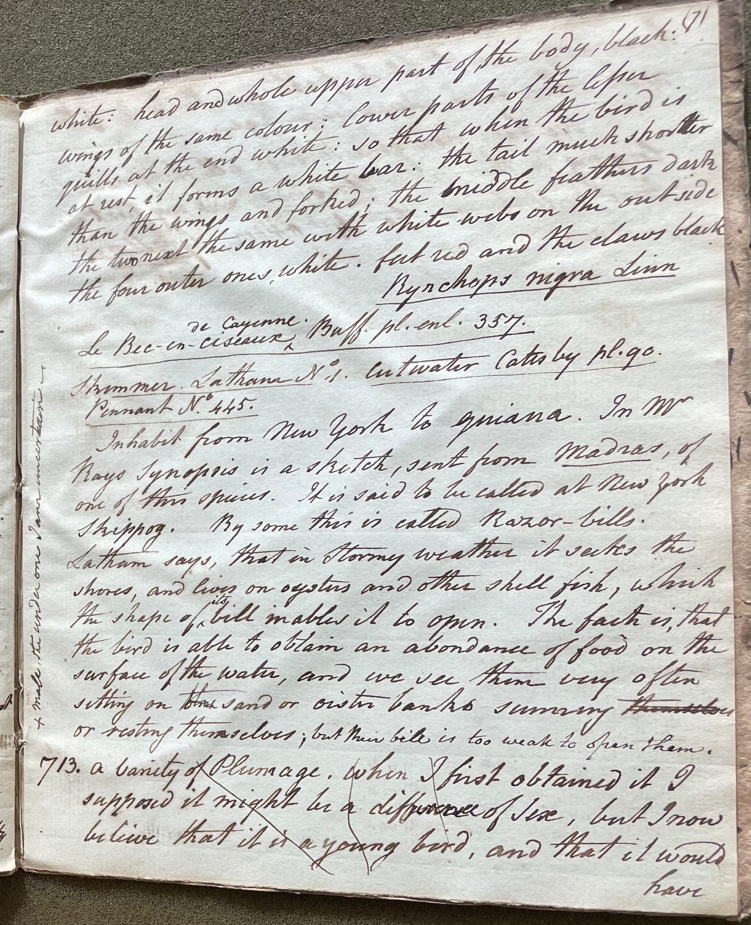
Peale wrote, in his 24th Lecture (ca. 1799): "712. Skimmer. [a footnote reads: "male, the under one I am uncertain"] Beak red at the base and black at the end; forehead, chin, front of the neck, breast white; head and whole upper part of the body, black; wings of the same colour; lower parts of the lesser quills at the end white; so that when the bird is at rest, it forms a white bar; the tail much shorter than the wings and forked; the middle feathers dark, the two next the same with white webs on the outside, the four outer ones white; feet red and the claws black. Rynchops nigra Linn. Le Bec-en-ciseaux de Cayenne. Buff. pl. enl. 357. Skimmer Latham No. 1. Cutwater Catesby pl. 90. Pennant No. 445. Inhabit from New York to Guiana." (Academy of Natural Sciences of Drexel University Archives, coll. 40)
Peale continued: "In Mr. Ray's Synopsis is a sketch, sent from Madras, of one of this species. It is said to be called at New York Skippog. By some this is called Razor-bills. Latham says, that in stormy weather it seeks the shores, and lives on oysters and other shell fish, which the shape of the bill inables it to open. The fact is, that the bird is able to obtain an abundance of food on the surface of the water, and we see them very often sitting on the sand or oister banks sunning themselves or resting themselves; but their bill is too weak to open them. 713. A variety of Plumage. When I first obtained it I supposed it might be a difference of sex, but I now believe that it is a young bird, and that it would have acquired the black feathers on the back of the neck when more advanced in age." (ANSP Archives, coll. 40)
Peale wrote, in "A Walk Through the Philad[elphi]a Museum" (1805–1806): "The last and not the least curious of the order Anseres is the Genus Rynchops, Skimmer or Cut water. This very singular bird has obtained with the french the name Le Bec-en-ciseaux, Scisar-bill, and in fact they do frequently cut their food in two. They are by Pennant and others called Skimmers, because they skim along the waters with the under Mandible catching up small Fishes while this on the wing. / Black Skimmer (R. Nigra) It inhabits from New York to Guiana. By some this is called Razor-bills. Latham says that in stormy weather it seeks the shores, and lives on oisters and other shell fish, which the shape of its bill enables it to open. The fact is, that the bird is able to obtain an abundance of food on the surface of the Water, and we see them very often sitting on the land or oister banks, sunning or resting themselves but their Bill is too weak to open them." (Historical Society of Pennsylvania, coll. 0481)
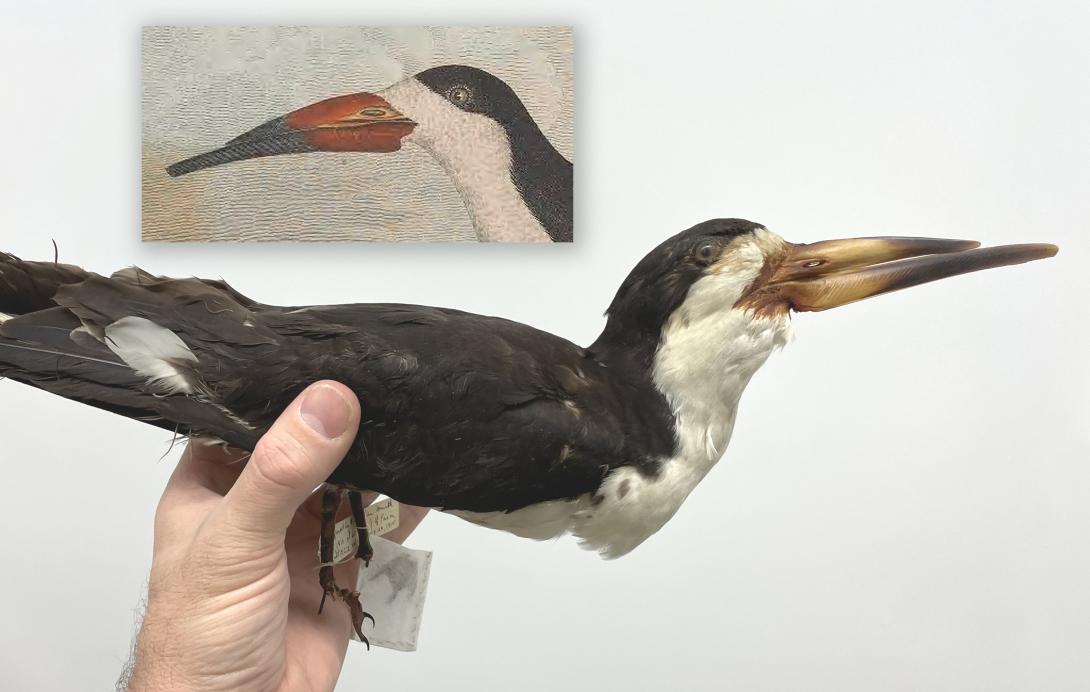
Alexander Wilson (1766-1813) described this species under the name "Black Skimmer, or Sheerwater / Rhynchops nigra" in American Ornithology vol. 7 (Pl. 60), where "Peale's Museum, No. 3530" was cited (Wilson 1813: 85). / https://www.biodiversitylibrary.org/item/175507#page/101/mode/1up (text) / https://www.biodiversitylibrary.org/item/175507#page/91/mode/1up (plate)
An entry in the Peale Museum Accessions Book (p. 99), on 23 September 1819, reads: "A Shear Water (Rynschops Nigra) which was Shot near the Permanent Bridge on the Schoolkill by the donor ... William Pugh." (HSP, coll. 0481)
A specimen of Rynchops nigra (Black Skimmer young)" was listed in "A Catalogue of Duplicate Specimens...", May 1822. [unpublished] American Philosophical Society Library (Mss.B.P31).
Notes:
After Peale's Museum closed, a portion of Peale's bird collection was purchased in 1850 by Moses Kimball (1809–95), who displayed it at his "Boston Museum". An advertisement in the Boston Transcript, printed 1 October 1850, stated that Kimball had acquired "One Half of the celebrated Peale's Philadelphia Museum". The other half of Peale's birds had been sold to the circus promoter P. T. Barnum (1810–91) and would be subsequently destroyed in a fire at his "American Museum" in New York City in July 1865. When the Boston Museum closed, Kimball's Peale remnants passed temporarily to the Boston Society of Natural History, who disposed of them to Charles J. Maynard (1845-1929), a local taxidermist. The specimens were stored in a barn in Massachusetts for several years, then eventually were deposited at the Museum of Comparative Zoology (MCZ), Harvard University. By the time the collection was catalogued by Walter Faxon (1848-1920) at MCZ, in 1914, in virtually every case the original mounts and labels had been disassociated from the specimens, and an untold number were lost. Walter Faxon, "Relics of Peale's Museum," Bulletin of the Museum of Comparative Zoology, 59, no. 3 (July 1915): 128 speculated that MCZ 67813, a data-deficient specimen once in the Boston Museum collection, was “without doubt the original of Wilson’s figure." Faxon's claim seems unlikely to be true, because Peale had specimens of this species by 1793, and he had little room (or interest) to display duplicates. / https://www.biodiversitylibrary.org/page/6339801#page/178/mode/1up Wilson (1810: viii, American Ornithology, vol. 2) stated that "no drawings have been, or will be made for this work, from any stuffed subjects, where living specimens of the same can be procured; yet the former serve a very important purpose; they enable the author to ascertain the real existence and residence of such subjects". / https://www.biodiversitylibrary.org/item/175511#page/14/mode/1up Wilson deposited many specimens at Peale's Museum, after completing his drawings, but the combined evidence from American Ornithology and the Peale Museum Accessions Book (Historical Society of Pennsylvania, coll. 0481) suggests that it was probably fewer than 50 skins, whereas many authors have assumed that all the "Peale numbers" cited in Wilson's work were those of his own specimens (e.g., "he contributed 279 specimens to the collection", Edward H. Burtt, Jr., and William E. Davis, Jr., 2013, Alexander Wilson: The Scot Who Founded American Ornithology, Belknap Press, p. 310). This assumption appears to be based on a misunderstanding — Wilson was citing the numbers to give credit to Peale, to acknowledge his contributions, not to stake a claim to his own specimen deposits. If Burtt & Davis (2013) were correct, the "Catalogue of Duplicate Specimens" (APS Library, Mss.B.P31) would be full of Wilson's specimen deposits—but this is not the case. To the editor's (MRH) knowledge, there is no evidence that Wilson deposited a Black Skimmer at Peale's Museum.
Specimen Type:
Dead/preserved
Current Common Name:
Black Skimmer
Current Scientific Name
Laridae | Rynchops niger
Repository:
Museum of Comparative Zoology, Harvard University (MCZ 67813)