Object Status:
Extant
Accession Date:
By 1799
Primary Source Reference:
Charles Willson Peale, Lecture on Natural History 13. (ca. 1799). Academy of Natural Sciences of Drexel University Archives, coll. 40. / https://ansp.org/research/library/archives/0000-0099/coll0040/
Additional Source Text:
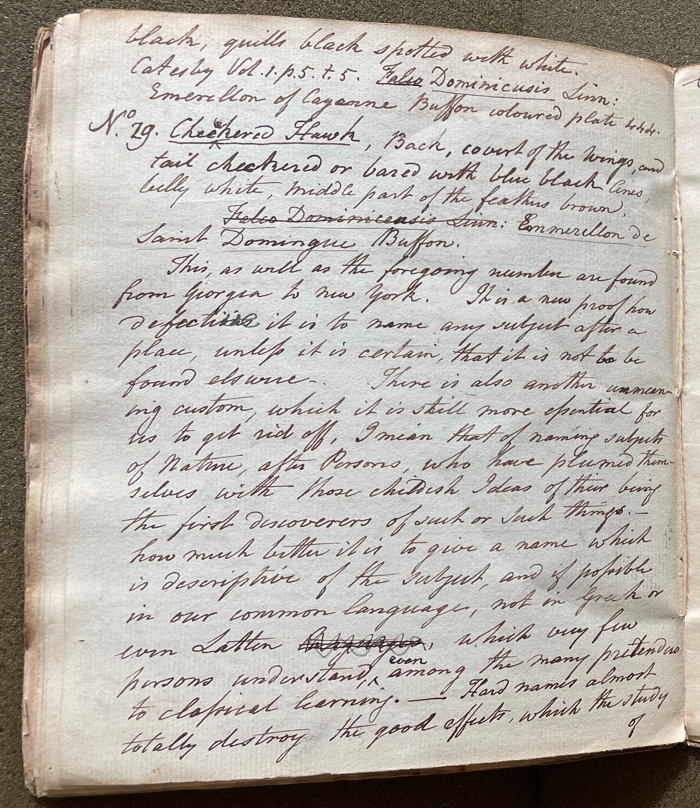
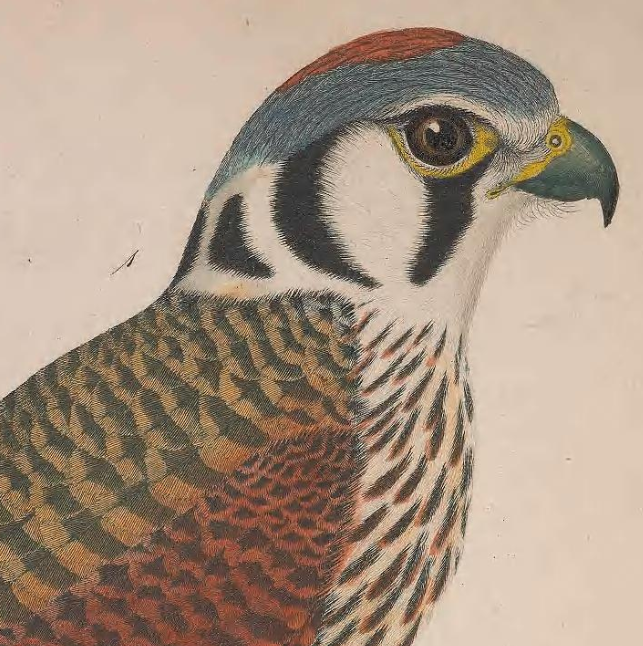
Charles Willson Peale (1741-1827) wrote, in his 13th Lecture (ca. 1799): "No. 28. Variegated Little Hawk. Cere and feet yellow; blueish bead with a large reddish spot on the back of it; back reddish; tail the same, with black & white at the extremity; coverts of the wings blue spotted with black; quills black spotted with white. Catesby vol. i. p. 5. t. 5. Falco Dominicensis Linn. Emerellon of Cayanne. Buffon coloured plate 444. No. 29. Checkered Hawk. Back, covert of the wings, and tail checkered or barred with blue black lines; belly white, middle part of the feathers brown. Emmerellon de Saint Dominique Buffon. This, as well as the foregoing number are found from Georgia to New York. It is a new proof how defective it is to name any subject after a place, unless it is certain, that it is not to be found elsewhere." (Academy of Natural Sciences of Drexel University Archives, coll. 40)
Peale continued: "There is also another unmeaning custom, which it is still more essential for us to get rid off [sic]. I mean that of naming subjects of Nature, after Persons, who have plumed themselves with those childish ideas of their being the first discoveres of such or such things. How much better it is to give a name which is descriptive of the subject, and if possible in our common language, not in Greek or even Latten, which very few persons understand, even among the many pretenders to classical learning. Hard names almost totally destroy the good effects, which the study of Botany might be of to mankind; they deter many from attempting a knowledge of the classification of Plants, and with many of those persons who pretend to make a study of this pleasing science, their heads get so filled with those abominable long and difficult names, that there is no room left to contain any thing about the qualities. Thair [sic] skulls like a cup is cramed full of names and will hold nothing about the uses to which various plants of this vast continent must contain, for food and phisick." (ANSP Archives, coll. 40)
Alexander Wilson (1766-1813) described an adult female under the name "American Sparrow Hawk / Falco sparverius" in American Ornithology vol. 2 (Pl. 16), where "Peale's Museum No. 389" was cited (Wilson 1810: 117). / https://www.biodiversitylibrary.org/item/175511#page/135/mode/1up (text) / https://www.biodiversitylibrary.org/item/175511#page/134/mode/1up (plate).
Wilson (1811) also described an adult male under the same name in American Ornithology vol. 4 (Pl. 32), where "Peale's Museum, No. 340" was cited (Wilson 1811: 57). / https://www.biodiversitylibrary.org/item/175531#page/71/mode/1up (text) / https://www.biodiversitylibrary.org/item/175531#page/66/mode/1up (plate)
Male and female specimens (unmounted) of "Falco sparverius (Sparrow H)", which had been collected in Florida, were listed in "A Catalogue of Duplicate Specimens...", May 1822. [unpublished] American Philosophical Society Library (Mss.B.P31).
Notes:
Thomas Hall (ca.1746-1813) was a natural history dealer and showman in London who, like Peale, assembled a collection of exotic taxidermy and natural oddities in his home, which he displayed to paying customers. Hall’s museum was known by the names “Curiosity House” and “Finsbury Museum”, and he distributed tokens advertising himself as “The first artist in Europe for preserving Birds, Beasts &c.” Today, many of these tokens are preserved in the British Museum. / https://www.britishmuseum.org/collection/term/BIOG145361 Peale proposed a specimen exchange with Hall, in a letter dated 28 April 1792: “I therefore make you the proposal of sending you all the Variety of this Country, for an Equal number of European [species] … which shall be preserved in the best manner (of which I now feel myself fully equal to) and sent and that I may be prepared for such an exchange I am now using every means in my power to Collect and preserve the Birds of the present season … I have not time to give you any description of such as I suppose are peculiar to this part of America, and I find that every year I discover some kinds that I had not known before, and from what I have read, I find that those who have attempted the Natural History of this Country [were] generally deficent of inteligence [sic].” (Miller 1988: 31–32, Selected Papers, Vol. 2, part 1, Yale University Press). Peale announced in June 1792 that he was “busily employed in preserving the Birds of our Country [the United States] in order to furnish [himself] with such a number of duplicates as [would enable him] to make an extensive exchange” with Hall, and with institutions in Sweden and Holland (Miller 1988: 37). During his travels in London, Rubens Peale (1784-1865) wrote to his father on 1 June 1803: “I wish you to inform me in the next [letter] how you stand with Hall, recolleckting that I have had from him a considerable number of subjects in return from what I let him have” (Miller 1988: 529). The final specimen deposit from Hall was recorded in the Peale Museum Accessions Book on 17 August 1806 (Historical Society of Pennsylvania, coll. 0481). Peale's commentary foreshadowed the "Bird Names for Birds" (#birdnamesforbirds) movement by two centuries. / https://en.wikipedia.org/wiki/Bird_Names_for_Birds Matthew R. Halley, 29 March 2022. "Eponymous bird names feed ornithologists’ vanity, without enlightening the science". / https://matthewhalley.wordpress.com/2022/03/29/eponymous-bird-names-fee… American Ornithological Society (AOS) Leadership. 1 November 2023. "American Ornithological Society Will Change the English Names of Bird Species Named After People". / https://americanornithology.org/american-ornithological-society-will-ch…
Specimen Type:
Dead/preserved
Current Common Name:
American Kestrel
Current Scientific Name
Falconidae | Falco sparverius