Object Status:
Extant
Accession Date:
By 30 April 1797
Primary Source Reference:
Charles Willson Peale, letter to Étienne Geoffroy Saint-Hilaire (1772-1844) dated 30 April 1797; Selected Papers, 2, part 1: 198.
Additional Source Text:
Charles Willson Peale (1741-1827) sent a "Loon, or great diver" to Étienne Geoffrey Saint-Hilaire (1772-1844) at the Paris Museum, on 30 April 1797 (Miller 1988: 198, Selected Papers, Vol. 2, part 1, Yale University Press).
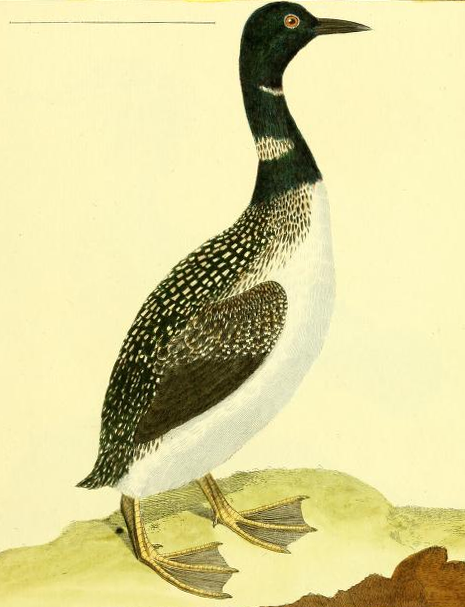
Peale wrote, in his 24th Lecture (ca. 1799): "No. 629. Northern Diver, commonly called a Loon. It is the largest of the Diver genus, weighing about 16 […]. Head and neck, Black violet; under the throat a cross line of interrupted white, lower on each side a patch of white streaks pointing downwards; upper parts of the body and wings black, varied with white spots; bill, tail & feet dark. iris orange. Columbus glacialis Linn. L'Imbrim Buff. pl. enl. 952. Northern Diver Latham No. 1. Pennant No. 439. Inhabits the north of Europe, and spreads alpong the Arctic coasts, as far as the mouth of the 66 only. It is found about Spitzbergen, Iceland, Hudson's bay [a footnote indicates this information was sourced from Pennant], and throughout all (perhaps) of the United States. I have seen it in Virginia. It makes its nest in the more northern regions, on the isles of fresh water lakes." (Academy of Natural Sciences of Drexel University Archives, coll. 40)
Peale continued: "Every pair keeps a lake to itself. Sees well; flies high, and darting obliquely, falls secure into its nest. Tries to save itself by diving, not flying. The young defend themselves stoutly with their bills. Appears in Greenland in April or the beginning of May. Goes away in September, or October, on the first fall of Snow. The natives use the skins for cloathing; and the Indians about Hudson's bay adorn their heads with circlets of their feathers. The Russians [a footnote reads: Russia, vol. ii. p. 234—downy side worn outwards. iii. p…], tan the breasts of this and other water-fowl; whose skins they prepare in such a manner as to preserve the down upon them; and, sewing a number togher, they sell them to make pollices, caps, &c. Garments made of these are very warm, never imbibing the least moisture; and are more lasting than could be imagined." (ANSP Archives, coll. 40)
Peale continued: "630. Female. All the upper parts brown, the edges of the feathers on the back being cenerious, gives her a pretty appearance of lunar spots; the belly underparts of the body white, and the bill lighter than in the male. Those which have four toes are united by membrane as if torn & cobled." (ANSP Archives, coll. 40)
Peale wrote, in "A Walk Through the Philad[elphi]a Museum" (1805–1806): "Our American Lumme is the same as the Northern Diver (C. glacialis) the largest of the diver genus. The Russians tan the breast of this and other water fowl; whose skins they prepare in such a manner as to preserve the down upon them; and, sewing a number together, they sell them to make pellices, caps & the downy side is worn outwards and no doubt is handsome. Garments made of these are very warm, never imbibing the least moisture; and are more lasting than could be imagined." (Historical Society of Pennsylvania, coll. 0481)
On 12 June 1811, "A Loon's egg" donated by N. Combs was entered in the Peale Museum Accessions Book (HSP, coll. 0481).
Alexander Wilson (1766-1813) described this species under the name "Great Northern Diver, or Loon / Colymbus glacialis" in American Ornithology vol. 9, published posthumously (Pl. 74), where "Peale Museum, No. 3262, male and young.— [and] 3263, female" were cited (Wilson 1814: 84). / https://www.biodiversitylibrary.org/item/175518#page/92/mode/1up (text) / https://www.biodiversitylibrary.org/item/175518#page/86/mode/1up (plate)
Two mounted specimens of "Colymbus glacialis (Loon)" were listed in "A Catalogue of Duplicate Specimens...", May 1822. [unpublished] American Philosophical Society Library (Mss.B.P31).
Specimen Type:
Dead/preserved
Current Common Name:
Common Loon
Current Scientific Name
Gaviidae | Gavia immer