Object Status:
Extant
Accession Date:
By 1799
Primary Source Reference:
Charles Willson Peale, diary entry dated 30 August 1793. American Philosophical Society Library, Peale-Sellers Family Collection (Mss.B.P31).
Additional Source Text:
Charles Willson Peale (1741-1827) wrote in his diary on 30 August 1793, during a collecting trip to Cape Henlopen, Delaware: "Mr. [blank] shot a fishing hawk which he gave me ... at my return, I mounted the fishing-hawk" (American Philosophical Society Library, Peale-Sellers Family Collection, Mss.B.P31).
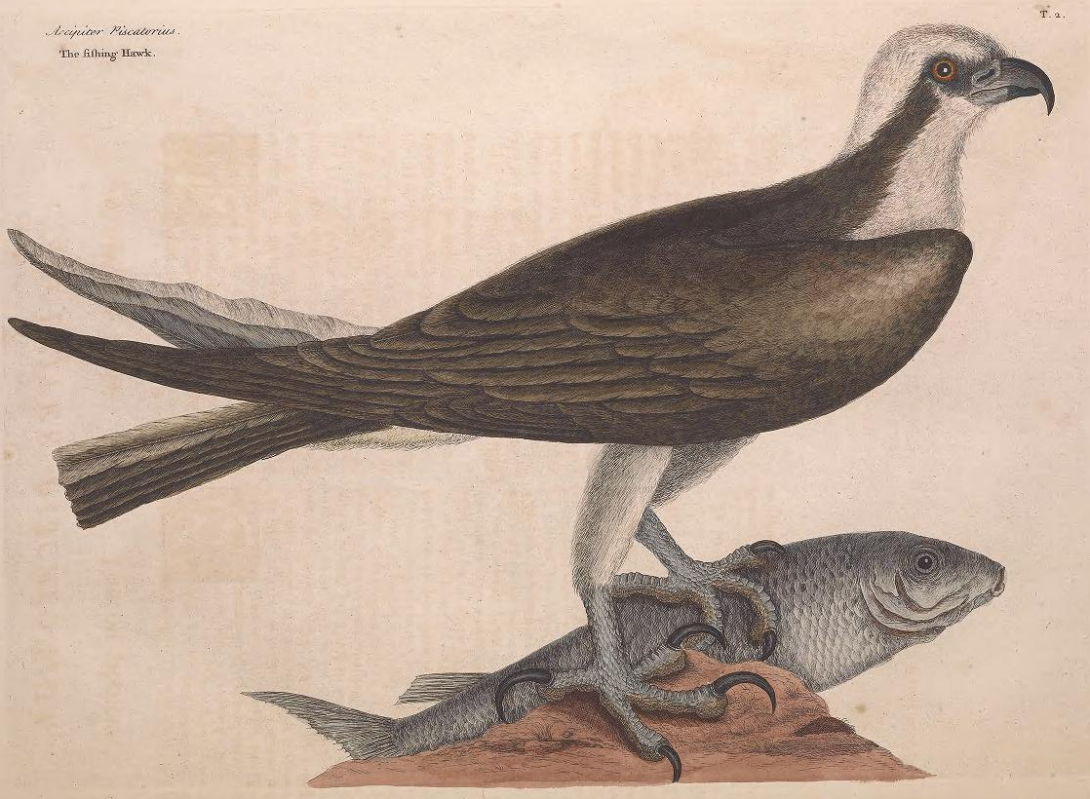
Peale wrote, in his 13th Lecture (ca. 1799): "No. 18. Fishing Hawk. The bill is Black, the cere blue, the Iris of the eye orange-yellow. Brown Back and white belly, the back of the neck as well [as] the under part white, forming a dark stripe from each eye towards the shoulders. The feet & toes rough & scaly, of a pale blue colour. The feathers of the legs and thighs are short, and adhere to them, contrary to others of the Hawk kind; which nature seems to have designed for their more [easily] penetrating the water. Their manner of fishing (after hovering a while over the water) to precipitate into it with prodigious swiftness; where it remains a short time, brings up its prey, they mount screaming, and as some have remarked seem to call the White head eagle [i.e., Bald Eagle, Haliaeetus leucocephalus], who as I mentioned before, watches soars above, and forces him to let fall his fish, and thus he looses his labour. The lower parts of Rivers and creeks near the sea, abound with these Eagles and Hawks, where these diverting contests are frequently seen. It is the Falco carolinensis of Linnaeus."(Academy of Natural Sciences of Drexel University Archives, coll. 40)
Peale continued: "No. 19. This fishing Hawk [specimen] differs from the other in having all the feathers tipted with white, and the top of its head is in distinct stripes. Whether this difference arises from their being of a different sex, or whether the variety arises from being of different ages, I cannot determine. In every respect they perfectly agree. They build their nest in old trees near rivers and lay 3 or four eggs." (ANSP Archives, coll. 40)
Alexander Wilson (1766-1813) described this species under the name "Fish-Hawk, or Osprey / Falco haliaetus" in American Ornithology vol. 5 (Pl. 37), where "Peale's Museum, No. 144" was cited (Wilson 1812: 13). / https://www.biodiversitylibrary.org/item/175520#page/19/mode/1up (text) / https://www.biodiversitylibrary.org/item/175520#page/8/mode/1up (plate)
A male specimen of "Falco haliaetus (Fish Hawk, Osprey)" was listed in "A Catalogue of Duplicate Specimens...", May 1822. [unpublished] American Philosophical Society Library (Mss.B.P31).
Notes:
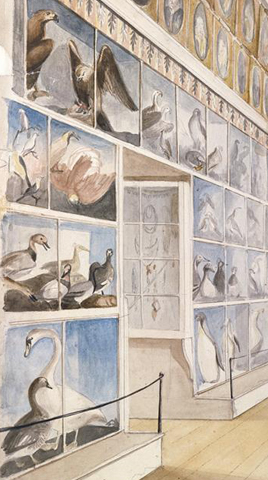
A specimen of this species is visible in the Peales' watercolor painting of the Long Room interior at the Pennsylvania State House (shown here), executed ca. 1820, in the display case above the doorway (Detroit Institute of Arts, 57.262). Peale's collecting efforts at Cape Henlopen were overlooked by compilers of Delaware bird records, prior to this study (Gene K. Hess, in litt. 10 February 2024).
Specimen Type:
Dead/preserved
Current Common Name:
Osprey
Current Scientific Name
Pandionidae | Pandion haliaetus