Object Status:
Extant
Accession Date:
By 1799
Primary Source Reference:
Charles Willson Peale, Lecture on Natural History 37. (ca. 1799). Academy of Natural Sciences of Drexel University Archives, coll. 40. / https://ansp.org/research/library/archives/0000-0099/coll0040/
Additional Source Text:
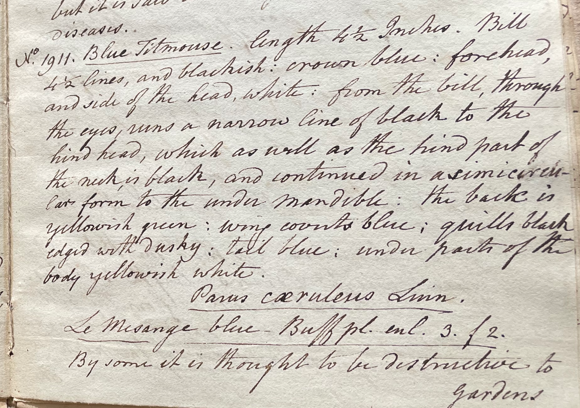
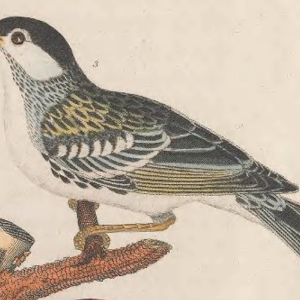
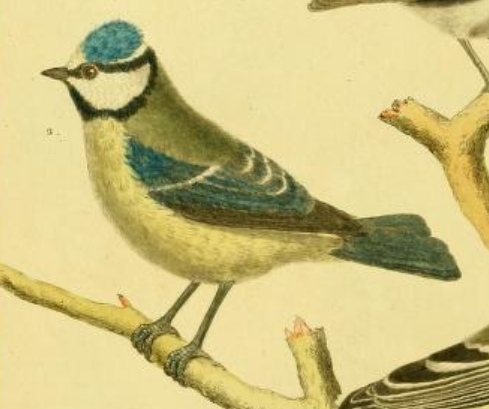
Charles Willson Peale (1741-1827) wrote, in his 37th Lecture (ca. 1799): "No. 1911. Blue Titmouse. Length 4 ½ Inches. Bill 4 ½ lines and blackish; crown blue; forehead, and side of the head, white; from the bill, through the eyes, runs a narrow line of black to the hind head, which as well as the hind part of the neck, is black, and continued in a semicircular form to the under mandible; the back is yellowish green; wing coverts blue; quills black edged with dusky; tail blue; under parts of the body yellowish white. Parus caeruleus Linn. Le Mesange blue. Buff. pl. enl. 3. f. 2." (Academy of Natural Sciences of Drexel University Archives, coll. 40)
Peale continued: "By some it is thought to be destructive to gardens and orchards, by biting off the buds of the blossoms, in search of insects; yet it is acknowledged to be useful in destroying young caterpillars, and eggs of those Insects which destroy the fruit. It has the same propensity to flock with other Titmice, and it picks so clean the bodies of small birds, which it masters, that Klein proposes to employ it for preparing their skeletons. He advises us previously to remove most of the flesh and the brain of the bird, whose skeletons we want to have prepared. The female makes a nest in hollows of walls or trees, lining it well with feathers, have 14 or 15 Eggs & some say 22; but hatches but once a year, except when the nest is disturbed; but when the young is hatched, no bird defends them more courageously. No. 1912. Female, a little less brilliant in the colours." (ANSP Archives, coll. 40)
Specimen Type:
Dead/preserved
Current Common Name:
Eurasian Blue Tit
Current Scientific Name
Paridae | Cyanistes caeruleus