Object Status:
Unlocated
Accession Date:
29 June 1790
Primary Source Reference:
Dunlap's American Daily Advertiser and General Advertiser, 26 May 1791.
Additional Source Text:
A notice in (Dunlap's American Daily Advertiser(, on 26 May 1791, announced Peale's acquisition of "A flamingo [presumably of the American species]—although in good condition, it serves to give an idea of the form of that beautiful bird. Presented by Capt. Tatem."
Charles Willson Peale (1741-1827) wrote, in his 25th Lecture (ca. 1799): "No. 715. This singular bird is scarce as big as a Goose, but has the neck and legs in a greater length in proportion to the body than any other bird; the length from the end of the bill to that of tail, measures more than six feet. The bill is 4 Inctes long, and of a construction different that of any other bird; the upper mandible very thin and flay, and somewhat moveable; the under [mandible] thick; both of them bending downwards from the middle; the nostrils are linear, and placed in a blackish membrane; the end of the bill, as far as the bend, is black, from thence to the base reddish yellow; round the base, quite to the eye, covered with a flesh coloured cere; the neck is slender, and of a great length; the tongue large, fleshy, filling the cavity of the bill; furnished with twelve or more hooked pallae on each side, turning backwards; the tip a sharp cartilaginous substance. The bird when in full plumage, is wholly of a most beautiful deep scarlet, except the qulls, which are black; from the base of the log to the claws measure thirty two inches, of which the feathered part takes up no more than three Inches. These birds do not gain their full plumage till the third year. In the first they are of a greyish white, for the most part; the second year of a clearer white, tinged with red, or rather rose colour, but the wings and scapulars are red." (Academy of Natural Sciences of Drexel University Archives, coll. 40)
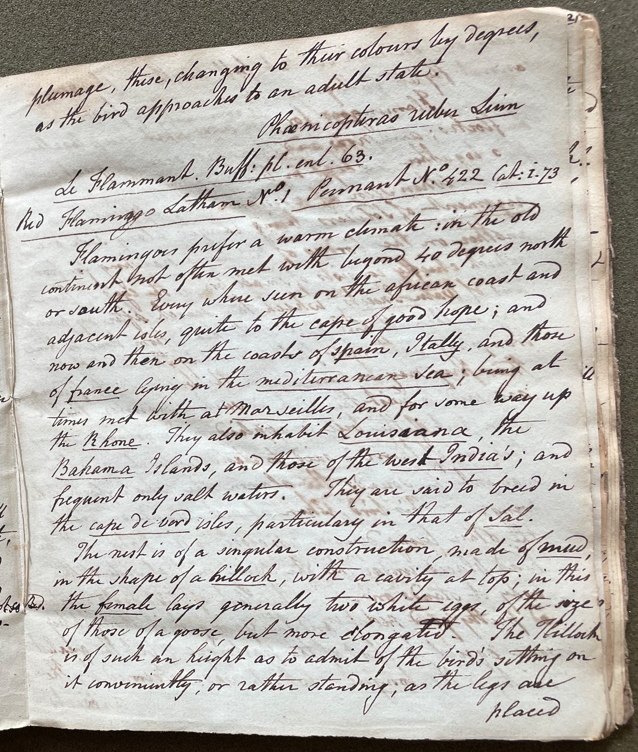
Peale continued: "No. 716. Most probably is at this age, it is less …] & in the third, a general glowing scarlet manifests itself throughout; the bill and the feet also keep pace with the gradation in the plumage, these, changing to their colours by degrees, as the bird approaches to an adult state. Phoenicopteras ruber Linn. Le Flammant. Buff. pl. enl. 63. Red Flamingo Latham No. 1. Pennant No. 422. Cat. i. 73. Flamingoes prefer a warm climate; in the old continent not often met with beyond 40 degrees north or south. Every where sun on the African coast and adjacent isles, quite to the Cape of Good Hope; and now and then on the coasts of Spain, Itally, and those of France […] in theMediterranean Sea; being at times met with at Marseilles, and for some way up the Rhone. They also inhabit Louisiana, the Bahama Islands, and those of the West India's [sic]; and frequent only salt waters. They are said to breed in the Cape de Verd Isles, particularly in that of Sal. The nest is of a singular construction, made of mud, in the shape of a hillock, with a cavity at top; in this the female lays generally two white eggs, of the size of those of a goose, but more elongated. The Hillock is of such an height as to admit of the bird's sitting on it conveniently, or rather standing; as the legs are placed one on each side at full length. The young cannot fly till full grown, but run very fast." (ANSP Archives, coll. 40)
Peale continued: "Flamingoes for the most part commonly keep together in flocks; and now and then are seen in great numbers together, except in breeding time. When seen at a distance they appear as a regiment of Soldiers, being ranged along side on another on the borders of the rivers searching for food, which chiefly consists of small fish, or the eggs of them, and of Water-Insects, which they search after by plunging in the bill and part of the head, from time to time trampling with their feet to muddy the water, that their prey may be raised from the bottom. In feeding are said to twist the neck in such a manner that the upper part of the bill is applied to the groun; during this, one of them is said to stand centinel, and the moment he sounds the alarm the whole flock take wing. This bird, when at rest, stands on one leg, the other being drawn up close to the body, with the head placed under the wing on that side of the body it stands on." (ANSP Archives, coll. 40)
Peale continued: "The flesh is esteemed pretty good meat; and the youngest is thought by some equal to that of the partridge; but the greatest dainty is the tongue, which was esteemed by the Antients an excellent morsel. The skin of these birds, which is well cloathed with down, serves for the same purposes as that of the swan. According to Dutertre would be very useful for persons troubled with a cold debilitated stomack. The Flamingo although very wild in a state of liberty, when once caught, is submissive, and even affectionate. In fact, it has a rather timorous than a lofty spirit; and the […] fear or reason which prompts it to fly, subdues it after it is taken. Two of them was keep tame a few years ago in a gentleman's yard at New York." (ANSP Archives, coll. 40)
Peale (1805–1806) also wrote extensively of this species in "A Walk Through the Philad[elphi]a Museum" (1805-1806), copying much the same information, while adding: "Both of these [specimens] were living in our City some time; our climate is too severe to domesticate them." (Historical Society of Pennsylvania, coll. 0481)
Etienne (Stephen) Dutilh (1751-1810), a French-born Philadelphia merchant, donated "Phoenicopteros Ruber. Red Flamingo."on 15 March 1806, as recorded in the Peale Museum Accessions Book, p. 15 (HSP, coll. 0481).
Alexander Wilson (1766-1813) described this species under the name "Red Flamingo / Phoenicopterus ruber" in American Ornithology vol. 8, published posthumously (Pl. 66), where "Peale's Museum, No. 3545, bird of the first year; [and] No. 3546, bird of the second year" were cited (Wilson 1814: 45). / https://www.biodiversitylibrary.org/item/175758#page/57/mode/1up (text) / https://www.biodiversitylibrary.org/item/175758#page/50/mode/1up (plate)
Notes:
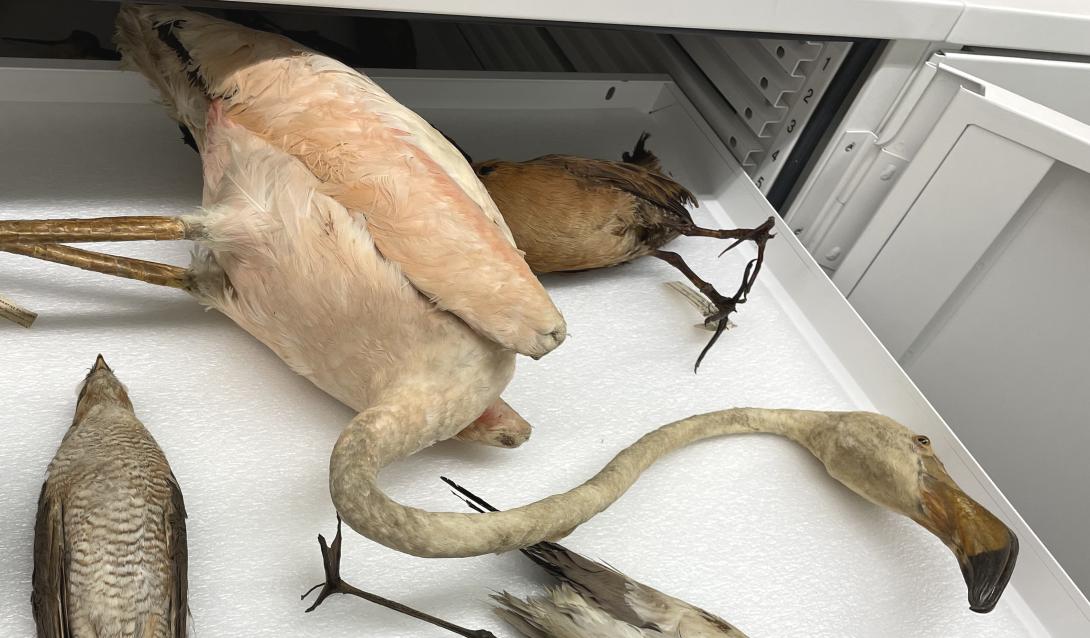
After Peale's Museum closed, a portion of Peale's bird collection was purchased in 1850 by Moses Kimball (1809–95), who displayed it at his "Boston Museum". An advertisement in the Boston Transcript, printed 1 October 1850, stated that Kimball had acquired "One Half of the celebrated Peale's Philadelphia Museum". The other half of Peale's birds had been sold to the circus promoter P. T. Barnum (1810–91) and would be subsequently destroyed in a fire at his "American Museum" in New York City in July 1865. When the Boston Museum closed, Kimball's Peale remnants passed temporarily to the Boston Society of Natural History, who disposed of them to Charles J. Maynard (1845-1929), a local taxidermist. The specimens were stored in a barn in Massachusetts for several years, then eventually were deposited at the Museum of Comparative Zoology (MCZ), Harvard University. By the time the collection was catalogued by Walter Faxon (1848-1920) at MCZ, in 1914, in virtually every case the original mounts and labels had been disassociated from the specimens, and an untold number were lost. Walter Faxon, "Relics of Peale's Museum," Bulletin of the Museum of Comparative Zoology, 59, no. 3 (July 1915): 130, speculated that MCZ 67825 (shown here), a data-deficient specimen from the Boston Museum collection, was the model for Wilson’s plate. However, he conceded that the “neck [is] differently disposed, and the foot uplifted in the figure.” Wilson's (1814: 45) account contains almost no original matter, so it seems likely that he consulted Peale's "Ornithological Museum" when preparing his description and drawing. However, since there were multiple specimens of this species documented in Peale's collection over the years, there is little reason (given the incorrect pose) to presume that MCZ 67825 was the one Wilson studied.
Specimen Type:
Live (later taxidermied)
Current Common Name:
American Flamingo
Current Scientific Name
Phoenicopteridae | Phoenicopterus ruber
Repository:
Museum of Comparative Zoology, Harvard University (MCZ 67825)