Object Status:
Extant
Accession Date:
By 1799
Primary Source Reference:
Charles Willson Peale, Lecture on Natural History 26. (ca. 1799). Academy of Natural Sciences of Drexel University Archives, coll. 40. / https://ansp.org/research/library/archives/0000-0099/coll0040/
Additional Source Text:
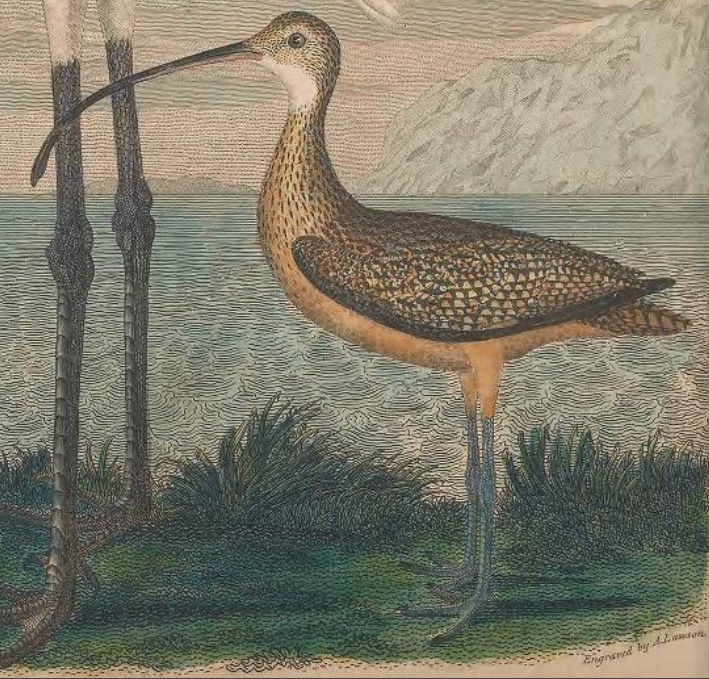
Charles Willson Peale (1741-1827) wrote, in his 26th Lecture (ca. 1799): "No. 828. Is the American Curlew. The beak is curved, the under much the shortest; the upper terminated by kind of button; obtuse & round; throat white, the breast & belly brown; or tinged with a russet tint; the rest of the plumage varied with white brown & black; the quills black. It is much larger than the European Curlew, though in their general appearance they are much alike, but the under beak being much shorter than the other is a specific character of this American bird. The bill measures 9 Inches in length. It is found on our Sea coast from Georgia to New York & perhaps further eastward. No. 829. Is a female; it is a little smaller, and the plumage generally lighter." (Academy of Natural Sciences of Drexel University Archives, coll. 40)
Peale wrote, in "A Walk Through the Philad[elphi]a Museum" (1805–1806): "There is a specific difference between the European Curlew (T. arquata) and the American Curlew, the under bill being much shorter in the latter, in proportion of the birds. — The plumage of each species are much alike but the American Curlew is considerably larger than the European." (Historical Society of Pennsylvania, coll. 0481)
An undated list of 21 bird specimens in Charles Willson Peale's (1741-1827) handwriting includes one "Cerlew Pennsyl[vani]a" (American Philosophical Society Library, Mss.B.P31).
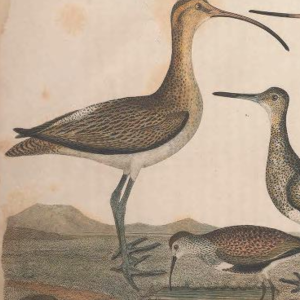
Alexander Wilson (1766-1813) described this species under the name "Long-billed Curlew / Numenius longirostra" in American Ornithology vol. 8, published posthumously (Pl. 64), where "Peale's Museum, No. 3910" was cited (Wilson 1814: 23). https://www.biodiversitylibrary.org/item/175758#page/31/mode/1up (text) / https://www.biodiversitylibrary.org/item/175758#page/8/mode/1up (plate)
Notes:
Spencer Trotter, 1907, "Type birds of eastern Pennsylvania and New Jersey", Cassinia 11: 17-27, who overlooked Peale's contributions, incorrectly stated that "This bird [was] first clearly distinguished by Wilson as a distinct species from the European Curlew." / https://dvoc.org/CassiniaOnLine/Cassinia11/C11_17_27.pdf
Specimen Type:
Dead/preserved
Current Common Name:
Long-billed Curlew
Current Scientific Name
Scolopacidae | Numenius americanus