Object Status:
Extant
Accession Date:
By 1799
Primary Source Reference:
Charles Willson Peale, Lecture on Natural History 23. (ca. 1799). Academy of Natural Sciences of Drexel University Archives, coll. 40. / https://ansp.org/research/library/archives/0000-0099/coll0040/
Additional Source Text:
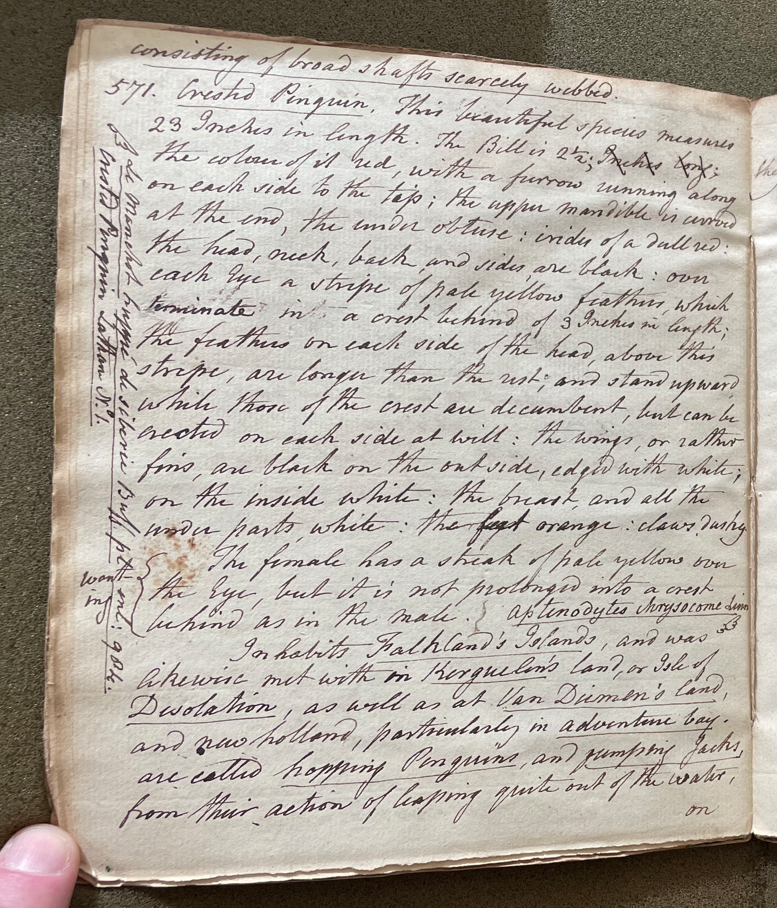
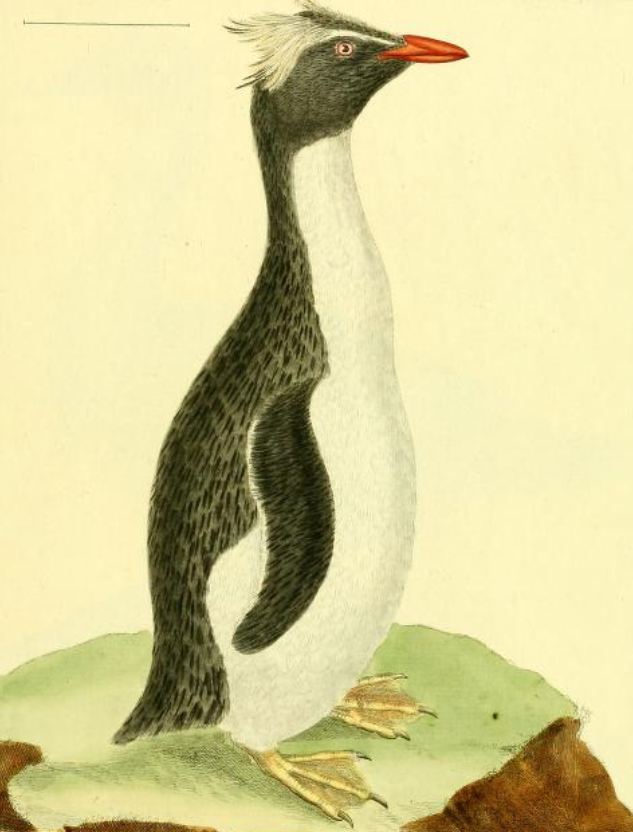
Charles Willson Peale (1741-1827) wrote, in his 23rd Lecture (ca. 1799): "571. Crested Pinguin. This beautiful species measures 23 Inctes in length. The Bill is 2 ½ Inches long; the colour of it red, with a furrow running along each side to the tip; the upper mandible is curved at the end, the under obtuse; irides of a dull red; the head, neck, back, and sides are black; over each Eye a stripe of pale yellow feathers, which terminate in a crest behind of 3 Inches in length. The feathers on each side of the head, above this stripe, are longer than the rest; and stand upward while those of the crest are decumbent, but can be erected on each side at will; the wings, or rather fins, are black on the outside, edged with white; on the inside white; the breast, and all the under parts white; the feet orange; claws dusky. The female has a streak of pale yellow oever the Eye, but it is not prolonged into a crest behind as in the male [a note in the margin reads "wanting"]." (Academy of Natural Sciences of Drexel University Archives, coll. 40)
Peale continued: "Aptenodytes chrysocome Linn. Le manchot huppé de Sibérie Buff. pl. enl. 984. Crested Pinguin Latham No. 1. It inhabits Falkland's Islands, and was likewise met with in Kerquelan's land, or Isle of Desolation, as well as at Van Diemen's Land [Tasmania] and New Holland [Australia], particularly in adventure bay. [They] are called hopping pinguins and jumping jacks, from their action of leaping quite out of the water, on meeting with the least obstacle, for three or four feet at least; and indeed, without any seeming cause, they do the same frequently, appearing chiefly to advance by that means. This species seems to have a greater air of liveliness in its countenance than others yet is in fact a very stupid bird, so much as to suffer itself to be knocked on the head with a stick, when on land. When angered, it erects its crest in a beautiful manner." (ANSP Archives, coll. 40)
Peale continued: "These birds make their nests among those of the Pelican tribe, living in tolerable harmony with them; and lay seldom more than one egg, which is white, and larger than that of a Duck. They are mostly seen by themselves, seldom mixing with other Pinguins, and often met with in great numbers on the outer shores, where they have been bred. Are frequently so regardless as to suffer themselves to be taken by the hand. The females of this species lay their eggs in burrows, which they easily form of themselves with their bills, throwing out the dirt with their feet. In these holes the eggs are deposited on the bare Earth. The general time of sitting is in October; but some of the species, especially in the colder parts, do not sit till December, or even January. How long they sit is not known." (ANSP Archives, coll. 40)
Peale wrote, in "A Walk Through the Philad[elphi]a Museum" (1805–1806): "They are not less active in the water than are clumsy on the land, for some have been seen to spring 3 or 4 feet out of the Water more especially the Crested Pinguin (a. Chrysocome) found by the late Navigators in their voyages of discoveries in the south seas." (Historical Society of Pennsylvania, coll. 0481)
A "Pinguin" donated by Captain J. W. Cox on 17 April 1807, and "Two Pinguins" donated by Captain Ferris on 19 May 1808, may also have been of this species (Peale Museum Accessions Book, HSP, coll. 0481).
A mounted specimen of "Aptenodytes chrysocome (Crested Penguin)" was listed in "A Catalogue of Duplicate Specimens...", May 1822. [unpublished] American Philosophical Society Library (Mss.B.P31).
Notes:
A smaller penguin specimen is visible next to the relatively large King Penguin (Aptenodytes patagonicus) in Charles W. Peale's oil painting, "The Artist in His Museum" (1822), in the floor-level case to the right of the door (Pennsylvania Academy of Fine Art, 1878.1.2). / https://www.pafa.org/museum/collection/item/artist-his-museum
Specimen Type:
Dead/preserved
Current Common Name:
(Southern) Rockhopper Penguin
Current Scientific Name
Spheniscidae | Eudyptes chrysocome