Object Status:
Extant
Accession Date:
By 1799
Primary Source Reference:
Charles Willson Peale, Lecture on Natural History 20. (ca. 1799). Academy of Natural Sciences of Drexel University Archives, coll. 40. / https://ansp.org/research/library/archives/0000-0099/coll0040/
Additional Source Text:
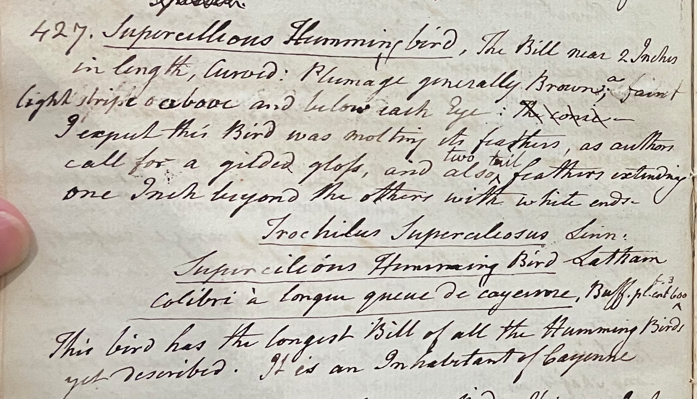
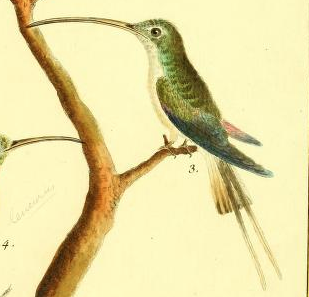
Charles Willson Peale (1741-1827) wrote, in his 20th Lecture (ca. 1799): "427. Supercillious Hummingbird. The Bill near 2 inches in length, curved; plumage generally brown, a failt light stripe above and below each eye. I expect this bird was molting its feathers, as authors call for a gilded gloss, and also two tail feathers extending one inch beyond the others with white ends. Trochilus superciliosus Linn. Supercilious Humming Bird Latham. Colibri à longue queue, de Cayenne. Buff. pl. enl. 600. f. 3. This bird has the longest bill of all the Humming Birds, yet described. It is an inhabitant of Cayenne." (Academy of Natural Sciences of Drexel University Archives, coll. 40)
In "A Walk Through the Philad[elphi]a Museum" (1805-1806), Peale briefly mentioned "the plain dress of the supercilious Hummingbird." (Historical Society of Pennsylvania, coll. 0481)
Notes:
In 1793, Raphaelle Peale (1774-1825) travelled to Cayenne, French Guiana, to collect specimens for Peale's Museum. However, to the editor's (MRH) knowledge, there is no detailed inventory of the specimens he brought back, and there are many examples of specimens from northern South America that were donated by other people. For more discussion, see Lillian B. Miller, 1993, ""Father and Son: The Relationship of Charles Willson Peale and Raphaelle Peale"", The American Art Journal 25: 4-161. / https://doi.org/10.2307/1594599 Peale's description is inadequate to identify the species.
Specimen Type:
Dead/preserved
Current Common Name:
Long-tailed Hermit
Current Scientific Name
Trochilidae | Phaethornis superciliosus