Object Status:
Extant
Accession Date:
By 1793
Primary Source Reference:
Charles Willson Peale, letter to Thomas Hall of Moorfields, London, dated 1793; Selected Papers, 2, part 1: 46.
Additional Source Text:
Charles Willson Peale (1741-1827) sent a "Cock Robin" to Thomas Hall in London, in early 1793, in exchange for European specimens (Miller 1988: 46, Selected Papers, Vol. 2, part 1, Yale University Press).
On 30 April 1797, Peale sent a "Field fare of Carolina. [Catesby]" to Étienne Geoffrey Saint-Hilaire (1772-1844) at the Paris Museum (Miller 1988: 198).
On 1 June 1797, Peale sent another "Robin [Cock]" to Thomas Hall in London (Miller 1988: 207).
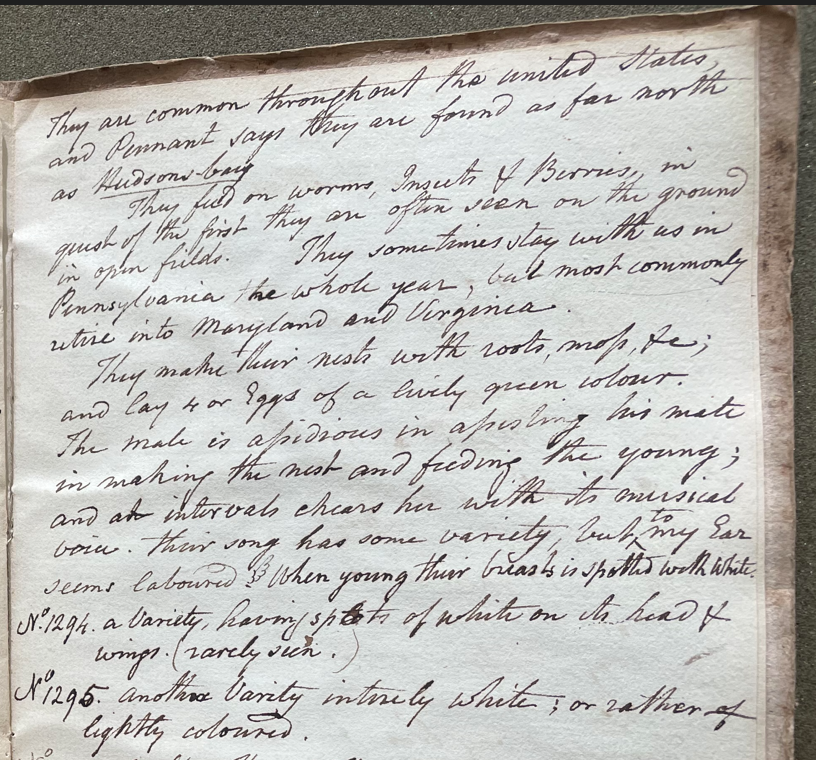
In his 31st Lecture, Peale wrote: "No. 1292. Red Breasted Thrush. commonly called a Robin. Brown back, and red breast & on the top of the head, nearly black, throat Black & white striped, Bill whitish. Turdus migratorius Linn. Grive de Canada Buff. pl. enl. 556 f. i. No. 1293. Female much like the male. They are common throughout the united states, and Pennant says they are found as far north as Hudson's bay. They feed on worms, Insects & Berries, in quest of the first they are often seen on the ground in open fields. They sometimes say with us in Pennsylvania the whole year, but most commonly retire into Maryland and Virginia." (Academy of Natural Sciences of Drexel University Archives, coll. 40)
Peale continued: "They make their nests with roots, moss, &c.; and lay 4 or [5] eggs of a lively green colour. The male is assiduous in assisting his mate in making the nest and feeding the young; and at intervals cheers her with its musical voice. Their song has some variety, but to my Ear seems laboured. Near habitations where these birds have been allowed to remain in peace, I have observed families of them, who keept constantly togather, even after the young had attained to the full size of their parents, who even at that advanced groath of the brood were still constant in their attentions to find food for them, although it might seem at such a period that this grown brood were equally capable to help themselves. But in the economy of Nature, we are not always capable of comprehending all that is necessary to be done. And I must say that this species affords a pleasing model of parental affection. When young their breasts is spotted with white. No. 1294. a Variety, having spots of white on its head & wings. (rarely such.) No. 1295. Another variety intirely white; or rather of lightly coloured." (Academy of Natural Sciences of Drexel University Archives, coll. 40)
Peale wrote, in "A Walk Through the Philad[elphi]a Museum" (1805–1806): "Red breasted Thrush (T. migratorus) commonly called a Robin, with some varieties of the same. Common throughout the United States. near habitations where these birds have been allowed to remain in peace. I have observed families of them, who keept constantly together even after the young had attained to the full size of their parents, who even at that advanced groath of the brood, were still constant in their attentions to find food for them, although it might seem at such a period that this groan brood were equally capable to help themselves. But in the economy of Nature, we are not always capable of comprehending all that is necessary to be done. and I must say, that this species affords a pleasing model of parental affection. / here are a variety of them & one nearly white." (Historical Society of Pennsylvania, coll. 0481)
Alexander Wilson (1766-1813) described this species under the name "Robin / Turdus migratorius" in American Ornithology vol. 1 (Pl. 2), where "Peale's Museum No. 5278" was cited (Wilson 1808: 35). / https://www.biodiversitylibrary.org/item/175530#page/51/mode/1up (text) / https://www.biodiversitylibrary.org/item/175530#page/44/mode/1up (plate)
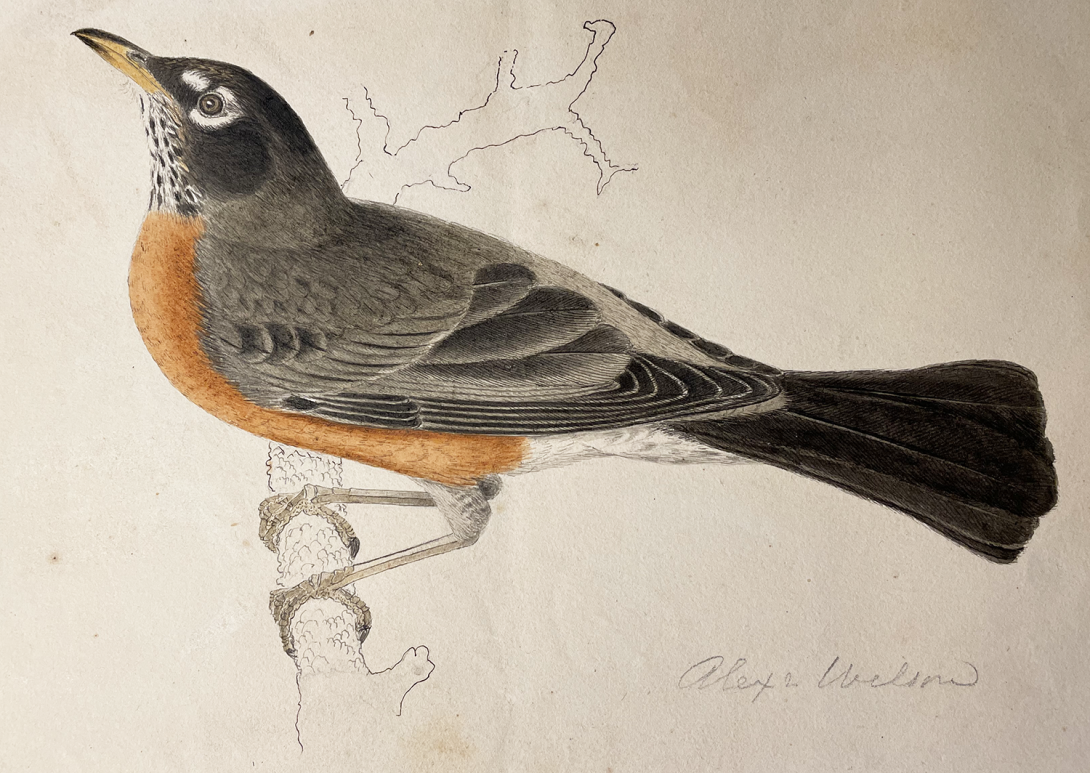
Wilson's original drawing (shown here), which was engraved by Alexander Lawson (ca.1772-1846) for Plate 2 (1808), is extant in the Historical Society of Pennsylvania (Ferdinand J. Dreer autograph collection, HSP coll. 175, box 308, folder 44).
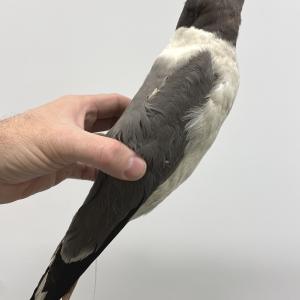
On 7 November 1819, a "White [leucistic] Robbin, shot near Phila. and presented by Mr. William Trimble" was entered into the Accession Ledger.
Specimen Type:
Dead/preserved
Current Common Name:
American Robin
Current Scientific Name
Turdidae | Turdus migratorius