Object Status:
Unlocated
Accession Date:
21 May 1789
Primary Source Reference:
Pennsylvania Packet, 21 May 1789.
Additional Source Text:
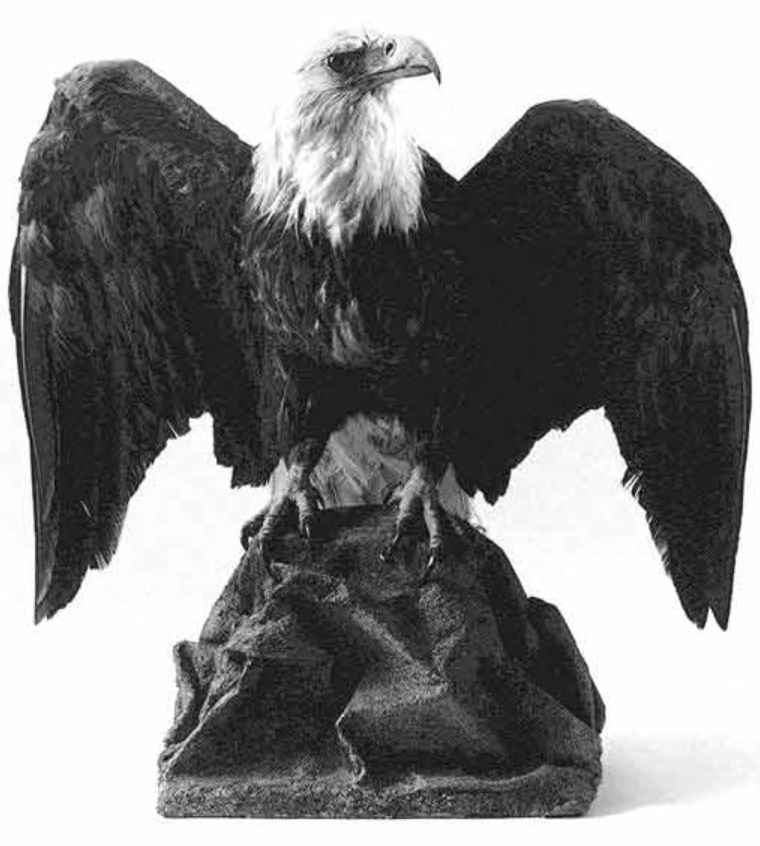
On 21 May 1789, a notice in the Pennsylvania Packet (Philadelphia) announced the arrival of "A beautiful bald eagle, alive" at Peale's Museum.
Charles Willson Peale (1741-1827) wrote in a 1792 broadside: "Of the rapacious, the first [species] that presents itself to my view, is the American called the bald eagle. I have a fine one, which I have kept alive these four years; it is now five years old; and what is remarkable, it did not shew its white head and tail, until the last past summer; before that period it had the appearance of the other grey eagles, that are preserved in the room; not only the colour of the feathers is changed (which is common to many birds annually) but also its bill and eyes, from a grey brown colour to a yellow of some brightness. The grey-coloured and the bald eagle have been often observed to use the same nest; but it has not been generally known that they were the same birds, but of different ages" (Miller 1988: 16, Selected Papers, Vol. 2, part 1, Yale University Press). The aforementioned eagle was kept in a cage on the rooftop of Philosophical Hall, when Peale's Museum occupied the site in 1794 (Miller 1988: 202).On 30 April 1797, Peale included "Eagle, commonly though improperly called the Bald Eagle" in a list of living animals sent to Étienne Geoffrey Saint-Hilaire (1772-1844) at the Paris Museum (Miller 1988: 198).
Peale wrote, in his 13th Lecture (ca. 1799): "No. 14. White head Eagle, improperly called Bald-Eagle, the Leucocephalus of Linnaeus. The Bill, cere, or waxy skin on the base [of the bill], and also the toes are of a light flesh colour. Head, neck and tail perfectly white; eyes yellow; body & wings brown black. This bird does not get the white head and tail untill the 5th year of his age, which I have proved by keeping two of them alive until the change took place. Their general appearance before that period was of a Brown and white mixture of feathers, hence, some of them have been called grey Eagles, when at the same time they were only young Eagles of this kind. It is a mild bird, and unless provoked by hunger never injures other animals. It is remarkable that they will never eat meat the least tainted. Fish they are fond of." (Academy of Natural Sciences of Drexel University Archives, coll. 40)
Peale continued: "A curious train in the character of this Eagle, is, its watching the fishing Hawk [i.e., Osprey, Pandion haliaetus], which is seen hovering over the water seeking for food, and, after catching a Fish and rising into the air with it, The Eagle, from his superior strength and flight, immediately darts on the Hawk, who with fright lets go his prey, and then the Eagle with surprising velocity catches the fish before it falls into the water. The nest of the Eagle is commonly on some high old tree, it is said the same nest serves the Eagle during [its entire] life; I have seen a tree cut down with a nest, and I am confident that the sticks (some of them nearly as thick as my wrist) would fill a single Horse cart—no doubt, but it had been the labour of many years. They bred about February. It is said that it is also found in Europe, but not so common as in America, but of this I have my doubts. Was that the case, it is more than probable that [European authors] would have given plates [of the Bald Eagle] of which I have not yet found to be case." (ANSP Archives, coll. 40)
Peale also described an immature Bald Eagle in his 13th Lecture, which had a foul disposition in captivity: "No. 17. Great […] Eagle, also found in Pennsylvania. It is considerably larger than either of those described [i.e., two immature specimens of Golden Eagle, Aquila chrysaetos, described immediately prior]. After it had been some time caged it became much fiercer, and we have proof of its revengeful disposition. Ever on the watch, when any thing came within reach, it made sure of its prey. It had taken many fowels, with difficulty some of them have been taken from it, in which case it showed great anger, and did not fail to testify its resentment for a long time afterwards. The feathers are generally white at the base, much pointed and coloured with dark brown at their ends, so that its general appearance is what might be called, a Grey Eagle, with a slight tinge of a rufous colour on its head. The quil feathers [i.e., primaries] of the wings are black. The Bill is large & strong, of a dark horn colour, the cere of a very light grey. The feet are not covered with feathers as the two last described [i.e., the Golden Eagles], but covered with rough white scales, with strong claws. Its cry, very different from all the others, presented by Mr. David Greig." (ANSP Archives, coll. 40)
Years later, Peale reminisced in his autobiography about this "Gray Eagle," which "[became] the Bald Eagle, at 5 years of age ... he had [it] in a large wire cage on the top of the [Philosophical] Hall ... [with] Gold letters on his cage [that read] Feed me daily 100 years. however it did not live in captivity only 15 years." (Selected Papers, 5: 226)
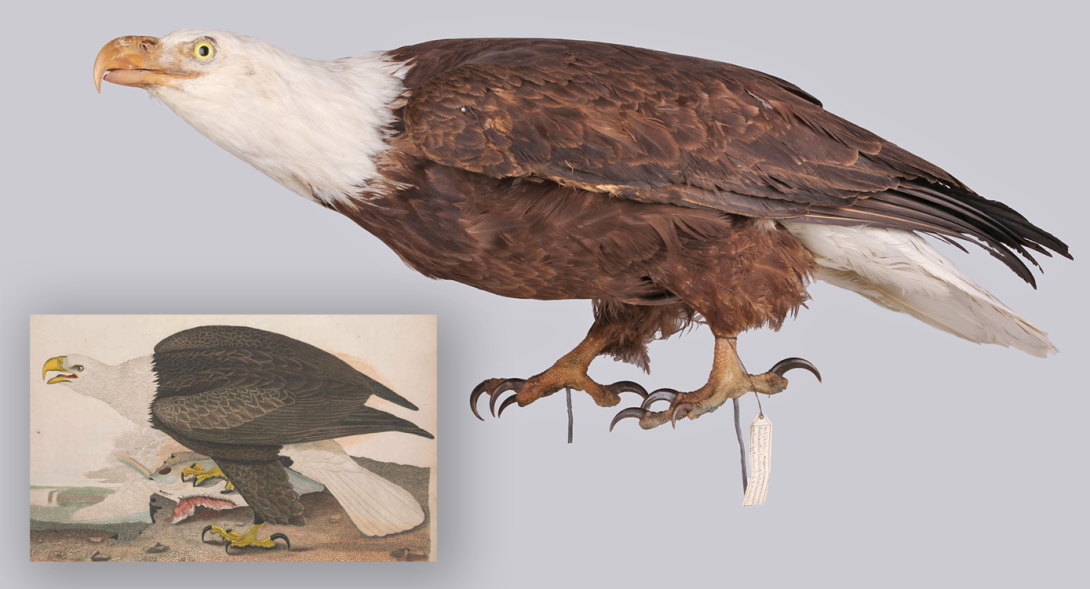
Alexander Wilson (1766-1813) described an adult of this species under the name "White-headed, or Bald Eagle / Falco leucocephalus" in American Ornithology vol. 4 (Pl. 36), where "Peale's Museum, No. 78" was cited (Wilson 1811b: 89). / https://www.biodiversitylibrary.org/item/175531#page/111/mode/1up (text) / https://www.biodiversitylibrary.org/item/175531#page/110/mode/1up (plate)
Wilson described an immature individual under the name "Sea Eagle / Falco ossifragus" in American Ornithology vol. 7 (Pl. 55), where "Peale's Museum, No. 80" was cited (Wilson 1813: 16). / https://www.biodiversitylibrary.org/item/175507#page/22/mode/1up (text) / https://www.biodiversitylibrary.org/item/175507#page/8/mode/1up (plate)
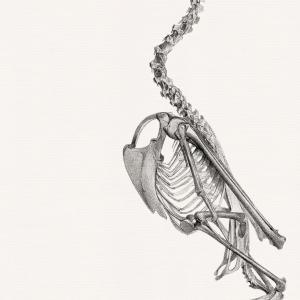
On 9 January 1822, a notice in Poulson's American Daily Advertiser mentioned that Dr. Richard Harlan (1796-1843) donated a Bald Eagle skeleton to Peale's Museum.
An unmounted immature male specimen of "Falco leucocephalus. (Bald Eagle)" was listed in "A Catalogue of Duplicate Specimens...", May 1822. [unpublished] American Philosophical Society Library (Mss.B.P31).
On 8 November 1824, the donation of a "Bald Eagle" by Levi Lewis of Delaware County, Pennsylvania, was recorded in the Peale Museum Accessions Book (HSP, coll. 0481).
Notes:
Many different specimens of the Bald Eagle were deposited at Peale's Museum over the years, including some that were living when they arrived. Two brown eagle specimens are visible in the Peales' watercolor painting of the Long Room interior at the Pennsylvania State House, executed ca. 1820, in the case to the upper left of the doorway (Detroit Institute of Arts, 57.262). An adult is visible in Peale's oil painting, "The Artist in His Museum" (1822), in the case above and to the right of the door (Pennsylvania Academy of Fine Art, 1878.1.2).
The model for Wilson’s plate of the adult was collected in Great Egg Harbor, New Jersey, “in the month of January [1811]," and prepared as a mount by Daniel Burlington Smith (1792-1883), a Philadelphia-based taxidermist. / https://en.wikipedia.org/wiki/Daniel_B._Smith
After Peale's Museum closed, a portion of Peale's bird collection was purchased in 1850 by Moses Kimball (1809–95), who displayed it at his "Boston Museum". An advertisement in the Boston Transcript, printed 1 October 1850, stated that Kimball had acquired "One Half of the celebrated Peale's Philadelphia Museum". The other half of Peale's birds had been sold to the circus promoter P. T. Barnum (1810–91) and would be subsequently destroyed in a fire at his "American Museum" in New York City in July 1865. When the Boston Museum closed, Kimball's Peale remnants passed temporarily to the Boston Society of Natural History, who disposed of them to Charles J. Maynard (1845-1929), a local taxidermist. The specimens were stored in a barn in Massachusetts for several years, then eventually were deposited at the Museum of Comparative Zoology (MCZ), Harvard University. By the time the collection was catalogued by Walter Faxon (1848-1920) at MCZ, in 1914, in virtually every case the original mounts and labels had been disassociated from the specimens, and an untold number were lost.
Walter Faxon, "Relics of Peale's Museum," Bulletin of the Museum of Comparative Zoology, 59, no. 3 (July 1915), pp. 134-135, stated that MCZ 67846, a mounted specimen from the Boston Museum collection, once bore a label that read “Presented by A. Wilson.” / https://www.biodiversitylibrary.org/page/6339801#page/184/mode/1up
Unlike Wilson’s donation of “Eggs, of the Bald Eagle, from Egg harbour," which were recorded in the Peale Museum Accessions Book (Historical Society of Pennsylvania, coll. 0481) on 20 March 1813, there is no evidence (not even in Wilson’s own published account) that the Smith mount was deposited at Peale’s Museum. MCZ 67846 is also posed with a Hudsonian Godwit in its talons—not a fish, as in Wilson’s plate. Faxon (1915, Bull. Mus. Comp. Zool. 59) also claimed that MCZ 67847, an immature Bald Eagle, was the model of the immature bird depicted in Wilson’s Pl. 55, but this claim lacks primary evidence and Faxon had no memory of an original label. A third mounted specimen of this species (an adult), now displayed in the Peale Portrait Gallery at the Second Bank of the United States, Independence National Historical Park, Philadelphia, was donated by Mary Jane Peale in 1873.
One of Wilson’s eggs is also extant and bears an inscription (“Bald Eagle Egg”) in his flowery handwriting (MCZ 67846). This specimen has a separate entry in the "America's Earliest Museums" database.
Specimen Type:
Live (later taxidermied)
Current Common Name:
Bald Eagle
Current Scientific Name
Accipitridae | Haliaeetus leucocephalus
Repository:
Museum of Comparative Zoology, Harvard University (MCZ 67845) | Peale Portrait Gallery at the Second Bank of the United States, Independence National Historical Park, Philadelphia